Feeds:
Posts
Comments

Posts Tagged ‘tree planting’

The Massachusetts Arborists Assocation bare-root workshops — one in August 2008, and one in August 2009 — have been spreading word through the Commonwealth about the benefits of air-tool tree transplanting, and word is travelling throughout Massachusetts horticulture circles now.

A couple of weeks ago I was chatting with Kristen DeSouza, one of the horticulturists at the New England Wild Flower Society‘s Garden In The Woods, and she mentioned that she had passed my name along to Sonia Baerhuk, who tends the grounds at Watertown’s Perkins School for the Blind.  Kristen told me that Sonia and her crew have been using air tools to  transplant trees on the school’s grounds for the last several months, and suggested that I get in touch with her.

And so last Thursday, a couple of emails and a phone call later, I pulled in to the visitor’s parking area at the Perkins School.  Sonia soon arrived in one of the grounds department’s Gators.  She very kindly showed me around the campus, explaining that a new and large building project had required the removal of dozens of large trees.

It’s a scenario typical of many institutional sites:  a program outgrows its home, the phasing of a master plan leads to a shifting of facilities or the construction of a new building, and the vegetation on site must either be removed or relocated.  Having worked at Perkins for several years, Sonia was no stranger to this course, of events, but still, she had been dismayed to see so many large specimen trees being cut and fed into the chipper.

Though the grounds crew does most of its own tree work, over the years they have called in arborists for their expertise, and Sonia knew and trusted Matt Foti’s expertise.  Matt had told her about the air-tool method, and on the strength of his recommendation, she signed up for the MAA’s Elm Bank bare-root workshop this past August.  At it, she absorbed as much information as possible.  She came away from the day’s event convinced that air-tool excavation and transplant was the best way for her crew to relocate any salvageable campus trees.

So Sonia and her boss Rich Falzone equipped the crew with an Air Spade and an Air Knife, coveralls, eye protection, ear protection, and respirators, and began to direct the relocation of trees.

To date, the Perkins crew — Sonia Baerhuk, Rolando Ortega, Mynor Tobar, and Santo Masciari — has moved several 15-20′ Norway spruce, a fastigiate white pine, a Forest Pansy redbud, several apples, and a beautifully structured 25-30′ tall Halesia.

On the day I visited, they were ready to move another Norway spruce from a location that is slated to become a pondside patio.  Its new home would be a lawn next to a parking lot to which they had already moved a number of evergreens.  The new planting is beginning to screen the lot from adjacent buildings; over time, this grove will shade the parking lot and the walkway near it.
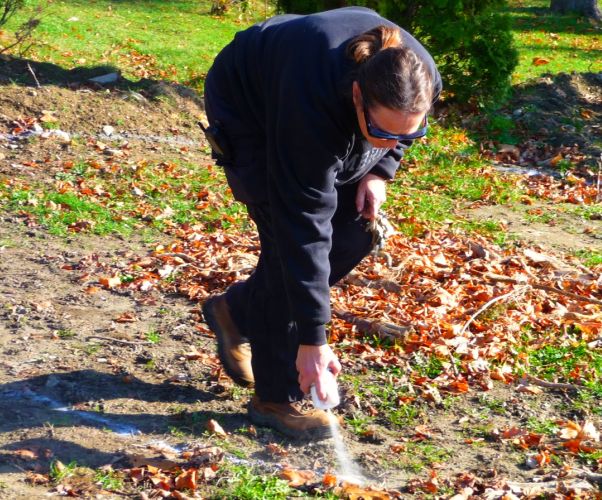
Sonia Baerhuk marking the new home of a 15' Norway spruce to be relocated.

Fifteen-foot Norway spruce in its original location next to the campus pond. The crew discovered that the Norway's roots were interwoven with roots from other nearby trees. This tree was flat on the side facing the fence.

Currently, the grounds crew rents compressors. These two generated air for an Air Knife and an Air Spade. Note the plywood barriers set up to prevent soil overspray onto the lawn. In this project, the crew did not dig a trench to hold blown-out soil; they simply started blowing soil out from the trunk and followed the roots out to and beyond the dripline.

Sonia and Rolando, kitted out in their PSE: coveralls, gloves, hats and hoods, ear protection, eye protection, and respirators.
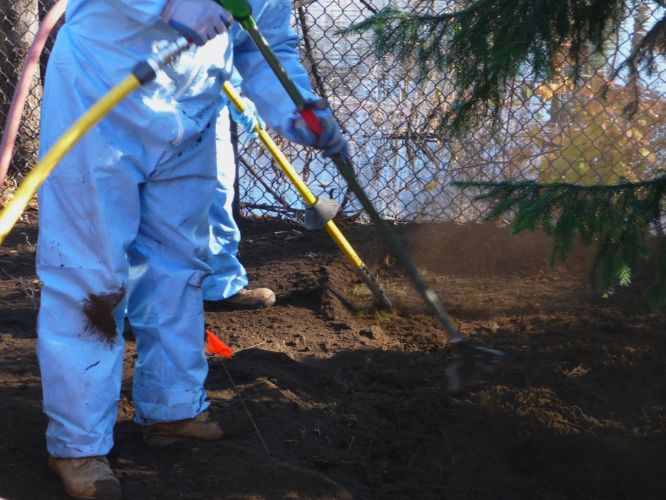
Blowing soil off the roots took about three hours. Sonia likes to divide the root mass diameter into quadrants and work systematically, while Rolando prefers to work all around the tree; when they work in tandem they use whichever method fits the site conditions best.

Edges of the original B&B root ball are barely visible here; it was roughly 24-30" across. Rolando and Sonia discovered the wire basket still around it. They also discovered that the root flare sat several inches down in the original root ball.

The spruce was anchored with a thick mat of fibrous roots; the crew found virtually no roots larger than 1/2" in diameter. Here, they are pruning root ends under the eighteen-inch deep mat.
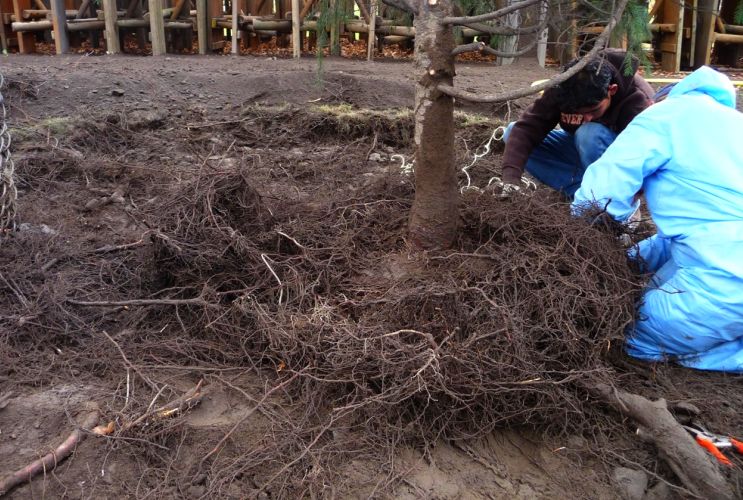
Still pruning the mat, and rolling it up toward the trunk to blow soil out from under the tree.

The root mat rolled up and bound in burlap for further blowing-out and moving.

Project site:  The Perkins School for the Blind, Watertown, MA

Project manager:  Sonia Baerhuk

Project crew:  Rolando Ortega, Mynor Tobar, Santo Masciari

Read Full Post »

Mike Furgal sent me photos of an 8″ caliper Weeping White Pine  that he moved a couple of weeks ago, remarking that this tree, though relatively small, was the most challenging tree he’s moved bare-root.

The tree was situated in a small berm next to a house and a driveway, and shared the bed with a 7′ Hinoki Cypress and an 8′ Blue Holly.  Mike blew soil out of the entire bed to move all three plants, whose roots were interwoven.

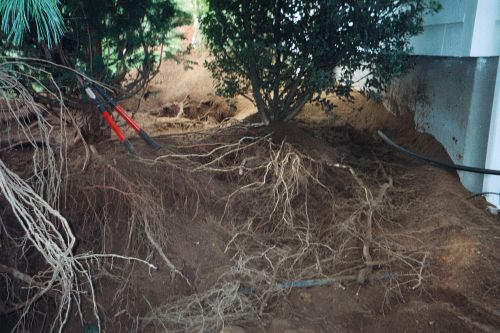
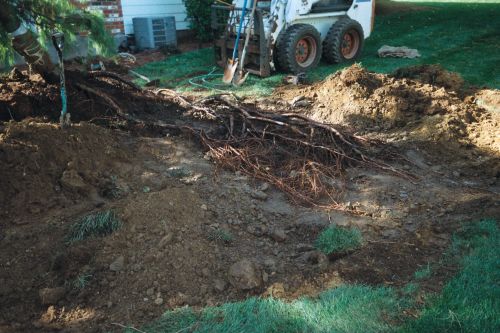
Pine roots running toward the house and drive extended no more than three feet. Roots running under the lawn told a different story; the two main roots that Mike found were 16-18 feet in length; they had plenty of moisture available and plenty of rooting room to grow.

Mike began work on the bed by blowing soil at the tree’s dripline and at its root collar, to assess where the roots were.  He found that they ran along the edge of the bed until they hit the house; from that point they grew out into the lawn.

Here are his photos:

beginning location 2

Rooting space is constrained by the berm's proximity to the house and the driveway.

begining location 3

Ample lawn space gives plenty of rooting opportunity in other directions.

beginning location 1

Lots of roots here -- note how they run along what had been the bed edge, and extend back toward the house. Once they hit the house, they then ran out into the lawn.

beforemove

Here's what the excavated bed looked like, with Hinoki Cypress, Blue Holly, and Weeping White Pine roots woven together.

veron pine diggiing

Tremendous root extension can be kept with air-tool excavating, and while not all fine roots remain, a significant number of them do.

veron white pine digging 2

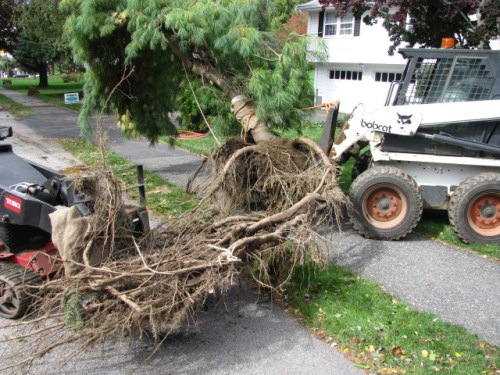
The Pine ready for its move. These lawn-side roots are sixteen to eighteen feet long. Compare that root length to the accepted standard size of a B&B root ball, which allows ten inches of root-mass diameter for one inch of trunk caliper. For an apples to apples comparison, if we include the three feet of root on the tree's other side, this tree has 19 to 21 feet of root extension, as opposed to the 6-foot, 8-inch root mass diameter you would see on a B&B specimen.

veron white pine digging 3

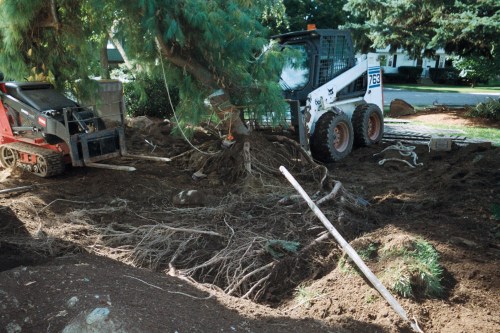
Moving the excavated pine was the trickiest part. Mike and his helper used a Bobcat and a Dingo -- tricky to coordinate both machines at once.

veron moving 3

Closeup of the two monster roots extending away from the house and drive.

veron moving 1

Anyone else reminded of a bride with a really long train? One major difference: a bride doesn't require this kind of machinery to move around.

veron moving 2

The pine moving to its new home on the other side of the house.

I’ll post photos of the tree in its new location shortly.

Arborist:  Mike Furgal, Furgal Tree and Landscape, Northborough, MA

Read Full Post »

Posted on Taking Place on July 1, 2009:

A few posts back I mentioned my February 2009 article in Lawn and Landscape Magazine on bare-root tree transplanting using an air spade. That article was preceded by my December 1, 2008 article in American Nurseryman, in which news of the technique debuted. Both articles describe the workshop at which several trees — a Juniperus virginiana, a couple of Acer palmatum, a couple of Betula pendula ‘Gracilis’, among others — were spaded and moved. Both articles outline how to carry out the process, though the Lawn and Landscape article is a bit more explicit. And they compare the merits of different methods of transplanting (tree spaded, ball & burlap, and air spade), including how cost, speed of operation, and effect on tree health may vary.

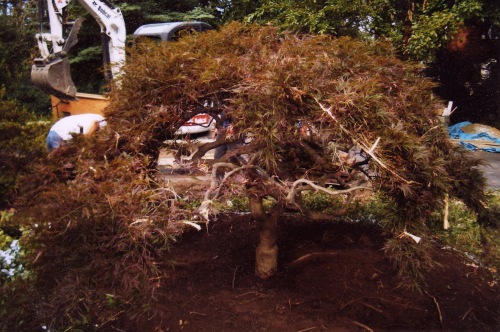
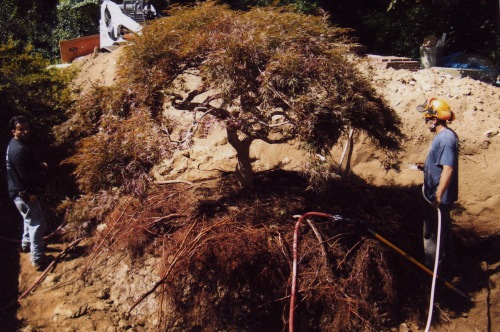
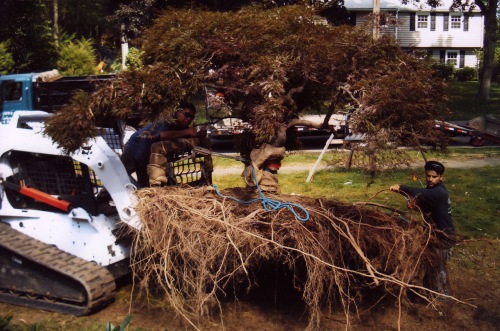
The beauty of using an air spade to transplant specimen trees is that so much root mass can be preserved and moved with the tree. The following photos of a dwarf Japanese maple (Acer palmatum dissectum), lent by Matt Foti, illustrate just how effective at saving roots this technique is.

Matt and his crews are using an air spade routinely now in transplanting work, because it preserves the tree’s resources so well, minimizing transplant shock and easing re-establishment. They moved this tree in early September of 2008. Take a look:

Acer palmatum dissectum awaiting its move.  Soil under the tree has been lightly spaded to check surface roots.

Acer palmatum dissectum awaiting its move. Soil under the tree has been lightly spaded to check surface roots.

Same tree, roots now exposed by the air spade.  Note how far beyond the tree's dripline these roots extend.

Same tree, roots now exposed by the air spade. Note how far beyond the tree's dripline these roots extend.

Tree being lifted up for the move.  The crew has wrapped its trunk and main limbs, to avoid injury; guy lines insure that it won't tip in transit.

Tree being lifted up for the move. The crew has wrapped its trunk and main limbs, to avoid injury; guy lines insure that it won't tip in transit.

Wrapping thoroughly during this kind of move lessens the chance of bark injury.

Wrapping thoroughly during this kind of move lessens the chance of bark injury.

Tree in its new location, backfilled and awaiting thorough watering.  No staking is necessary, as most of the root plate has been preserved and will continue to support the tree in its new home.

Tree in its new location, backfilled and awaiting thorough watering. No staking is necessary, as most of the root plate has been preserved and will continue to support the tree in its new home.

Read Full Post »

If you’ve been interested in the issues on this blog, you might well want to look into another blog, this one written by four horticulture professors.  They’re each based somewhere different — Washington State, Virginia, Michigan, and Minnesota — and they write with humor and expertise about plants and plant issues.  The Garden Professors started posting in July 2009.  They talk about root-washing, propagation, nursery practices, soil contaminants, slugs, rubber mulch — you name it, they’re addressing it.  A recent post highlighted the air-tool transplant of a beautiful 10″ caliper weeping white pine by a Michigan State University Nursery Management class and the MSU arborist. — take a look for some good pix and clear, personable, often funny writing about a great range of up-to-the-minute plant issues.

Read Full Post »

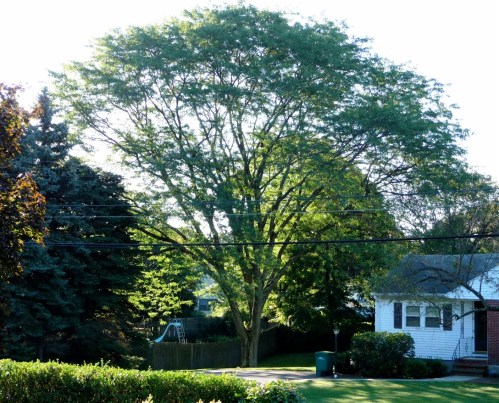
Well, this town outside of Boston can’t be considered ‘the country’ these days, but still, there’s plenty of room for a tree to grow. This Gleditsia, unlike the two in the previous post, can stretch its arms and legs, and shows what form and size a Honey Locust really wants to take:

Plenty of rooting room translates into plenty of canopy.

Plenty of rooting room translates into plenty of canopy.

Read Full Post »

As you may know, this blog started as a series of posts on our other blog, Taking Place.  I branched it off that blog to avoid unbalancing the whole endeavor, and began posting on woody plant issues here.  I am currently working on copying older posts from Taking Place over to this blog as well (they’ll remain at Taking Place, too, as they are important there) — but it’s taking me a while.

So — if you want to read older posts on bare-root transplanting (root-washing and air-tool excavation), or on woody plants in design and woody plant management, you’ll be able to read current (from August onward) posts here, but will have to wait a bit for the older ones to arrive on this site.  If you just can’t wait, though, you can see all my pre-Taking Place In The Trees woody plants posts by clicking on the highlighted name — Taking Place — in the first paragraph.  That blog will then pop up.

Once that happens, scroll down and click on ‘Plants’ in the Categories list to the right of the page; doing so will make the list of tree and shrub posts pop up.  Scan through the list, and click on whatever title interests you to bring up the whole post, including some excellent photos.

And if you like what you see and read, take a look at the rest of the Taking Place site — there are some dandy photos and lots of observations on landscape architecture, design, and how we live in the green world.

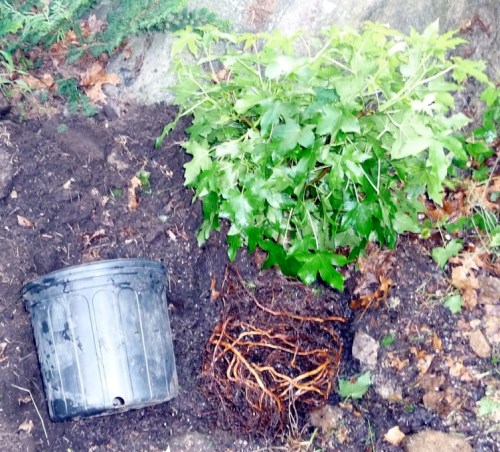
Cute little dwarf liquidambar, freed from its container and soil washed away with the hose, ready to have its circling roots unwound, spread radially (as best as possible), and planted.

Cute little 'Gumball' dwarf Liquidambar, freed from its container and soil washed away with the hose, ready to have its circling roots unwound, spread radially (as best as possible), and planted.

Read Full Post »

One reader wrote in with this comment to my last post: “It would be no good to specify bare root unless you were thoroughly acquainted with the land – soil, ledge, utility lines, for example – and spreading roots of other trees.”

And my answer, because there’s a lot to it:

Actually, bare root is good just for the reasons you enumerate; it’s much easier to plant roots alone than it is to plant a big slug of soil encasing a plant’s roots. And landscape architects, contractors, and arborists have ways of dealing with the issues you mention.

Contractors are required to call Dig Safe (http://www.digsafe.com/) to locate underground utilities on site before any excavation begins. The mis-location of utilities has been known to happen, but excavators are (ideally) careful about how they dig and about stopping when they hit something. Accidents can and do happen, but safeguards have been worked out to minimize their occurrence. (We had a little excitement at last week’s transplanting site over a gas line — apparently DigSafe found one gas line and marked it, but didn’t realize there was another several feet away. The mini-excavator found it — without breaking it — and DigSafe was called out to mark its course immediately.)

Irrigation lines, visible in some of the photos from last week’s posts, are considered expendable/fixable during a construction project. They are relatively flimsy and they run everywhere under many projects, so it is understood that they may be broken (even a shovel can break one), and will be fixed after construction and planting have been completed.

Bare-rooting a tree or shrub for planting — regardless of the surrounding soil type — often is better for the plant than planting it in a soil root ball. When one type of soil is introduced to another, as when a clayey soil root ball is placed in a sand/loam soil, the interface between those two types of soil resists the movement of water from one to the other. That means that if a clay root ball gets watered in thoroughly, water may not move so readily into the sandy loam. What incentive does the root mass have to move beyond that interface and thus into the sandy loam? Not much.

Opening up a root ball and mixing some of its clay with the surrounding soil in the wall of the hole will help, but still — with a bare-root plant that issue is a non-issue. Even with a poor soil, it’s easy to mix some planting loam in with the surrounding soil (again, you want to mix, not simply dump a pile that will give you that same resistant interface) and plant the bare-root tree or shrub in the mix; doing so will make it possible for the plant’s roots to reach as far as they have to for the moisture they need.

it is a tendency, unfortunately, of many planting crews (especially on very large jobs where speed is of the essence and there may be little job training for laborers) simply to push the burlap on a root ball down just below the surface, or in some instances to leave it tied in place before backfilling. Natural burlap eventually will rot, but it can take years, especially given the subsurface soil environment, where the burlap is protected from the atmospheric oxygen and UV light that breaks it down so readily in the nursery. In the meantime, that burlap constrains root extension into the surrounding soil, and can contribute to the roots turning back in to the root ball, which affects the growth of the whole tree. So — another reason bare-root is a good approach: no burlap to fool around with and to constrain root growth.

As for ledge: You’re unlikely to know the location and profile of subsurface ledge until you start digging. That’s just the way it is. Again, though, the presence of high ledge (that is, ledge just below the soil surface) argues for using a bare-root planting method. Since tree roots typically live in the top 12″ of soil (sometimes 18″, and sometimes deeper, given the plant genus and the depth of good soil), and tree root balls can be as deep as 36″, planting a tree with soil around its roots means that you have to accommodate that root ball. Sometimes you can slice off its bottom with little ill effect on the roots. Sometimes you can’t. With a bare-root plant, you don’t have to jimmy around so much with adjusting the height of the root ball.

Certainly, you’ll have to be sure you have adequate soil depth to plant the roots themselves (spreading them out radially, as they typically need to grow), but bare-root planting gives you much more flexibility in this regard.

OK. That’s it for this post, because I have to hit today’s design deadline, and this was a digression from working on it. Sorry about the lack of photos on this post; next one will have a set of really good ones, courtesy of Matt Foti.

Read Full Post »

Tom Ryan*, my first landscape architecture mentor, and I have discussed the desirability of specifying that the trees and shrubs we design into a site be planted bare root whenever possible.   As long as the roots can be kept moist — something now entirely possible with the use of hydrogels — most nursery-grown plants fare better, are more apt to be planted in a way that promotes their future health, and are less expensive than B&B plants. And we all know that healthier plants mean more long-lived designs….

Nina Bassuk and the Urban Horticulture Institute at Cornell have put up on the web an outstanding illustrated tutorial on how to plant shrubs and trees bare root.

One of the challenges for landscape architects is to get more nurseries to offer bare-root plants for sale. Currently, balled-and-burlapped and container-grown are the most available kinds of woody plants in the nursery-to-contractor trade. Like any business, nurseries respond to demand.

Years ago, I was having a casual chat with the president of a local nursery and garden center, and asking why plant selections were limited to a number of fairly standard species and cultivars (I had recently assembled a plant list that specified some more unusual species than his large nursery carried). He told me that his nursery responded to demand; without greater demand for more variety, his business stuck with the standard choices. If more contractors were to bring him more complex lists, his nursery would be happy to accommodate them. It’s a bit of a chicken and egg argument — but essentially it means that continued and persistent demand will get results.

If landscape architects, through our planting choices and plant specifications, possess the ability to influence nursery offerings, then why shouldn’t we also be able to influence the method with which those offerings are packaged? With a greater understanding of the benefits of bare-root plants, perhaps more of us will start to specify bare-root plants, and so create the demand for nurseries to meet. It’s an idea worth exploring.

If you have had experience specifying bare-root plants for a project, we’d love it if you would write in and tell us about it.

Chionanthus retusus, Swan Point Cemetery

Chionanthus retusus, Swan Point Cemetery

*This September Tom will be named a Fellow of the American Society of Landscape Architects — a great honor for any landscape architect, and one that he fully deserves.

Read Full Post »

For those of you checking out this blog for the air-tool transplanting posts, you may find it helpful to read the comments on those posts for more information…And if you’re a landscape architect or arborist and have observations, questions, comments, please feel free to submit them in the comment box as well. This technology and its applications are so new that the more good information gets exchanged, the better.

Lots of root mass.  Irrigation lines run through it; they are cut during the trenching process, and then pulled out in feet-long lengths once enough soil has been blown away from the roots.

Lots of root mass. Irrigation lines run through it; they are cut during the trenching process, and then pulled out in feet-long lengths once enough soil has been blown away from the roots.

Read Full Post »

The project showcased in the last post continued this week, with the bare-root transplanting of five London Plane trees (Platanus x acerifolia) and a mature crabapple. Again, Matthew R. Foti Landscape and Tree Service was the prime arborist on this site in a Boston suburb — but this week the Foti crew was joined by Mike Furgal, who was the first arborist to use the air tool for bare-rooting trees in this way.

Mike has been doing this work a bit over five years, and his expertise was the basis for the bare-root workshop sponsored by the Massachusetts Arborists Association and hosted by Matt last August.   Still, neither arborist had moved this many trees of this size — the London Planes ranged from 11 inches dbh to 13″ dbh — and in teaming up they brought all their knowledge to bear to the challenges of this particular project. (The homeowner figured she had hired the A team, given the pair’s depth of knowledge and breadth of experience.)

I took a lot of photos during the first day, and returned today to shoot more. My colleague Bruce Jones and I also shot extensive videotape of the process, which is currently in editing, and will explain the sequence of bare-root transplanting using compressed air — watch this blog for word that it’s done and available.

To avoid computer-use burnout (mine), I’m posting one batch of photos today, and will add another post with more in a few days. I promise, this first batch of images will be plenty to digest for a while….

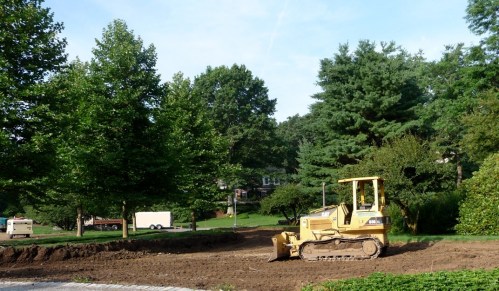
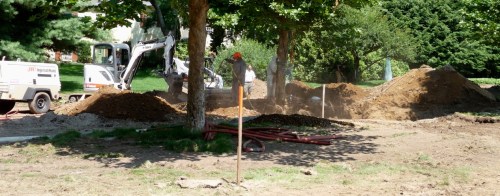
The site before the five London Planes get moved. The first tree to be excavated and moved is the one furthest from the camera, just to the right of the white trailer. These trees flanked a driveway; in this photo the driveway asphalt has been taken up and the gravel base has been partially removed. Trees are located 3-4 feet from the drive edge.

The site before the five London Planes get moved. The first tree to be excavated and moved is the one furthest from the camera, just to the right of the white trailer. These trees flanked a driveway; in this photo the driveway asphalt has been taken up and the gravel base has been partially removed. Trees are located 3-4 feet from the drive edge.

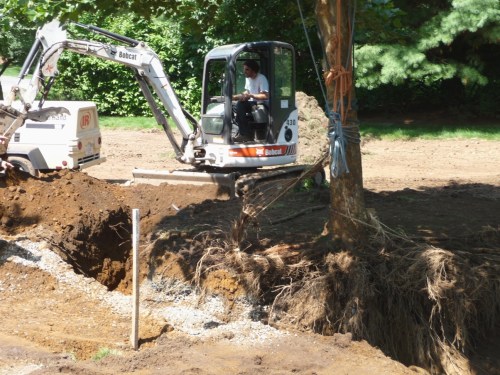
The mini excavator has dug a partial trench; the trench must be dug in sections, or it would be too difficult to reach in and haul out the blown soil.  A climber is in the tree, tying in lines to be used later during transport.

The mini excavator has dug a partial trench; the trench must be dug in sections, or it would be too difficult to reach in and haul out the blown soil. A climber is in the tree, tying in lines to be used later during transport.

Bare-rooting has begun, and one pigtail of roots is already tied to the tree's trunk.  The tree did not extend any roots into the gravel driveway base, so it only has 3-4 feet of root mass on that side.  It did extend its roots out parallel to the driveway, and radially out into the lawn.  A good depth of soil also let it sink its roots quite deep --  2-3 feet -- into the ground.  Mike Furgal is in the green jumpsuit and facemask.

Bare-rooting has begun, and one pigtail of roots is already tied to the tree's trunk. The tree did not extend any roots into the gravel driveway base, so it only has 3-4 feet of root mass on that side. It did extend its roots out parallel to the driveway, and radially out into the lawn. A good depth of soil also let it sink its roots quite deep -- 2-3 feet -- into the ground. Mike Furgal is in the green jumpsuit and facemask.

Pigtailed roots, and short roots along the driveway edge.

Pigtailed roots, and short roots along the driveway edge.

Good deep soil, good deep roots -- everywhere but at the gravel.

Good deep soil, good deep roots -- everywhere but at the gravel.

Lots of activity at the tree:  two air-tool excavators, an mini excavator digging the trench, a Bobcat taking soil away, and Matt Foti assessing progress.

Lots of activity at the tree: two air-tool excavators, an mini excavator digging the trench, a Bobcat taking soil away, and Matt Foti assessing progress.

Blowing out soil, getting closer to the move.

Blowing out soil, getting closer to the move.

Padding the trunk with layers of burlap for the move.

Padding the trunk with layers of burlap for the move.

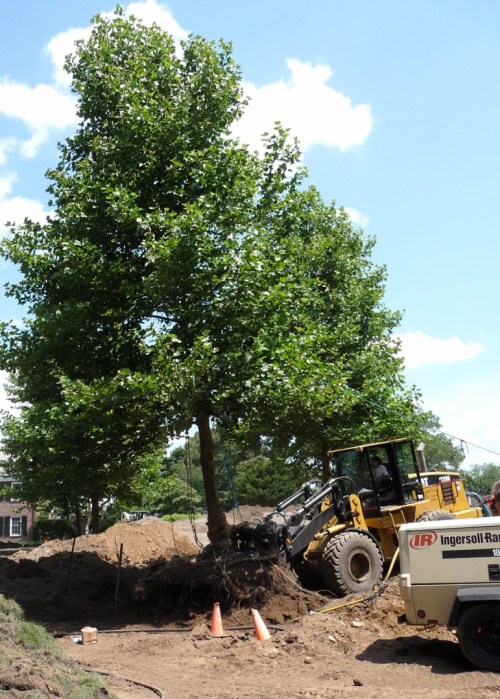
Giant forks have been run under the tree, and the loader is getting ready to lift it. Four taglines are visible in this shot; they won't prevent the tree from falling, but help indicate how it is balanced during the move.

Giant forks have been run under the tree, and the loader is getting ready to lift it. Four taglines are visible in this shot; they won't prevent the tree from falling, but help indicate how it is balanced during the move.

Lifting and backing, slowly and very carefully.

Lifting and backing, slowly and very carefully.

A pause for the forks to be positioned more firmly.

A pause for the forks to be positioned more firmly.

Big machine, bigger tree. The root plate on this tree extended about 18 feet across at its maximum width. Transporting a large, upright live tree is a slow-speed operation.

Big machine, bigger tree. The root plate on this tree extended about 18 feet across at its maximum width. Transporting a large, upright live tree is a slow-speed operation.

Compare this root plate to that of a B&B tree, or a tree-spaded one (though this tree is too large for a tree spade), and it's clear what an advance this technology promises to be in benefiting the health of trees to be transplanted. The tree's energy reserves are largely stored in the roots; save the roots, reduce stress on the tree, and speed re-establishment after planting.

Compare this root plate to that of a B&B tree, or a tree-spaded one (though this tree is too large for a tree spade), and it's clear what an advance this technology promises to be in benefiting the health of trees to be transplanted. The tree's energy reserves are largely stored in the roots; save the roots, reduce stress on the tree, and speed re-establishment after planting.

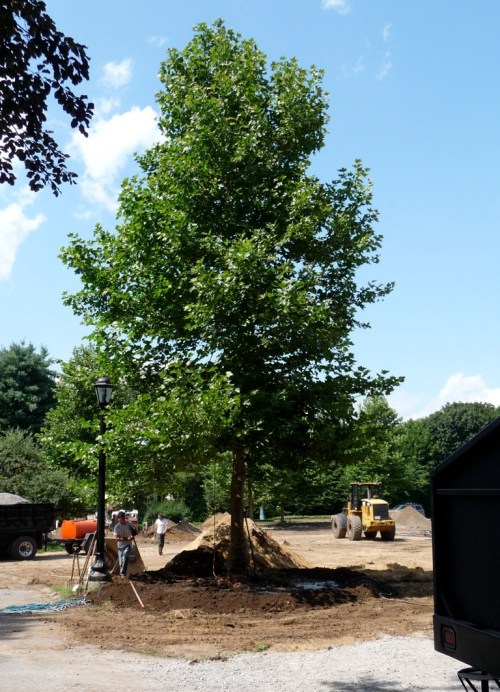
The tree, post-planting. The arborists assessed how deep the root mass was and how it was formed, and dug the planting hole to accommodate, roughly, its form. Once the tree is placed in the hole, the roots are spread out radially by hand, and loam shovelled in around, under, and over them. Watering starts during the digging process, once the tree has been levelled, so that a loam slurry anchors the root plate and tree to its new site. A well is formed to retain moisture and more water is added.

The tree, post-planting. The arborists assessed how deep the root mass was and how it was formed, and dug the planting hole to accommodate, roughly, its form. Once the tree is placed in the hole, the roots are spread out radially by hand, and loam shovelled in around, under, and over them. Watering starts during the digging process, once the tree has been levelled, so that a loam slurry anchors the root plate and tree to its new site. A well is formed to retain moisture and more water is added.

Two to four inches of mulch is added around the tree, and kept away from the trunk.

Two to four inches of mulch is added around the tree, and kept away from the trunk.


Minor pruning to fix a lamppost-branch conflict.

Minor pruning to fix a lamppost-branch conflict.

The transplanted tree seven hours later, in its new home.

The transplanted tree seven hours later, in its new home.

Matthew R. Foti Landscape and Tree Service, Lexington, MA – lead arborist

Furgal Tree and Landscape, Northborough, MA – consulting arborist

Robert Hanss Inc. Landscape Construction – landscape contractor

Reed Hilderbrand – landscape architects (Chris Moyles, project manager)

Read Full Post »

« Newer Posts - Older Posts »