Feeds:
Posts
Comments

Posts Tagged ‘air tool use’

Yesterday the Massachusetts Arborists Association held a day-long workshop at Elm Bank, headquarters for the Massachusetts Horticulture Society in Wellesley, MA.  Three arborists — Dave Leonard from Kentucky, Rolf Briggs of Holliston, MA, and Matt Foti of Lexington, MA — spoke about particular  root issues; Mike Furgal, from Northborough, MA, discussed the use of air tools in bare-root tree transplanting.  After hearing the talks, the hundred or so attendees split into groups and visited five stations on the Elm Bank grounds where the featured speakers were giving demonstrations on their topics.

It was a fine workshop, and I’ll be posting quite a few photos from it in the next few days.  Today, though, I’m only posting this photo:

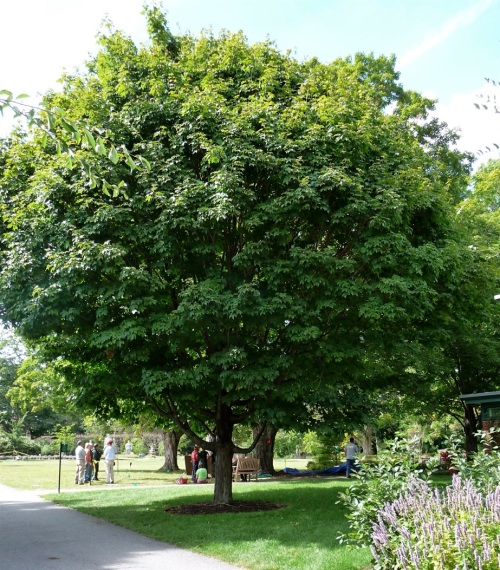
Sugar maple whose root flare was excavated several years ago at a Bartlett Tree workshop given to demonstrate the new and revolutionary use of air tools in tree work.

Sugar maple whose trunk flare was excavated several years ago at a Bartlett Tree workshop given to demonstrate the new and revolutionary use of air tools in tree work.

Several years ago, I went with a friend to this Bartlett Tree workshop at Elm Bank, and we were among a smallish group who watched as an arborist blew several inches of soil away from the trunk flare of this Sugar Maple.  As I recall, the tree had been planted a bit deep, it was set in a fairly compacted lawn, and it was not looking as well as it might; at the time (this was perhaps seven or eight, or perhaps even ten years ago) it had about a six-inch caliper trunk and was not thriving.

Now, however, the tree looks really good.  It may have a little too much mulch around its base — built up since its excavation — but its foliage is deep green, its bark is intact (trunk injuries sometimes show up as a result of some kind of root trauma or injury), and it certainly has grown.  A mulch bed surrounds it and keeps lawnmowers away as it minimizes compaction.  If this kind of growth results from attending to root issues early on and from maintaining a tree properly, the arborists from this workshop may prove, down the road, to be responsible for promoting what truly may be the best arboricultural practices around.

Workshop speakers:

Dave Leonard, Dave Leonard Consulting Arborist, Inc., Lexington, KY

Rolf Briggs, Tree Specialists, Inc., Holliston, MA

Mike Furgal, Furgal’s Tree and Landscape, Northborough, MA

Matt Foti, Matthew R. Foti Landscape and Tree Service, Inc., Lexington, MA

Read Full Post »

Here’s a quick post to alert readers to the Massachusetts Arborists Association‘s Special Seminar and Demonstration on air tool use. A team of four arborists — Mike Furgal, Matt Foti, Rolf Briggs, and Dave Leonard — will be showing how compressed-air tools can be used in arboricultural work (root forensics, bare-root planting, bare-root transplanting, shrub moving, etc.), and will discuss the advancements that this technology provide those working with or using woody plants in the landscape.

The seminar will be on September 10 at Elm Bank, the Massachusetts Horticultural Society’s property in Wellesley, MA — check the MAA link above for registration information.

Registration is not limited to arborists, so interested landscape architects and contractors can go and see this work. I highly recommend signing up; last year’s seminar at Matt Foti’s farm, where Mike Furgal debuted the air-tool transplanting method, was really outstanding, and this year there’s bound to be even more information available and a great deal of informed and informative discussion.

One point: Bare-root transplanting, either with an air-tool or by root-washing, may never replace other methods of transplanting. But for specimen tree transplanting, where the value of an existing tree merits the effort involved, it is currently the gold standard. The number of roots retained with bare-root transplanting prevents the tremendous stress caused by other methods, and should be considered a valuable tool in the kit available to landscape architects, arborists, and contractors.

Bare-rooting allows for the moving of a tree this large in less than one day...

Bare-rooting allows for the moving of a tree this large in less than one day...

...while preserving this much root mass.

...while preserving this much root mass.

Read Full Post »

Matt Foti took these photos from last week’s big transplant project, and they illustrate some useful points.

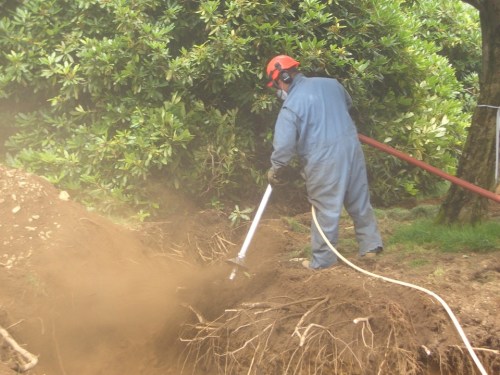
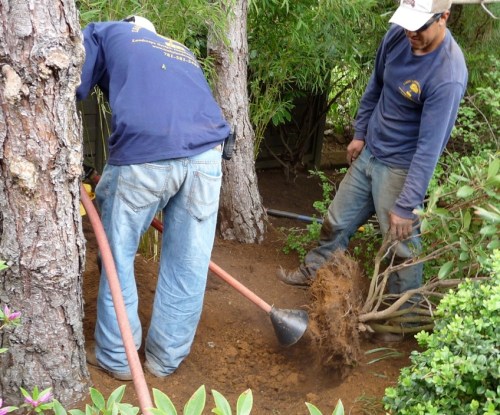
Air-tool excavation is a very messy process, and it bears mentioning again that eye, ear, head, and face protection are really necessary.  Mike Furgal is wearing a face mask here; a respirator would give him even greater lung protection.  Blowing a good sandy loam is one thing; when pebbles and small rocks show up in the soil they become missiles, so long sleeves and pants should also be worn.

Air-tool excavation is a very messy process, and it bears mentioning again that eye, ear, head, and face protection are really necessary. Mike Furgal is wearing a face mask here; a respirator would give him even greater lung protection. Blowing a good sandy loam is one thing; when pebbles and small rocks show up in the soil they become missiles, so long sleeves and pants should also be worn.

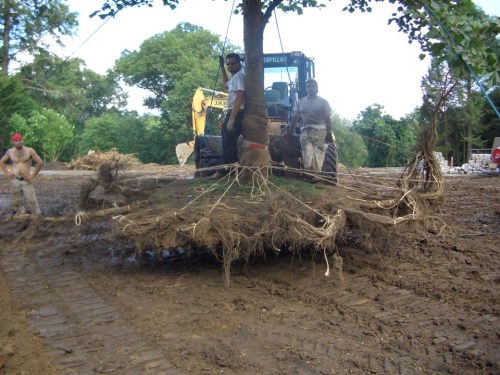
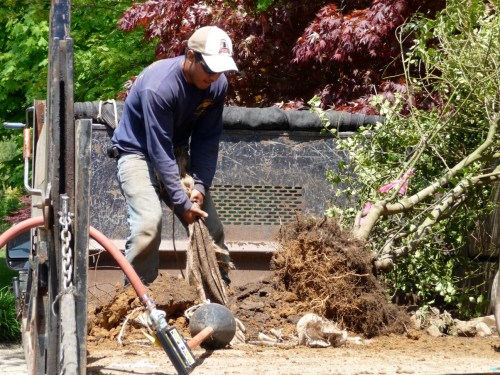
Here is what a well-tied tree looks like in transit.  Note how the roots have been carefully pigtailed, and tiebacks to the tree's trunk are done neatly and professionally, to preserve the roots during excavation and the move.

Here is what a well-tied tree looks like in transit. Note how the roots have been carefully pigtailed, and tiebacks to the tree's trunk are done neatly and professionally, to preserve the roots during excavation and the move.

This project took place in late July, during a week of 85-degree heat.  Leaf turgor pressure was maintained throughout by the trees themselves (aided with some in-process watering).

This project took place in late July, during a week of 85-degree heat. Leaf turgor pressure was maintained throughout by the trees themselves (aided with some in-process watering).

Keeping the pigtails neat from the start makes unbundling and spreading the roots fairly easy.  The tree is now resting in the crater dug for its new home; the crew will unbundle and spread the roots out radially, pack soil underneath them to help level the tree, and backfill, water, and mulch the transplant.  Using a forklift allows the arborists to look under the root plate and gauge its bottom profile, which helps in shaping the floor of the planting crater.

Keeping the pigtails neat from the start makes unbundling and spreading the roots fairly easy. The tree is now resting in the crater dug for its new home; the crew will unbundle and spread the roots out radially, pack soil underneath them to help level the tree, and backfill, water, and mulch the transplant. Using a forklift allows the arborists to look under the root plate and gauge its bottom profile, which helps in shaping the floor of the planting crater.

Project arborists:

Matthew R. Foti Landscape and Tree Service, Concord, MA

Furgal’s Tree and Landscape, Northborough, MA

Read Full Post »

For those of you checking out this blog for the air-tool transplanting posts, you may find it helpful to read the comments on those posts for more information…And if you’re a landscape architect or arborist and have observations, questions, comments, please feel free to submit them in the comment box as well. This technology and its applications are so new that the more good information gets exchanged, the better.

Lots of root mass.  Irrigation lines run through it; they are cut during the trenching process, and then pulled out in feet-long lengths once enough soil has been blown away from the roots.

Lots of root mass. Irrigation lines run through it; they are cut during the trenching process, and then pulled out in feet-long lengths once enough soil has been blown away from the roots.

Read Full Post »

The project showcased in the last post continued this week, with the bare-root transplanting of five London Plane trees (Platanus x acerifolia) and a mature crabapple. Again, Matthew R. Foti Landscape and Tree Service was the prime arborist on this site in a Boston suburb — but this week the Foti crew was joined by Mike Furgal, who was the first arborist to use the air tool for bare-rooting trees in this way.

Mike has been doing this work a bit over five years, and his expertise was the basis for the bare-root workshop sponsored by the Massachusetts Arborists Association and hosted by Matt last August.   Still, neither arborist had moved this many trees of this size — the London Planes ranged from 11 inches dbh to 13″ dbh — and in teaming up they brought all their knowledge to bear to the challenges of this particular project. (The homeowner figured she had hired the A team, given the pair’s depth of knowledge and breadth of experience.)

I took a lot of photos during the first day, and returned today to shoot more. My colleague Bruce Jones and I also shot extensive videotape of the process, which is currently in editing, and will explain the sequence of bare-root transplanting using compressed air — watch this blog for word that it’s done and available.

To avoid computer-use burnout (mine), I’m posting one batch of photos today, and will add another post with more in a few days. I promise, this first batch of images will be plenty to digest for a while….

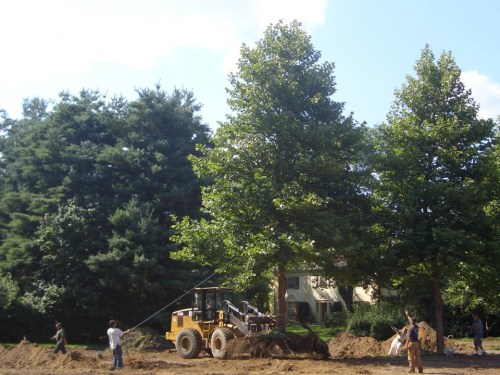
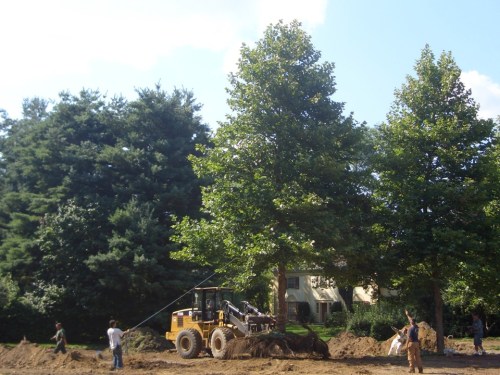
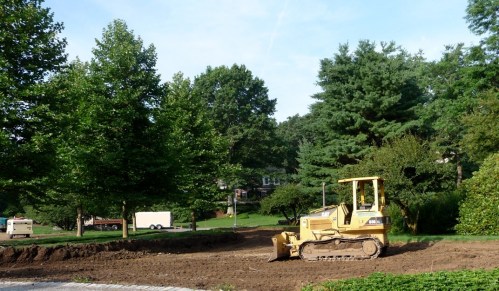
The site before the five London Planes get moved. The first tree to be excavated and moved is the one furthest from the camera, just to the right of the white trailer. These trees flanked a driveway; in this photo the driveway asphalt has been taken up and the gravel base has been partially removed. Trees are located 3-4 feet from the drive edge.

The site before the five London Planes get moved. The first tree to be excavated and moved is the one furthest from the camera, just to the right of the white trailer. These trees flanked a driveway; in this photo the driveway asphalt has been taken up and the gravel base has been partially removed. Trees are located 3-4 feet from the drive edge.

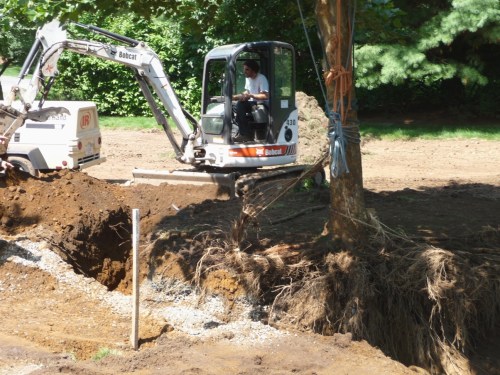
The mini excavator has dug a partial trench; the trench must be dug in sections, or it would be too difficult to reach in and haul out the blown soil.  A climber is in the tree, tying in lines to be used later during transport.

The mini excavator has dug a partial trench; the trench must be dug in sections, or it would be too difficult to reach in and haul out the blown soil. A climber is in the tree, tying in lines to be used later during transport.

Bare-rooting has begun, and one pigtail of roots is already tied to the tree's trunk.  The tree did not extend any roots into the gravel driveway base, so it only has 3-4 feet of root mass on that side.  It did extend its roots out parallel to the driveway, and radially out into the lawn.  A good depth of soil also let it sink its roots quite deep --  2-3 feet -- into the ground.  Mike Furgal is in the green jumpsuit and facemask.

Bare-rooting has begun, and one pigtail of roots is already tied to the tree's trunk. The tree did not extend any roots into the gravel driveway base, so it only has 3-4 feet of root mass on that side. It did extend its roots out parallel to the driveway, and radially out into the lawn. A good depth of soil also let it sink its roots quite deep -- 2-3 feet -- into the ground. Mike Furgal is in the green jumpsuit and facemask.

Pigtailed roots, and short roots along the driveway edge.

Pigtailed roots, and short roots along the driveway edge.

Good deep soil, good deep roots -- everywhere but at the gravel.

Good deep soil, good deep roots -- everywhere but at the gravel.

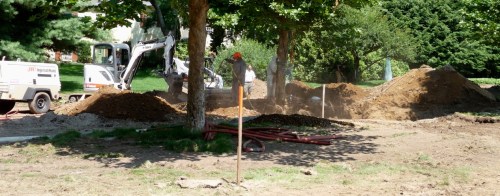
Lots of activity at the tree:  two air-tool excavators, an mini excavator digging the trench, a Bobcat taking soil away, and Matt Foti assessing progress.

Lots of activity at the tree: two air-tool excavators, an mini excavator digging the trench, a Bobcat taking soil away, and Matt Foti assessing progress.

Blowing out soil, getting closer to the move.

Blowing out soil, getting closer to the move.

Padding the trunk with layers of burlap for the move.

Padding the trunk with layers of burlap for the move.

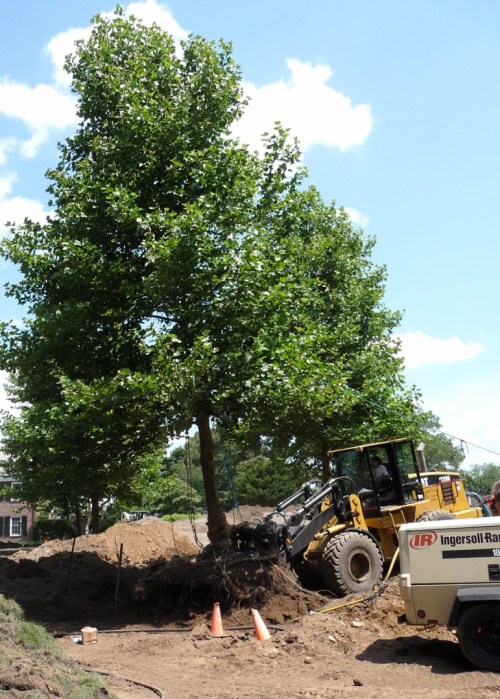
Giant forks have been run under the tree, and the loader is getting ready to lift it. Four taglines are visible in this shot; they won't prevent the tree from falling, but help indicate how it is balanced during the move.

Giant forks have been run under the tree, and the loader is getting ready to lift it. Four taglines are visible in this shot; they won't prevent the tree from falling, but help indicate how it is balanced during the move.

Lifting and backing, slowly and very carefully.

Lifting and backing, slowly and very carefully.

A pause for the forks to be positioned more firmly.

A pause for the forks to be positioned more firmly.

Big machine, bigger tree. The root plate on this tree extended about 18 feet across at its maximum width. Transporting a large, upright live tree is a slow-speed operation.

Big machine, bigger tree. The root plate on this tree extended about 18 feet across at its maximum width. Transporting a large, upright live tree is a slow-speed operation.

Compare this root plate to that of a B&B tree, or a tree-spaded one (though this tree is too large for a tree spade), and it's clear what an advance this technology promises to be in benefiting the health of trees to be transplanted. The tree's energy reserves are largely stored in the roots; save the roots, reduce stress on the tree, and speed re-establishment after planting.

Compare this root plate to that of a B&B tree, or a tree-spaded one (though this tree is too large for a tree spade), and it's clear what an advance this technology promises to be in benefiting the health of trees to be transplanted. The tree's energy reserves are largely stored in the roots; save the roots, reduce stress on the tree, and speed re-establishment after planting.

The tree, post-planting. The arborists assessed how deep the root mass was and how it was formed, and dug the planting hole to accommodate, roughly, its form. Once the tree is placed in the hole, the roots are spread out radially by hand, and loam shovelled in around, under, and over them. Watering starts during the digging process, once the tree has been levelled, so that a loam slurry anchors the root plate and tree to its new site. A well is formed to retain moisture and more water is added.

The tree, post-planting. The arborists assessed how deep the root mass was and how it was formed, and dug the planting hole to accommodate, roughly, its form. Once the tree is placed in the hole, the roots are spread out radially by hand, and loam shovelled in around, under, and over them. Watering starts during the digging process, once the tree has been levelled, so that a loam slurry anchors the root plate and tree to its new site. A well is formed to retain moisture and more water is added.

Two to four inches of mulch is added around the tree, and kept away from the trunk.

Two to four inches of mulch is added around the tree, and kept away from the trunk.


Minor pruning to fix a lamppost-branch conflict.

Minor pruning to fix a lamppost-branch conflict.

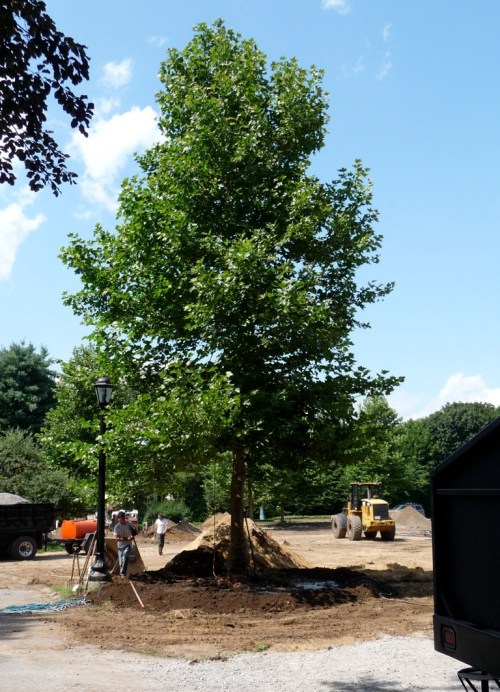
The transplanted tree seven hours later, in its new home.

The transplanted tree seven hours later, in its new home.

Matthew R. Foti Landscape and Tree Service, Lexington, MA – lead arborist

Furgal Tree and Landscape, Northborough, MA – consulting arborist

Robert Hanss Inc. Landscape Construction – landscape contractor

Reed Hilderbrand – landscape architects (Chris Moyles, project manager)

Read Full Post »

Here’s a series of photos from an air-tool transplant project executed last week by a crew from Matthew R. Foti Landscape and Tree Service of Lexington, MA. These guys have been using air tools to bare-root trees for some time now, and they have refined the process pretty skillfully.

Shown here are a very large treeform Taxus and a smallish Cornus kousa. The Kousa Dogwood had been planted only about 8′ away from the Yew, and probably had been sheltered by it in its early days. At this stage, though, their crowns had been competing, and a revised landscape design gave further reason to spade out and move both plants.

Taxus and Cornus kousa planted closely together, as part of a larger planting that has already been dismantled.

Taxus and Cornus kousa planted closely together, as part of a larger planting that has already been dismantled.

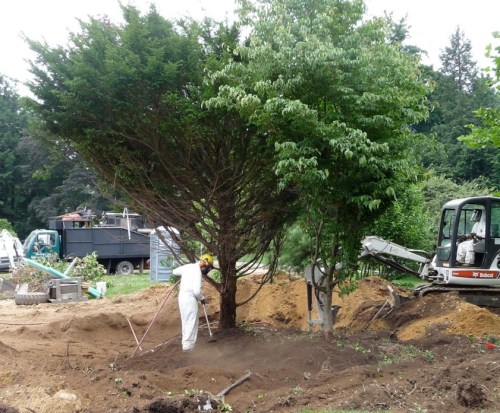
The Bobcat has dug a trench, and the crew is blowing soil into it. Note that the Yew's branches have been tied up to keep them out of the way.

The Bobcat has dug a trench, and the crew is blowing soil into it. Note that the Yew's branches have been tied up to keep them out of the way.

Taxus is a deeply rooted plant -- notice the trench depth, and presence of roots in the lower part of the mound.

Taxus is a deeply rooted plant -- notice the trench depth, and presence of roots in the lower part of the mound.

Soil and rocks fly during the process, so eye and ear protection are essential. The white jumpsuits keep these guys from getting covered with soil (color is optional).

Soil and rocks fly during the process, so eye and ear protection are essential. The white jumpsuits keep these guys from getting covered with soil (color is optional).

Bobcat continually takes blown soil out of the trench and stockpiles it.

Bobcat continually takes blown soil out of the trench and stockpiles it.

Double-teaming a soil clod. Pushing the nozzle down into the root mass helps loosen soil inside it.

Double-teaming a soil clod. Pushing the nozzle down into the root mass helps loosen soil inside it.

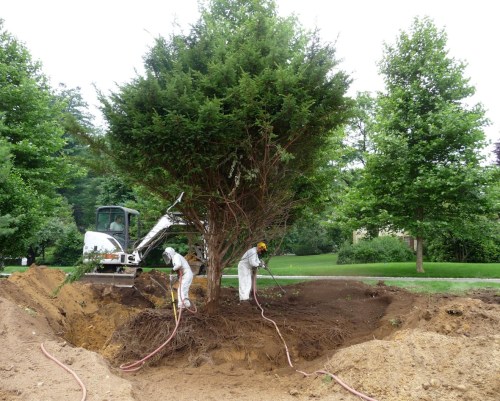
Pigtailing the roots -- tying them in long bundles -- helps keep them protected and out of the way.

Pigtailing the roots -- tying them in long bundles -- helps keep them protected and out of the way.

Twine holds the pigtails together; when the plant is ready to move, twine can also be used to tie the pigtails back to the trunk, to keep them from dragging during transport.

Twine holds the pigtails together; when the plant is ready to move, twine can also be used to tie the pigtails back to the trunk, to keep them from dragging during transport.

Progress shot. Look at how deep the trench is. The Taxus is nearly ready, and shortly the crew will move on to the Cornus kousa; when both trees have been blown out, they will be separated and moved to new locations.

Progress shot. Look at how deep the trench is. The Taxus is nearly ready, and shortly the crew will move on to the Cornus kousa; when both trees have been blown out, they will be separated and moved to new locations.

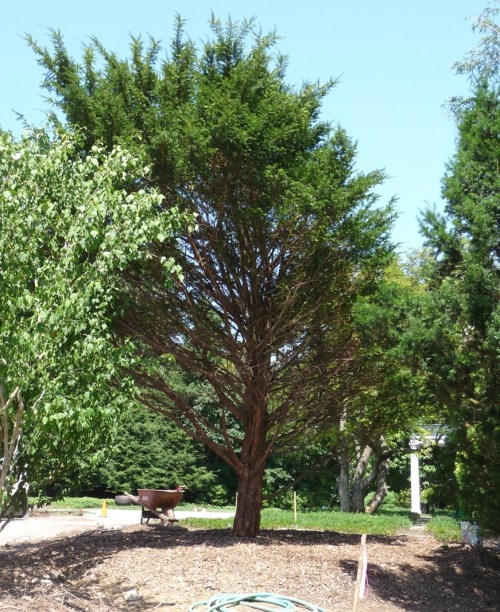
The following week: Taxus in a new spot, looking relaxed and healthy

The following week: Taxus in a new spot, looking relaxed and healthy

Final shot. Asymmetry in the Taxus crown reflects its previous location in a larger planting.

Final shot. Asymmetry in the Taxus crown reflects its previous location in a larger planting.

.”]<img title=”p1020427″ src=”http://takingplace.files.wordpress.com/2009/07/p10204273.jpg&#8221; alt=”Final shot. Asymmetry in the Taxus crown reflects its previous location in a larger planting.” width=”499″ height=”639″ />[/caption]

Read Full Post »

This past winter I developed plans for a couple of areas on the property belonging to my longest-standing and wonderfully enthusiastic clients, L. and A. on the North Shore. They have a lovely place on a rocky cliff overlooking Nahant Bay, and they enjoy making it even more beautiful and comfortable each year. They are both artists, and both appreciate art in two and three dimensions: L. gardens and sculpts; A. is a talented photographer.

L. and A. had asked me to figure out how to screen out views of two neighbors from their house, and to develop plans in the two areas that would work with the extensive mature plantings already in place. I drew up plans that would bring a few new plants in, as well as reuse a number of plants already onsite. L. and A. liked the ideas, and we scheduled a date to move ahead.

Leahy Landscaping of Lynn carried out the work of digging and moving the plants; the crew, led by Anibal Marita, was excellent. At my request, and under the supervision of Mark Bolcome, Leahy’s arborist, they used an air spade on the project; we were working in a heavily planted area and I wanted to disturb or lose as few roots as possible.

The plan:  Remove a 32′ long, 7′ high holly (<em>Ilex ‘China Girl'</em>) hedge from the edge of a residential drive court, reusing some of the plants for screening at the front property line, and install a collection of transplanted shrubs, a new Japanese maple, and some low Green Wave yews where the holly had been. Transplant most of the hollies to provide a 22’ long screen at the front property line, and use the rest at another location onsite.

Proposed methods:  Hand-dig the holly. To avoid further stressing the three aging red pines under which some of the hollies were to be transplanted, excavate the transplant site with an air spade. Hand-dig the rest of the plants.

Actual methods:  Hand-dug the holly, then air spaded the root balls to loosen the nursery soil at their cores. Discovered that the wire baskets had not been removed at the original planting, removed those, and loosened the remaining soil, leaving roots intact. Removing the soil allowed the plants to fit in shallower-depth holes, which was helpful on a site with a lot of existing tree roots and drainage pipes. Removing the wire baskets will allow the hollies’ roots (and crowns) to grow unimpeded in their new locations. Excavated under the pines with the air spade, and removed existing shrubs there also with the air spade, leaving all roots, including masses of feeder roots, intact. Unwrapped the Japanese maple root ball, removed the wire basket and burlap, and removed/loosened the soil with the air spade.

Removing a girdling root from the Japanese maple.  Note the root-ball soil line, four inches up the tree's trunk from the base of the trunk flare.

Removing a girdling root from the Japanese maple. Note the root-ball soil line, four inches up the tree's trunk from the base of the trunk flare.

With a mini-claw mattock, pulled soil away from the trunk flare; soil had been piled 4″ up the trunk, concealing a girdling root and the flare itself. Mark Bolcome chiseled away the girdling root and made sure the flare was correctly exposed before laborers backfilled and watered in the root ball.

Removed the red clay soil encasing the nursery root ball of a rhododendron that had been planted onsite several years ago, but that had struggled for those years.
Breaking up the clay soil in the root ball of a 4' rhododendron.

Breaking up the clay soil in the root ball of a 4' rhododendron.

With the concrete-like soil mostly gone, the plant should finally have a chance to spend its energy growing, rather than trying to break through that clay cast.

Cleared ground cover by hand in front of a row of mature Taxus trees,

Holes for holly transplants were dug by air spade, to minimize disturbance to the roots of the treeform yew hedge behind the plywood.

Holes for holly transplants were dug by air spade, to minimize disturbance to the roots of the treeform yew hedge behind the plywood.

then excavated transplant holes with the air spade — again, to keep from disturbing roots of the existing yews — and transplanted more of the holly here.

The original plan, which also included the planting of six large clump bamboos and the moving of several broadleaf evergreen and herbaceous plant, was scheduled to take perhaps two days. The hollies changed everything, though. They were enormous: planted eight or nine years ago at 3′ on center, they opened out to seven to eight feet in width.

One holly, trussed for moving.  Ten of these plants had been placed on 3' centers to make a hedge; when freed from the hedge, each one opened out to cover at least seven feet in breadth.

One holly, trussed for moving. Ten of these plants had been placed on 3' centers to make a hedge; when freed from the hedge, each one opened out to cover at least seven feet in breadth.

There was no way we could fit them all where we had intended; they would have taken up more than seventy linear feet if we had placed them side by side!
Hand-dug holly that has been bare-rooted being prepared for transplant. Notice the clumps of hard, heavy soil from its original root ball lying around it; the wire basket is lying off to the left.

Hand-dug holly that has been bare-rooted being prepared for transplant. Notice the clumps of hard, heavy soil from its original root ball lying around it; the wire basket is lying off to the left.

The trussed holly, now untied and moved to the planting bed, is at the back right of the photo. Liberated from the crush of a too-tight hedge planting, it has opened out to cover almost nine feet of fence.

The trussed holly, now untied and moved to the planting bed, is at the back right of the photo. Liberated from the crush of a too-tight hedge planting, it has opened out to cover almost nine feet of fence.

So it took a while to figure out where to put them, and then more time preparing those new locations to receive them. We ended up placing them — ten from the hedge, plus a shorter male plant — at various points around the property’s edge, where they do a magnificent job of screening out the neighbors.

Accomplishing the work took a full three days. Lessons learned:

1. An air spade is a great tool for any kind of planting work. We tested its capabilities, and found it invaluable for working under trees, for bare-rooting new plants, for excavating existing shrubs, and for removing that dreadful red clay soil from the 4′ rhododendron. We used it to investigate suspicious root issues — that concrete-like slug encasing the rhody’s root mass, the hollies’ wire baskets, the Japanese maple’s buried root flare and girdling root — and when it wasn’t being used on the transplanting operation, we used it to give a little breathing room to the root flare of a river birch planted on site a few years ago.

On this particular site, which has been intensively gardened for decades, the soil is beautifully dark and rock-free. The air spade had no difficulty blowing it out of planting holes. Even with a rockier soil, an air spade has enough pressure (90 psig) that bare-rooting shrubs takes a relatively short time. A laborer team can generally dig a 4-5′ broadleaf evergreen shrub in minutes. An air spade can do it as quickly or in a few more minutes, depending on soil type — but the amount of root mass saved makes the air spade by far the preferred method, horticulturally.

2. Plywood screens work beautifully to confine the overspray of soil from the spading site. For bare-rooting the already-dug hollies, the landscapers figured out that they could lift each plant into the back of their high-sided truck and spade off the root soil there, which kept the soil contained and the site clean.

3. At a minimum, workers using the air spade or helping with the bare-rooting should wear goggles and a face mask; very fine particles of soil spray everywhere at high pressure, and eyes and lungs should be protected. In rocky or sandy soil, the hazard is greater, and long sleeves and protective visored helmets are a good idea.

4. Never plant China Girl hollies that close together. They have a lush and luxuriant round form, and are determined to grow to that form (shrubs will push to grow into their particular habits — with some, you can push back by hedging them, but it makes sense to pick a variety whose natural habit lends itself to hedge form). Ten hollies had been planted at 3\’ o.c. to make a hedge; when removed from hedge configuration, the plants spread to between seven and nine feet in breadth. These plants now make a contribution to the landscape that they couldn’t in hedge form.

L. couldn’t remember if the original plan, done by another LA, had called for China Girls or for some other holly, and wondered if the contractor might have substituted China Girls for something else. We’ll never know — but we’ll know what to avoid in future.

Conclusion: The planting techniques were first-rate, the plants looked happy, the place looked great. L. and A. are delighted with the results (I know I’ve succeeded when I’ve pleased their artists’ eyes), and Leahy is moving on to do other air spade projects, knowing how well the technique works in a number of different situations. Now we’ll all be watching to see how everything grows; I’m betting they will all thrive.

Company:  Leahy Landscaping of Lynn, MA

Leahy Project Manager: Aisha Lord

Leahy Arborist: Mark Bolcome, MCA

Leahy Foreman: Anibal Marita

Read Full Post »
« Newer Posts