Feeds:
Posts
Comments

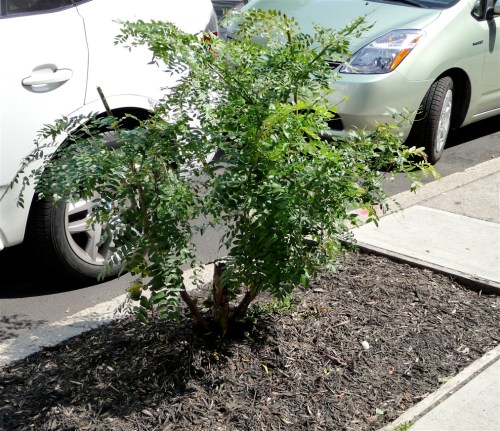
I was recently on Newbury Street in Boston. Turning away from the nifty pay-for-parking machine (these things have replaced meters on the street, and they couldn’t be more convenient, or more helpful for reducing street furniture clutter), I spotted this valiant little Gleditsia, working hard to stay alive:

What had been a typical street tree -- a standard-form Honey Locust -- was cut down at some point, and now sports shrub-like topgrowth.

What had been a typical street tree -- a standard-form Honey Locust -- was cut down at some point, and now sports shrub-like topgrowth.

A little way down the street was another Gleditsia, this one growing in a similarly sized tree pit, but intact from the saw:

Both trees work hard under severe limitations.  The far tree shows what the nearer tree could have looked like.

Both trees work hard under severe limitations. The far tree shows what the nearer tree could have looked like.

How well these characters are doing is a direct consequence of how well they’re being cared for, and of their native vitality. The far tree is impressive for its growth despite the tiny volume of root space available for it; the near tree admirable for its persistence.

Note on older posts

As you may know, this blog started as a series of posts on our other blog, Taking Place.  I branched it off that blog to avoid unbalancing the whole endeavor, and began posting on woody plant issues here.  I am currently working on copying older posts from Taking Place over to this blog as well (they’ll remain at Taking Place, too, as they are important there) — but it’s taking me a while.

So — if you want to read older posts on bare-root transplanting (root-washing and air-tool excavation), or on woody plants in design and woody plant management, you’ll be able to read current (from August onward) posts here, but will have to wait a bit for the older ones to arrive on this site.  If you just can’t wait, though, you can see all my pre-Taking Place In The Trees woody plants posts by clicking on the highlighted name — Taking Place — in the first paragraph.  That blog will then pop up.

Once that happens, scroll down and click on ‘Plants’ in the Categories list to the right of the page; doing so will make the list of tree and shrub posts pop up.  Scan through the list, and click on whatever title interests you to bring up the whole post, including some excellent photos.

And if you like what you see and read, take a look at the rest of the Taking Place site — there are some dandy photos and lots of observations on landscape architecture, design, and how we live in the green world.

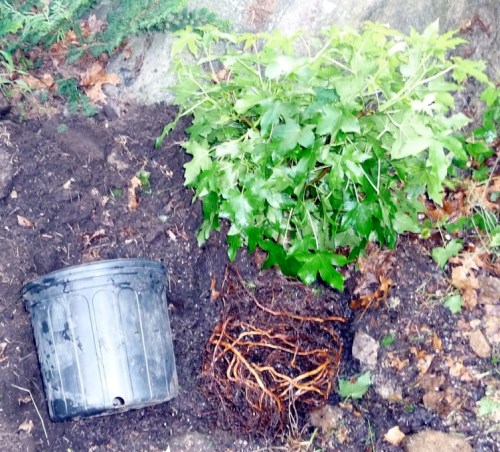
Cute little dwarf liquidambar, freed from its container and soil washed away with the hose, ready to have its circling roots unwound, spread radially (as best as possible), and planted.

Cute little 'Gumball' dwarf Liquidambar, freed from its container and soil washed away with the hose, ready to have its circling roots unwound, spread radially (as best as possible), and planted.

A note of thanks

In the year since I’ve been writing about bare-root transplanting and air-tool use, I’ve had the great good fortune to be able to ask questions of the real experts, the arborists who are doing this work and promoting it throughout Massachusetts and the US.  Three in particular have been especially helpful:

Mike Furgal

Mike Furgal

Mike Furgal, the original developer of the air-tool bare-root transplant method, has patiently reviewed my articles and given thoughtful and well-considered answers to all my questions.  He has a tremendous amount of knowledge about trees and transplanting, and he is extremely generous in sharing it.

Matt Foti

Matt Foti

Matt Foti, who hosted the first MAA workshop on air-tool bare-root transplanting (given by Mike and Matt) at his nursery at Nonset Farm, has taken the time to discuss a wide range of tree-related issues with me, and to provide clarifications to help make this information as up-to-the-minute and accurate as possible.  He has been the catalyst to get word of bare-root work out to the MAA and beyond, and has put energy and dedication into practicing, experimenting, and teaching.  Another generous guy.

Carl Cathcart

Carl Cathcart

Carl Cathcart, Consulting Arborist, has provided encouragement and still more information to me from the day we met at the Nonset Farm workshop.  He alerted me to the Cavicchio’s root-washing experiment, he talks up my writing to other arborists, and his encouragement is what got me writing about this stuff in the first place.

In July, Matt and Mike transplanted a number of very large trees for a project in Wellesley, MA.  They (and the homeowner, contractor, and landscape architect) kindly allowed me and a colleague to videotape the moving of two forty-foot high London Plane trees.  Editing of over six hours of videotape is underway now, and I’m hopeful that I’ll have a decent film this fall that Matt and Mike can do some voiceover comments on (not possible on site — air-tools are incredibly loud!).    When we’re done, it should give a fairly comprehensive look at how this method works for transplanting significant trees.  (And I bet Carl’s going to talk it up…)

For all these reasons, I offer my sincerest thanks to Mike, Matt, and Carl.  They are models of generosity, and I couldn’t be more grateful.

Air spade tree transplanting.  Warning:  Long post, tons of photos.

Probably the biggest draw of the Elm Bank workshop on September 10, 2009, was Mike Furgal’s moving of a 6″ caliper elm hybrid.  Mike first developed the method of air-tool bare-root transplanting in 2004, and has been working on it since, moving ornamental specimens and canopy trees with great success.  The biggest tree he has moved was a 21″ caliper, 50′ high mulberry (it was the owner’s choice), in November 2008; this past July he worked on Matt Foti’s project of moving several large trees, including the five 40′ high London plane trees showcased in posts on www.takingplace.net.

(To find those posts, click on the link in the last sentence, and then click on the ‘Plants’ link in Categories listed on the right side of the page.  All posts related to air-tool transplanting will pop up; the links for the London plane project are dated July 29, July 31, August 3, and August 7.  Browse among earlier ‘Plants’ posts for more articles on bare-root transplanting.)

So Mike has lots of experience with this work, and continues to think about the best ways — for the trees and for the crews — to move trees.  He made a number of observations in his Elm Bank talk about air-tool transplanting:

1.  The larger the tree, the more cost-effective the bare-root move is.

2.  Bare-root transplanting lets roots settle immediately into the soil on the new site.  With no root ball/surrounding soil interface to impede moisture saturation or interrupt moisture flow, the roots are able to adapt right away and start growing.  As a result, watering and aftercare are also easier and more effective.

3.  The greater the depth of good quality soil, the more apt roots are to grow down as well as out.

4.  Arborists and landscape architects MUST stress the need for sustained aftercare once a tree has been bare-root transplanted.  One year of attentive watering is good, but two, three, four, or even five years is better.

5.  Mike asked “Do we arborists plant trees or do we install them?”  When you install a B&B tree, he suggested, you dig a hole, put the tree in the ground, backfill, and water.  When you plant a tree, you remove the wire basket, remove the burlap and twine, possibly break up the soil mass, spread the roots out to promote outward growth, and water sufficiently for the next couple of years for the tree to root into its home.  ‘Installing’ a tree makes the tree simply a product, a commodity that can (and may have to be) replaced.  ‘Planting’ a tree recognizes and attends to the needs of this living organism, and promotes its good health and sustained long life.

6.  Air tools dry out root surfaces — pre-watering of the root mass and soil around a tree to be moved helps the tree hydrate and maintain turgor pressure during the transplant operation.  Mike suggested that trees may have a greater tolerance for short-term root drying than is commonly assumed, and urged the audience to observe what happens to the roots of trees they may move bare-root, and how those trees react to the process.

7.  When you use an air tool to excavate a tree for transplanting, dig your soil trench in sections, and dig it deep enough (measured in feet, not inches) to hold quite a bit of blown out soil, thus minimizing the number of times it needs to be emptied.  Mike pointed out that it’s necessary to consider how best to move the excess soil around; it’s important to plan the job at the outset, including how to access the plant(s) to be moved, how to avoid plants to remain, and where to stockpile the blown-out soil.

8.  The bare-root process can allow arborists use lighter equipment (depending on tree size, of course) than may be necessary for B&B trees.  A 2000-pound mini-excavator can pick up a six-inch elm, while to move that same tree B&B would require a large backhoe or front-end loader.

9.  The more fibrous a tree’s root system, the less likely it is to need cabling after a bare-root transplant.  A root mass’s size, the nature of its rooting, and the relationship between those factors and the tree’s size will also factor into the decision to cable a newly-planted bare-root tree.

Mike had blown soil out from around the roots of the Elm Bank elm the day before the workshop, and kept them covered until the workshop demonstrations began.
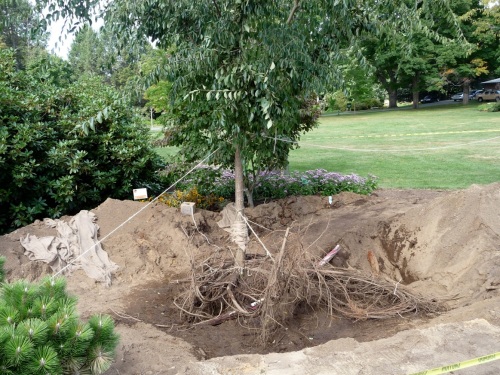
Healthy elm tree, soil blown off its roots, ready to be moved.
Healthy elm tree, soil blown off its roots, ready to be moved.

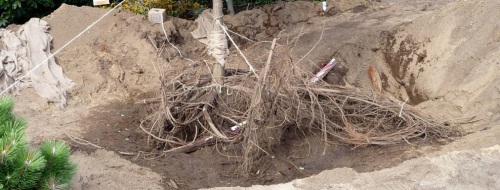
Closeup of the roots.  This root mass measured 14 feet across at its widest.  Roots have been pigtailed -- that is, tied together and lifted to keep them from breaking during the air-tool process and move.

Closeup of the roots. This root mass measured 14 feet across at its widest. Roots have been pigtailed -- that is, tied together and lifted to keep them from breaking during the air-tool excavation and move.
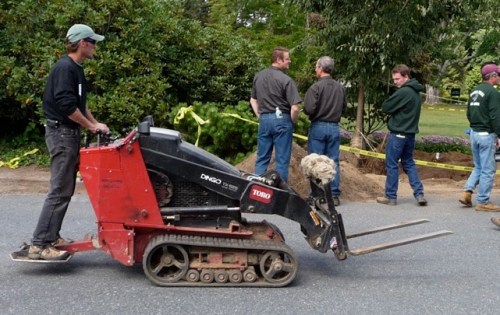
Dingo used to move the tree, whose new location was about fifty feet away from where it originally stood.
Dingo used to move the tree, whose new location was about fifty feet away from where it originally stood.

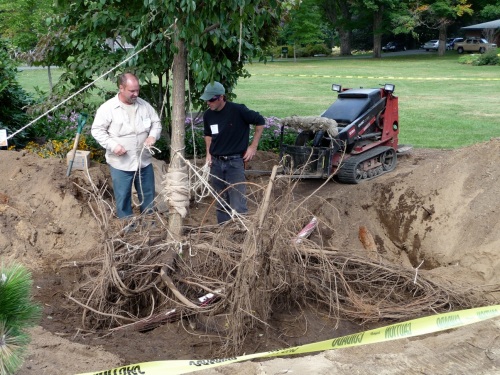
Mike Furgal and his assistant planning their course of action.  Note the tagline leading out from the canopy; it will be used to stabilize the tree during the move and backfill operation.
Mike Furgal and his assistant planning their course of action. Note the tagline leading out from the canopy; it will be used to stabilize the tree during the move and backfill operation.

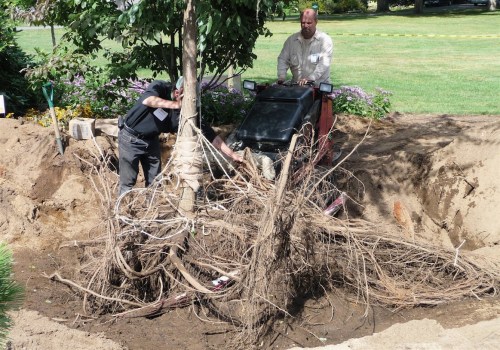
Mike directs the Dingo forks under the root plate while his assistant holds the trunk stable.  Note the heavy burlap padding both on the Dingo and on the tree trunk.

Mike directs the Dingo forks under the root plate while his assistant holds the trunk stable. Note the heavy burlap padding both on the Dingo and on the tree trunk.
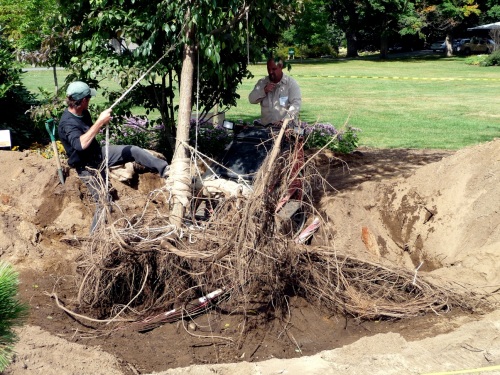
Lifting the tree.  Trunk padding rests on Dingo padding; tagline helps the trunk and canopy remain steady.

Lifting the tree. Trunk padding rests on Dingo padding; tagline helps the trunk and canopy remain steady.

Beginning to move the tree requires that it sit firmly on the forks, and remain balanced through the move.
Beginning to move the tree requires that it sit firmly on the forks, and remain balanced through the move.

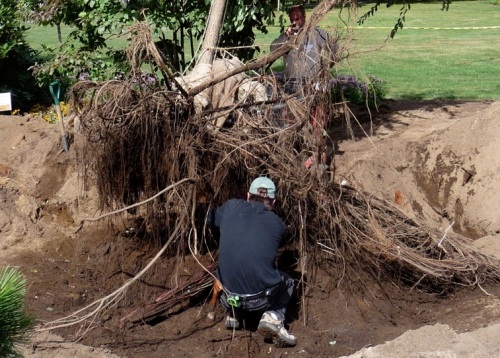
Cutting the last few anchored roots, and any roots broken in the process.  Loppers work best; be sure they are sharp enough to make clean cuts (a set of root-pruning tools is useful, as cutting dirty roots with top-growth tools will ruin their blades quickly).
Cutting the last few anchored roots, and any roots broken in the process. Loppers work best; be sure they are sharp enough to make clean cuts (a set of root-pruning tools is useful, as cutting dirty roots with top-growth tools will ruin their blades quickly).

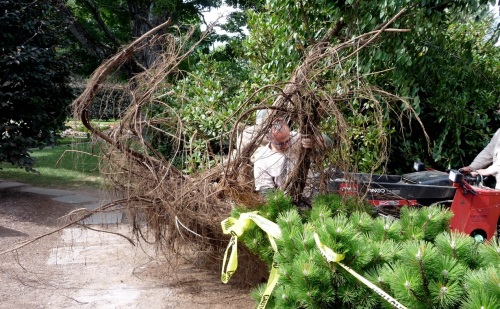
Moving the elm up its soil ramp and out of its plant bed; an attending arborist jumps in to help the roots past this thriving pine.
Moving the elm up its soil ramp and out of its plant bed; an attending arborist jumps in to help the roots past this thriving pine.

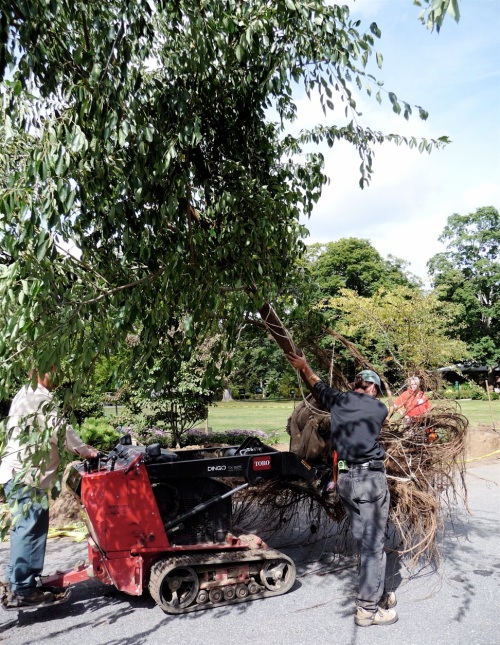
Elm tree on the move.  Stabilizing the trunk and moving slowly keeps the job safe.
Elm tree on the move. Stabilizing the trunk and moving slowly keeps the job safe.

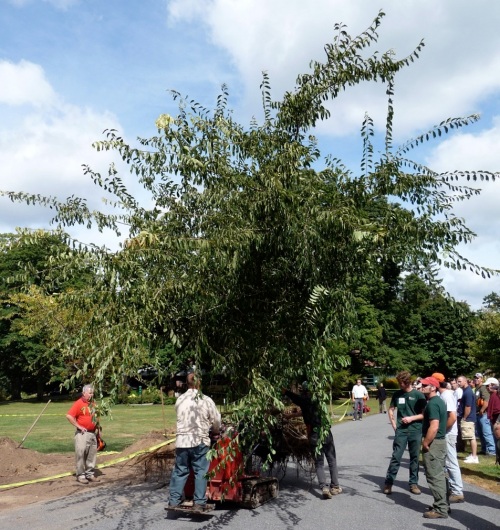
Big canopy.  This year's growing season was moist and fairly cool, leading to lots of topgrowth and long twig extension.
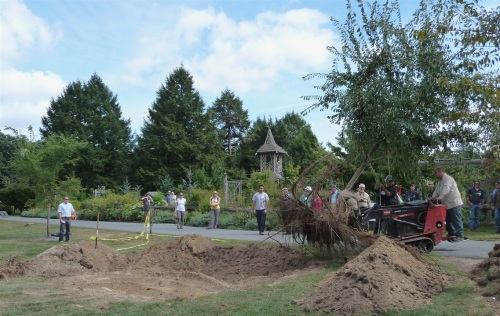
Big canopy. This year's growing season was moist and fairly cool, leading to lots of topgrowth and long twig extension.

Mike steers the Dingo to the crater he has dug.  It is relatively shallow, to match the elm root mass depth, and wide (though not wide enough at first -- a couple of trenches had to be dug beyond the crater at the last minute to some extra-long roots).
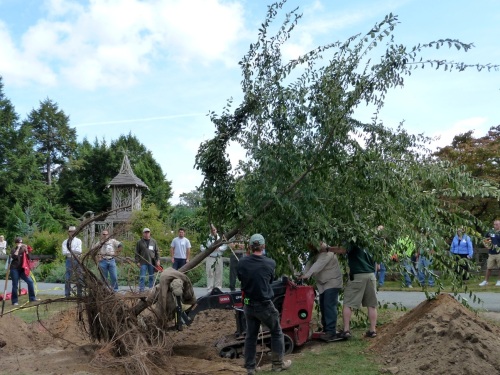
Mike steers the Dingo to the crater he has dug. It is relatively shallow, to match the elm root mass depth, and wide (though not wide enough at first -- a couple of trenches had to be dug beyond the crater at the last minute to some extra-long roots).

Lowering the elm into its crater.
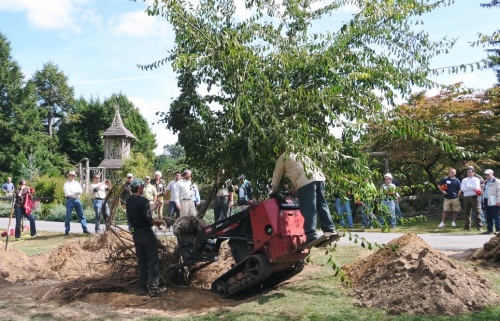
Lowering the elm into its crater.

Whoa!  A moment of excitement, when tree weight and crater's-edge sloped combined to tip the Dingo on its tracks.

Whoa! A moment of excitement, when tree weight and crater's-edge slope combined to tip the Dingo on its tracks.
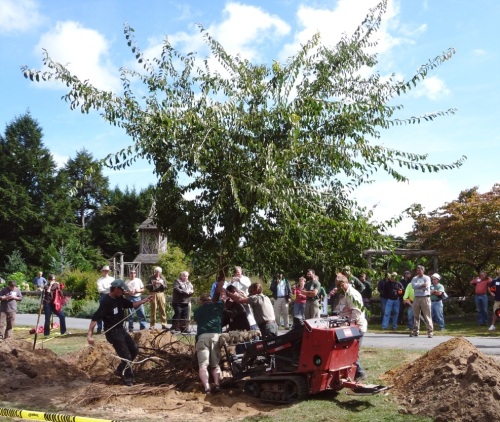
The Iwo Jima shot.  A team of volunteers ran in to right the tree.
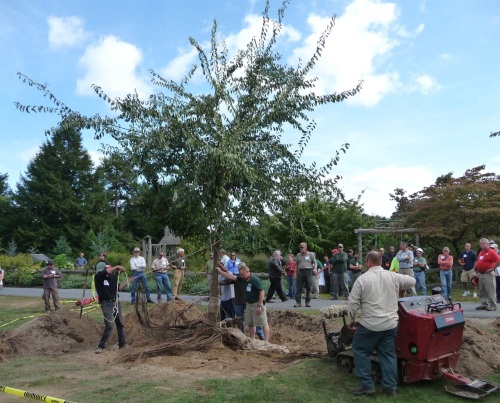
The Iwo Jima shot. A team of volunteers ran in to right the tree.

Holding the tree upright once the Dingo forks have been pulled out.
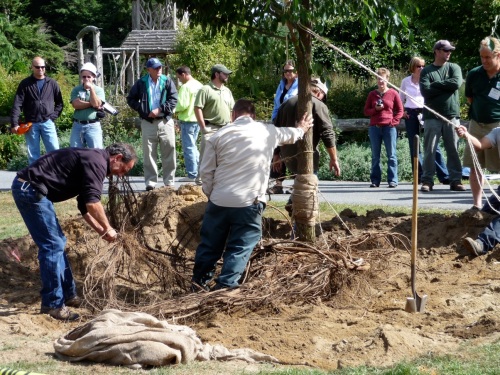
Holding the tree upright once the Dingo forks have been pulled out.

Again, holding the tree upright.  The pigtails now get cut open and roots spread out radially from the trunk.

Again, holding the tree upright. The pigtails now get cut open and roots spread out radially from the trunk.
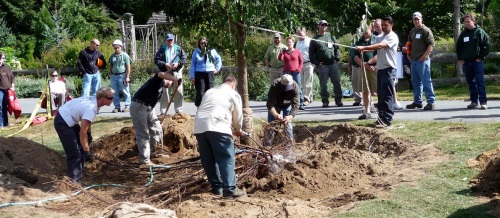
Freeing the roots, beginning to dig in backfill, and watering to make a soil slurry that will eliminate air pockets and help anchor the spread-out root plate.
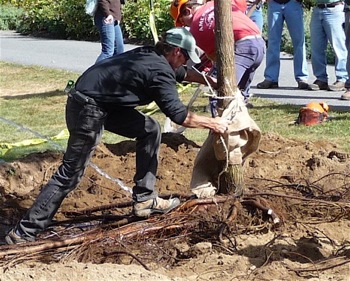
Freeing the roots, beginning to dig in backfill, and watering to make a soil slurry that will eliminate air pockets and help anchor the spread-out root plate.

With the tree in its new location, burlap padding the trunk may be removed.
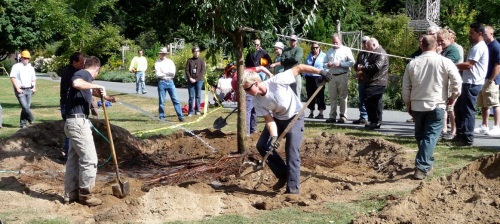
With the tree in its new location, burlap padding the trunk may be removed.

Digging in the root mass.  It's important to pack the soil directly under the tree's trunk, to eliminate air holes and ensure against settling of the tree lower in its hole over time.
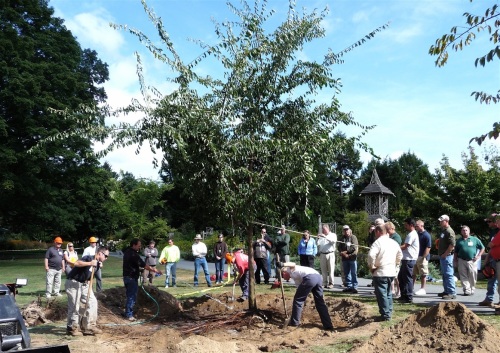
Digging in the root mass. It's important to pack the soil directly under the tree's trunk, to eliminate air holes and ensure against settling of the tree lower in its hole over time.

Big canopy on this tree, with a root mass to match.
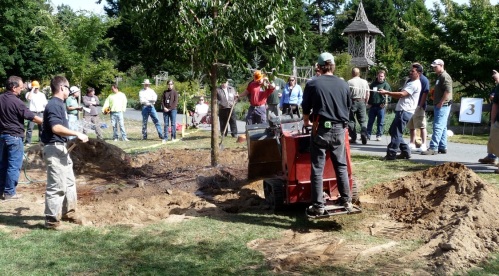
Big canopy on this tree, with a root mass to match.

A bucket on the Dingo shakes backfill -- the native soil onsite in this case -- into the crater as workers wield shovels and a hose.
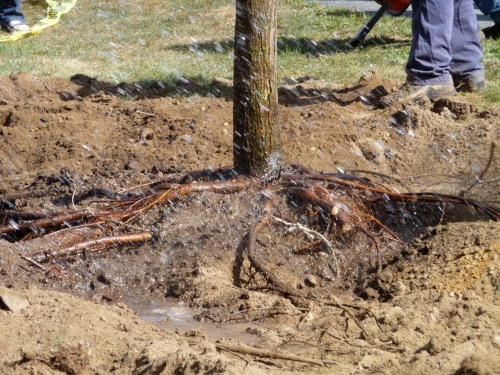
A bucket on the Dingo shakes backfill -- the native soil onsite in this case -- into the crater as workers wield shovels and a hose.

Trunk flare, placed in the proper relationship to finish grade.  Note the cut root ends; clean cuts with sharp tools let the wounds heal quickly.

Trunk flare, placed in the proper relationship to finish grade. Note the cut root ends; clean cuts with sharp tools let the wounds heal quickly.
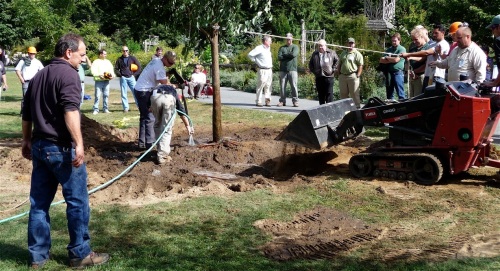
More backfill, more water, and someone still holds the tagline for safety.  The Dingo never drives over the root mass, but drops soil onto it from outside.

More backfill, more water, and someone still holds the tagline for safety. The Dingo never drives over the root mass, but drops soil onto it from outside the planting hole.
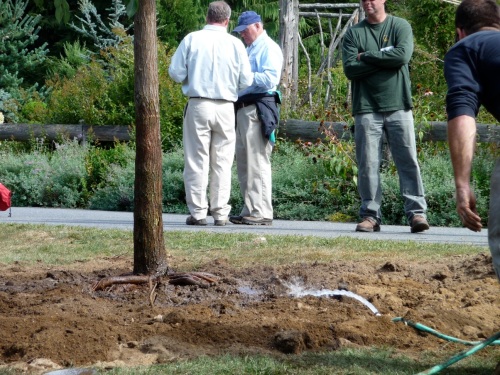
Still more water, as the backfilling continues.
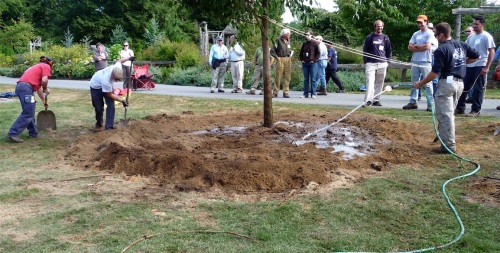
Still more water, as the backfilling continues.

Building the well wall, as water continues to flow.
Building the well wall, as water continues to flow.

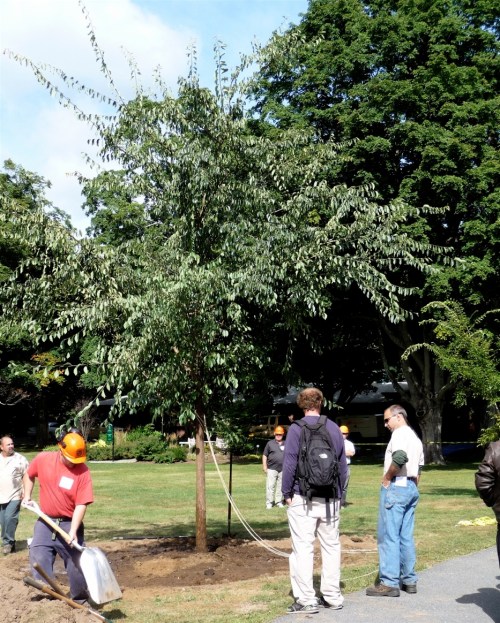
Six-inch caliper elm tree in its new location.  Some wilt is evident -- likely because the tree was excavated the day before and the roots had been exposed through the course of the several-hours long workshop.

Six-inch caliper elm tree in its new location. Some wilt is evident -- likely because the tree was excavated the day before and the roots had been exposed through the course of the several-hours long workshop. The tagline finally lies slack. Two to four inches of mulch will next be added, and kept away from the trunk.

Demonstrating arborist at this station:

Mike Furgal, Furgal’s Tree and Landscape, Northborough, MA

Air spade tree transplanting
Dave Leonard from Lexington, KY, manned the root forensics station at the September 10 MAA air-tool workshop at Elm Bank.  He used an Air Knife to excavate the root ball of a 4″ caliper red maple that was showing signs of decline.

Turf provided the only competition for this tree, but it was showing dieback and early fall color at the MAA workshop.

Turf provided the only competition for this tree, but it was showing dieback and early fall color at the MAA workshop. Dave Leonard excavated at its base to take a look at its rooting habit for possible problems.

With soil blown away from the original root ball, it was clear that the tree’s planting had initiated some problems — parts of the wire basket appeared at the edges of the root ball, and cut root ends had sent out an explosion of fibrous roots that turned back toward the trunk.

Root ends cut during the tree's digging in the nursery sent out masses of fibrous roots, quite a few of which turned back toward the trunk.  The interface between root ball soil and surrounding soil can inhibit root growth into the surrounding soil; removing burlap, removing the wire basket, and breaking up the root ball soil, particularly at the ball's perimeter, can help promote the spread of new roots.

Root ends cut during the tree's digging in the nursery sent out masses of fibrous roots, quite a few of which turned back toward the trunk. The interface between root ball soil and surrounding soil can inhibit root growth into the surrounding soil; removing burlap, removing the wire basket, and breaking up the root ball soil, particularly at the ball's perimeter, can help promote the spread of new roots. Note the soil line some inches up the trunk flare; removing soil above the trunk flare will also benefit the tree and lessen its stress.

Dave cut away the roots that he could not redirect outward, and trimmed off the roots that had begun to circle the trunk flare’s base, which would otherwise eventually girdle the trunk and major anchor roots.  Some of these roots were the beginnings of a secondary root system put out by the tree in response to its stress.

Removing the worst of the inward-growing and circling roots improves the tree's chances for survival.

Removing the worst of the inward-growing and circling roots improves the tree's chances for survival.

After excavating the root ball, Dave intended to continue to blow soil out away from the root ball, creating a shallow crater  out at least to the tree’s dripline.  Removing turf from that zone would eliminate plant competition for soil moisture; the addition of 2-4″ of mulch (kept away from the trunk) would help the soil retain moisture and an even temperature, add organics to it over time, and lessen the chance of soil compaction that inhibits soil/air gas exchange.

Dave said that he would also consider lifting the tree a few inches, to bring its trunk flare into a better relationship with surrounding grade.  This tree had been in the ground for a couple of years; Dave suggested that tree lifting might be worth doing within two to four years of planting, but could be detrimental to the tree after that.  (The window of opportunity for lifting a tree would be a lot wider if an air tool were used, rather than a Bobcat or excavator, as the tree could be bare-rooted and set back in place with relatively little stress from the process.)

Demonstrating arborist at this station:

Dave Leonard, Dave Leonard Consulting Arborist, Inc., Lexington, KY

At the MAA Elm Bank workshop on September 10, 2009, Matt Foti demonstrated how to address root problems at the time of planting.  He had a fairly large collection of trunk-and-root masses to illustrate his points, and used them to show how girdling roots, secondary root systems, and J-rooted systems can develop as a result of poor planting or growing practices.

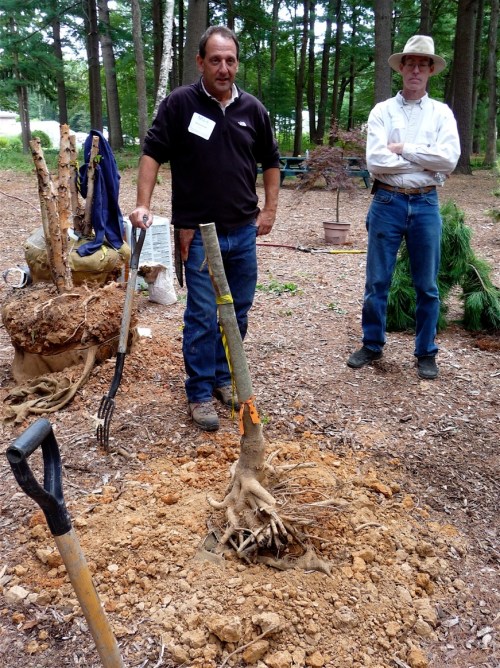
Matt first showed a couple of forest saplings he had pulled early in the day to illustrate how a naturally-seeded tree’s roots grow.  The sapling’s roots were evenly spaced around its stem, and extended out a distance relatively equivalent to the distance its topgrowth extended from the stem.

This little forest-grown white pine has a clean, evenly spaced root system.

This little forest-grown white pine has a clean, evenly spaced root system.

He then pointed to a couple of nursery-grown trees whose rooting problems had become evident after several years.

These root systems have been cut in the digging process.  In an attempt to regrow roots, the foreground tree has sent out a secondary root system, several of which are beginning to girdle other roots.  Kept too long in a burlapped ball or in a container, roots will often turn back in to the ball, making effective planting and long-term growth problematic.

These root systems have been cut in the digging process. In an attempt to regrow roots, the foreground tree has sent out a secondary root system, several of which are beginning to girdle other roots. Kept too long in a burlapped ball or in a container, roots will often turn back in to the ball, making effective planting and long-term growth problematic.

Shrubs as well as trees are susceptible to root problems; Matt dismantled an Ilex verticillata root mass to illustrate how he treats roots bound in a container or in burlap before planting.

Fibrous roots hold together in a near solid mass right out of the container.

Fibrous roots hold together in a near solid mass right out of the container.

Using a three-pronged fork to untangle the root mass.  For a bigger shrub or small tree, a machete or pitchfork may work well to loosen soil and reorient roots.

Using a three-pronged fork to untangle the root mass. For a bigger shrub or small tree, a machete or pitchfork may work well to loosen soil and reorient roots.

Ilex verticillata root mass, now ready for planting.

Ilex verticillata root mass, now ready for planting.

Soil can present another problem for nursery-dug B&B trees.  Clay soils make sturdy root balls, which can be useful for shipping, but not so great for root growth.

This pair of trees have root masses encased in rock-hard clay soils.  Note the solid clumps of clay in the foreground, and root growth only on top of the root ball -- these roots found it impossible to grow into and through this soil.  Breaking up the soil in a root ball like this before planting promotes the tree's future health; leaving this kind of root ball intact almost guarantees tree stress and decline.

This pair of trees have root masses encased in rock-hard clay soils. Note the solid clumps of clay in the foreground, and root growth only on top of the root ball -- these roots found it impossible to grow into and through this soil. Breaking up the soil in a root ball like this before planting promotes the tree's future health; leaving this kind of root ball intact almost guarantees tree stress and decline.

Closeup of rock-hard clay root ball, broken apart (fairly violently) for demonstration purposes.

Closeup of rock-hard clay root ball, broken apart (fairly violently) for demonstration purposes.

Another example of a dense clay root ball that constricted root growth to the tree's great detriment.  Soil had also been piled up around this tree's trunk flare, further challenging its ability to live.  Tough conditions for a tree to grow in.

Another example of a dense clay root ball that constricted root growth to the tree's great detriment. Soil had also been piled up around this tree's trunk flare, further challenging its ability to live. Tough conditions for a tree to grow in...

The point of these illustrations was to show how necessary it is, when planting a tree or shrub, to work with the root ball before covering it with soil.  Removing wire baskets, removing burlap, loosening or removing the soil, untangling roots as best as possible, pruning roots when necessary — all these tactics make up a strategy for promoting real tree growth.  Bare-root techniques have shown that a great deal of the work that arborists do these days is remedial — that is, is work intended to remedy poor growing, digging, or planting practices.  With the knowledge arborists now have of how root issues so obviously affect plant health, it only makes sense to attend to those issues early on, to avoid greater problems later.

Demonstrating arborist at this station:

Matt Foti, Matthew R. Foti Landscape and Tree Service, Inc., Lexington, MA

Tree Specialists manned the decompaction station at the MAA workshop on September 10, 2009.  Standing between two mature sugar maple trees, Rolf Briggs used a compaction meter (from Forestry Suppliers, Inc.) to show how thoroughly compacted the soil around these trees was (very).

Again, the arborists set up barriers to limit the area affected by blown-out soil and pebbles.  Rolf Briggs (right foreground) showed how to use a compaction meter, and explained that the green flags delineate the area to be decompacted.  Flagging the area for review by the client makes the limit of work clear to all parties.

Again, the arborists set up barriers to limit the area affected by blown-out soil and pebbles. Rolf Briggs (right foreground) showed how to use a compaction meter, and explained that the green flags delineate the area to be decompacted. Flagging the area for review by the client makes the limit of work clear to all parties.

Compaction limits the movement of moisture and of gases (oxygen included) in soils, and so can create significant problems for trees.  Trees rely on water being available to their roots, and on the ready intake of oxygen (from the air and from water molecules) for carbon dioxide discharged by those roots.  Compacted soils tend not to allow oxygen in in sufficient quantities, nor allow the steady release of carbon dioxide that a tree needs.  Breaking up the compaction, adding organic amendments to improve soil structure, and replacing lawn areas around trees with mulch beds are steps that benefit soil health, and as a result, tree health.

Decompacting soil around two sugar maple trees.  One man operates the air tool, blowing vertical trenches and mixing their backfill with a proprietary organic soil amendment that mimics forest duff.  The other operator mans the air hose, and tugs on it to signal to the operator.  Air tools are loud!.  Green flags indicate limits of the decompaction zone.

Decompacting soil around two sugar maple trees. One man operates the air tool, blowing vertical trenches and mixing their backfill with a proprietary organic soil amendment that mimics forest duff. The other operator mans the air hose, and tugs on it to signal to the operator. Air tools are loud!. Green flags indicate limits of the decompaction zone.

Tree Specialists prewaters the work area 24-48 hours before starting on a decompaction project, to hydrate the roots and help keep dust down.  As they proceed with the process, they begin to ‘fold in’ amendments.

For further information on decompaction, Briggs recommended an article in the current issue (September 2009) of Tree Care Industry Magazine on soil decompaction and amendment.

Demonstrating arborists at this station:

Tree Specialists, Inc.,  Holliston, MA

The Massachusetts Arborists Association workshop on September 10, 2009, took place on a sunny, cool day at the Mass. Hort. Society’s headquarters at Elm Bank in Wellesley, MA.

Quite a few arborists and other landscape professionals attended the workshop, which began with slide talks and then moved outside to field demonstrations.

Quite a few arborists and other landscape professionals attended the workshop, which began with slide talks and then moved outside to field demonstrations.

This workshop focused on root issues, with demonstrations of what some of those issues are — conflicts with utility lines, the effects of poor growing and planting practices, decline due to compacted and poor soils, and inappropriate tree locations — and how they may be remedied.

Rolf Briggs and Tree Specialists set up shop at a couple of different stations to show how they use air tools both to decompact soils and to excavate utility trenches near trees.  The demonstrating arborists first discussed protective equipment, and showed what  they use when they employ air tools:  We watched as they put on respirators, helmets with face masks, ear protection, gloves, and either foul weather gear or jumpsuits — all necessary to protect from the great quantities of dust, soil, and stones blowing into the air.

To protect the surrounding area from flying detritus, Mike Hickman of Tree Specialists set up plywood or screen barriers around his work zone.  I’ve seen plain plywood sheets used; the Tree Specialist guys have figured out that hinging several sheets together makes for a sturdier barrier, a good thing if you’re using air tools with any regularity in anything but a wide-open landscape.

Hinged plywood panels keep the dust contained to the area around a trench.

Hinged plywood panels keep the dust contained to the area around a trench.

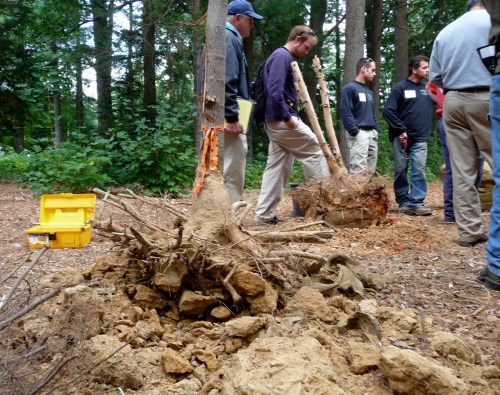
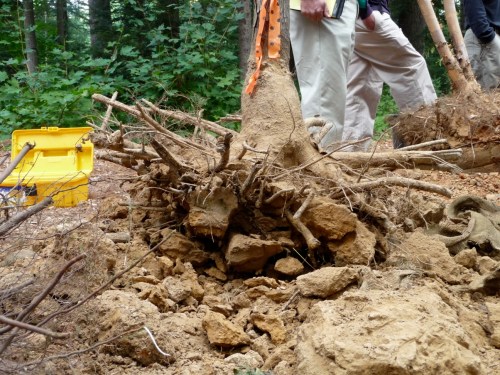
When it's necessary to dig a trench near a tree, air tools can do the job while preserving the tree's roots.  You can see roots crossing this trench, but plenty of space beneath them for a new conduit or line.  This trench was blown out with an air spade, and rocks and excess loose material after the blowing-out removed by hand.

When it's necessary to dig a trench near a tree, air tools can do the job while preserving the tree's roots. You can see roots crossing this trench, but plenty of space beneath them for a new conduit or line. This trench was blown out with an air spade, and rocks and excess loose material after the blowing-out removed by hand.

The power of compressed air will break up soil move it out of the way; it can also damage roots to some extent, by blowing root bark or feeder roots entirely away.  When using an air tool, experienced operators keep the nozzle moving to limit this kind of damage, and whenever possible (definitely not always possible in trenching work), they direct the air flow parallel to the direction of major root growth, away from the base of the tree.

Note the plywood barrier inside the trench as well, to focus the air blast and prevent soil from blowing into a previously blown-out section.

Note the plywood barrier inside the trench as well, to focus the air blast and prevent soil from blowing into a previously blown-out section.

Blowing out the trench.  This air tool is a new product that uses an auxiliary stream of water to help keep the roots hydrated and the dust down.  Tree Specialists is assessing this new feature.

Blowing out the trench. This air tool is a new product that uses an auxiliary stream of water to help keep the roots hydrated and the dust down. Tree Specialists is assessing this new feature.

After blowing out a utility trench, Tree Specialists simply returns the native soil to the excavated area.  They may add some amendments such as lime or humates, if they have already had soil tests done that indicate the need for such amendments.  And to mulch the area once excavation and backfilling are complete, they have developed a proprietary mix of chipped and composted wood fibers (mainly from tree parts 3″ and less in diameter), twigs, and leaves.  They use this same mix in their soil decompaction process, and note benefits to the trees from its use.

Mike Hickman pointed out that air tools break down soil aggregates and so obliterate soil structure in the area blown out.  This breakdown can be considered a disadvantage of using compressed air for excavation; in Mike’s words, “Destruction of some of the soil aggregates I see as a “con,” but proper horticultural practices such as mulching and site specific amendments effectively mitigate these cons.”

Demonstrating arborist at this station:

Mike Hickman, Tree Specialists, Inc., Holliston, MA

MAA Elm Bank workshop

Yesterday the Massachusetts Arborists Association held a day-long workshop at Elm Bank, headquarters for the Massachusetts Horticulture Society in Wellesley, MA.  Three arborists — Dave Leonard from Kentucky, Rolf Briggs of Holliston, MA, and Matt Foti of Lexington, MA — spoke about particular  root issues; Mike Furgal, from Northborough, MA, discussed the use of air tools in bare-root tree transplanting.  After hearing the talks, the hundred or so attendees split into groups and visited five stations on the Elm Bank grounds where the featured speakers were giving demonstrations on their topics.

It was a fine workshop, and I’ll be posting quite a few photos from it in the next few days.  Today, though, I’m only posting this photo:

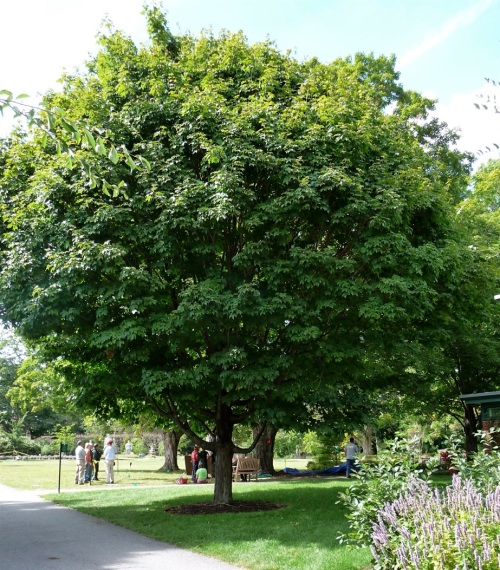
Sugar maple whose root flare was excavated several years ago at a Bartlett Tree workshop given to demonstrate the new and revolutionary use of air tools in tree work.

Sugar maple whose trunk flare was excavated several years ago at a Bartlett Tree workshop given to demonstrate the new and revolutionary use of air tools in tree work.

Several years ago, I went with a friend to this Bartlett Tree workshop at Elm Bank, and we were among a smallish group who watched as an arborist blew several inches of soil away from the trunk flare of this Sugar Maple.  As I recall, the tree had been planted a bit deep, it was set in a fairly compacted lawn, and it was not looking as well as it might; at the time (this was perhaps seven or eight, or perhaps even ten years ago) it had about a six-inch caliper trunk and was not thriving.

Now, however, the tree looks really good.  It may have a little too much mulch around its base — built up since its excavation — but its foliage is deep green, its bark is intact (trunk injuries sometimes show up as a result of some kind of root trauma or injury), and it certainly has grown.  A mulch bed surrounds it and keeps lawnmowers away as it minimizes compaction.  If this kind of growth results from attending to root issues early on and from maintaining a tree properly, the arborists from this workshop may prove, down the road, to be responsible for promoting what truly may be the best arboricultural practices around.

Workshop speakers:

Dave Leonard, Dave Leonard Consulting Arborist, Inc., Lexington, KY

Rolf Briggs, Tree Specialists, Inc., Holliston, MA

Mike Furgal, Furgal’s Tree and Landscape, Northborough, MA

Matt Foti, Matthew R. Foti Landscape and Tree Service, Inc., Lexington, MA

Crowding the bed

Harvard University has recently been building on Memorial Drive, along the Charles River. The site that had held a garden center (most recently, Mahoney’s, and before that, the Grower’s Market, where I sold Christmas trees one year) is now becoming a park and a graduate student dormitory. The dorm is done; the park (originally slated for a Renzo Piano museum building) is still apparently in construction.

The other day I was strolling past the parcels, and had to stop to look at a planting buffering one of the dorm’s corners. It was so rich-looking, so dense and lush, and yet it stood only a few feet high. Fantastic! What was it?

Two feet high, with thick foliage making a bumper at the building's base.

Three feet high, with thick foliage making a bumper at the building's base.

I leaned in to take a look, and discovered that it was a mass of Fothergilla, a shrub related to Hamamelis, or Witch Hazel.  (I thought at first that it was Hamamelis, wrote and posted an entire blog post on it, and then realized a few days later that I’d been mistaken.  So consider this post a corrective to the other one, which I’ve now taken down.)

I figure that these are Fothergilla gardenii, or Dwarf Fothergilla, given their spacing and configuration.  The plants in this mass are set on 18-24″ centers.  That’s quite close even for a dwarf plant that’s recorded to grow to between three and six feet in height.

Spacing between 18 and 24 inches on center.

Spacing between 18 and 24 inches on center.

We have discussed plant spacing issues in TakingPlace, and have talked about the differing (and equally viable) strategies of planting close versus planting to make each plant a specimen. The jostling that plants do with each other when planted close can make for an interesting and complex arrangement.

Fothergilla gardenii is a suckering shrub that tends to form thickets; perhaps the landscape architect was aiming for a full-thicket look right from the start.  It’ll be interesting to see how the planting grows, and what forms the plants can negotiate in this circumstance (will they be able to sucker where light appears not to reach the ground inside the mass?).

Michael Van Valkenburgh, landscape architect of record for this Harvard site, is known for using close plantings in his projects, and he’s generally pretty horticulturally astute. This planting represents an interesting experiment, one worth revisiting over time to see how it progresses.