Feeds:
Posts
Comments

Word is in:  the rough cut of the London Plane transplant video I’ve been working on will be showing at the Foti Tree and Landscaping booth at New England Grows tomorrow, Thursday, and Friday.  If you want to take a look at how these guys moved five very large (12-14″ caliper, 30′ high) London Plane trees bare-root last summer, stop by the booth, which is #2850 on the expo floor.  The process astonishing.  The sight of a fully leafed-out mature tree, in all its bare-root glory, travelling across a construction site fully upright on the forks of a front-end loader is amazing.

Bring your own popcorn; the video runs about 29 minutes long.

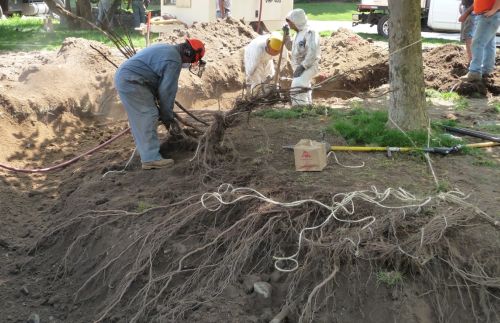
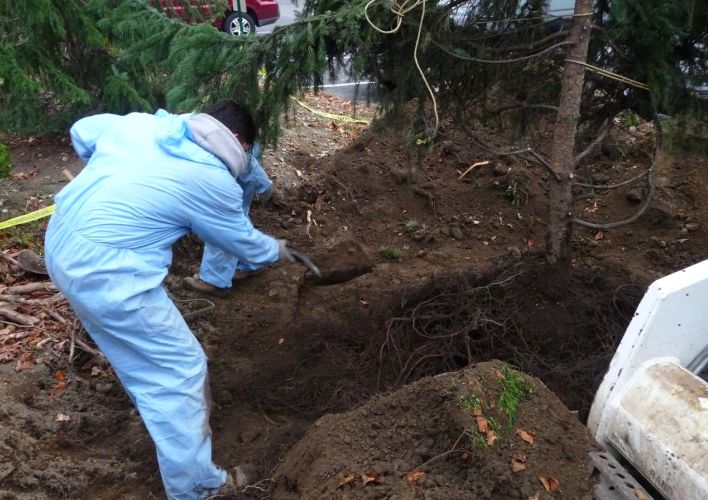
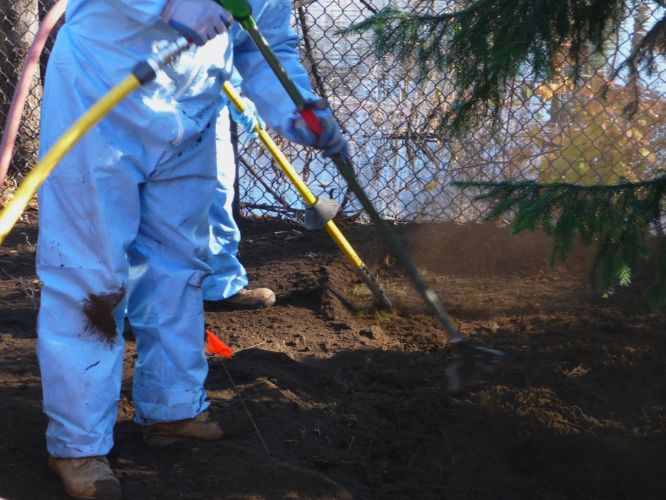
Blowing soil out from the first London Plane root mass, prior to moving.

This set of images popped up on my Google Reader today, and I just have to share them.  Click on the highlighted link to Vulgare, a blog on landscape issues, and take a look at the remarkable Chapel Oak in France.

Then take a look at Leaves from the Notebook of a Tamed Optimist,, to see images of other tree-chapels.

Finally, here’s a more rustic, but still graceful example:

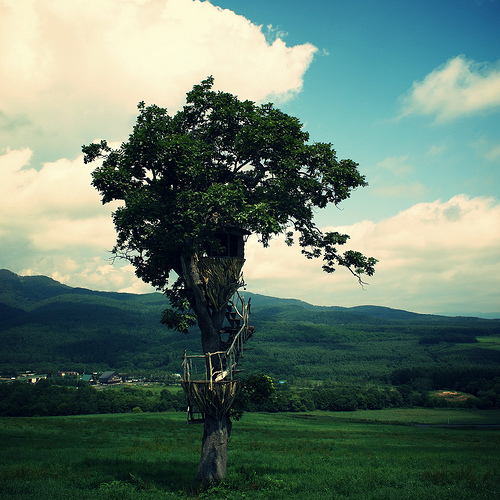
Flickr image by dagochan*55

In memoriam

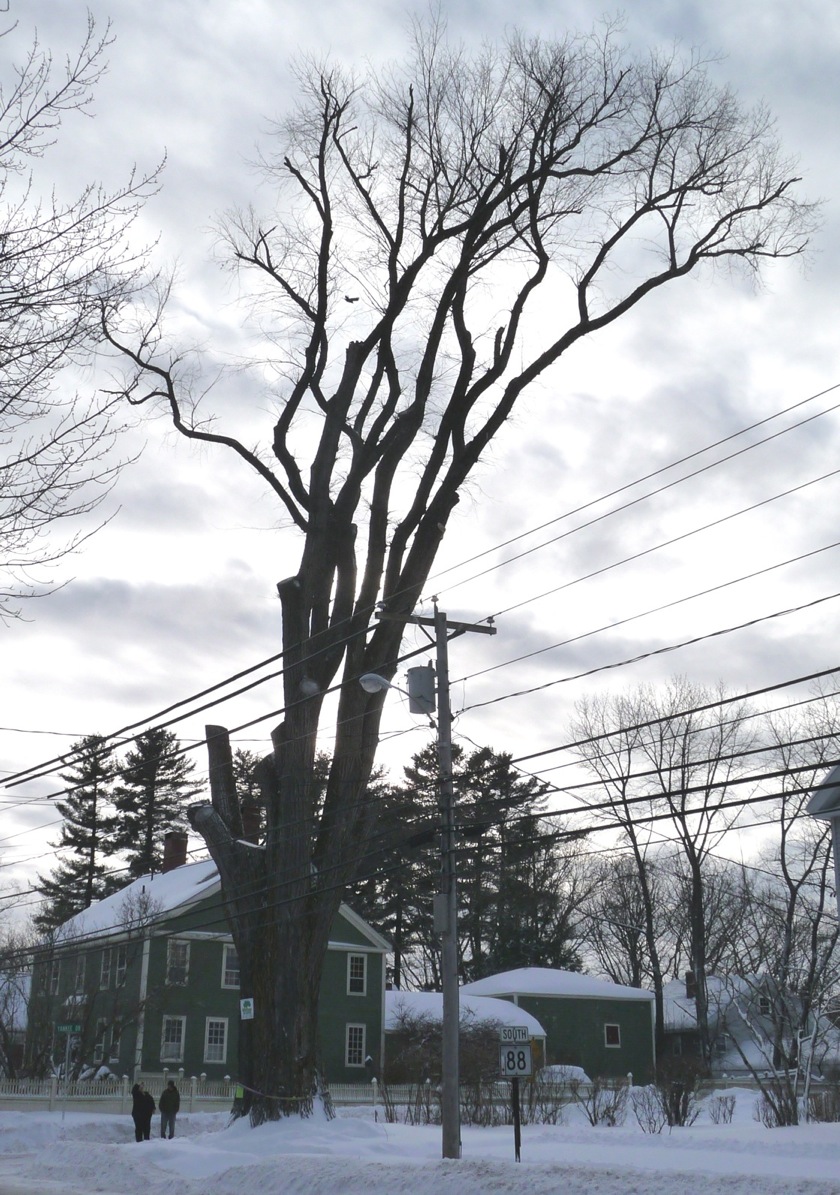
I was in Maine last week, and planned to stop in Yarmouth on Monday to watch the removal of Herbie, the champion American Elm (Ulmus americana) that had finally become too compromised to stay standing.

For several months,  stories about Herbie and his long-time steward, Yarmouth tree warden Frank Knight (at 101 years old, he is now retired) had been appearing in the news — Knight had cared for Herbie for over 50 years, and had treated the elm in repeated battles with Dutch Elm Disease.  He had succeeded for decades, but in recent years the disease and old age had been catching up, infecting whole limbs and making it necessary to remove large chunks of the tree’s crown.  Last summer, the town’s current tree warden, Debra Hopkins, determined that Herbie should come down, and Knight concurred.   The date of removal was set for January 18.

There were reports that arborists and Herbie-fans from around New England would show up to watch the proceedings.  As I would be driving past Yarmouth that day, I decided to join them.  Work was slated to begin at 7:30 a.m.

Fortunately or not, a heavy snowstorm started on Sunday night, and when I awoke at 5 on Monday morning several inches had already fallen, with no end in sight.   A couple of tasks delayed my departure by several hours, and as it seemed unlikely that the work would proceed that day anyway, I didn’t arrive in Yarmouth until about 2:30 p.m.  Herbie still stood.  As I drove up, several people were snapping photos of the tree; more showed up when they left, and still more arrived as I was leaving.  Lots of people wanted to get a last look at this giant.

Herbie the American Elm, on the day scheduled for his removal.

Herbie was massive — in his prime, he stood 110′ tall, with a crown spread of 120′ and a girth of 20′.  Disease and age had diminished him, and it was clear that this was a tree under serious stress, but it was impossible to stand next to or near him without feeling awe.

To get a sense of the tree's scale, note the people standing to the left of Herbie.

Someone had tied a red, white, and blue ribbon around the tree, and people had attached cards and well wishes and information on this champion to it.

The placard in the middle is an 8.5" x 11" sheet of paper, with facts on Herbie's size and life.

The tree had quite a lot of evidently viable growth in the canopy, but the canopy itself had been hugely compromised, with several very large limbs removed.  I remember hearing Alex Shigo talk about how and when to make the decision to remove a tree; he spoke eloquently about the native dignity of trees, and about how at some point the act of removal shows more respect for the tree than leaving it in place.

There comes a point in a tree's life where removal of this much of its crown is a removal of dignity, as well. Though the tree's trunk appeared to be sound, and the limb removals had eliminated hazard wood, Herbie's time had come.

For about 15 minutes, I ran around in the cold photographing Herbie from different angles.  As I did, I saw carloads of people arrive, jump out, snap photos of themselves with the tree, put a hand out to feel its bark, and then gaze up at it reverently before they left.  And then I went over, put my hand on the craggy, lichen-speckled bark, and also said a silent goodbye.

Herbie in his heyday. This was a classic American elm.

Herbie was taken down the following day, with Frank Knight in attendance.  To see removal photos and videos, as well as how the wood from this elm will be used, click on this link.

I just got a rough cut today of the video, shot last summer, of the moving of a very large (about 14″ caliper, 30′ height) London Plane Tree.  It’s taken a while to edit several hours of footage down to a half an hour, but it’s about done, and in the next few weeks I hope to have added commentary.  This video is from the project run by Matt Foti’s crew, aided by Mike Furgal, and it showcases the techniques used in air-tool transplanting.  I hope to be able to preview the rough cut at New England Grows, and have the final version completed by the end of February; if there’s enough interest in the arborist community I’ll sell copies.  Stay tuned.

The first of five 12-14' caliper London Plane trees being excavated with air tools and transplanted bare root in August 2009.

The Massachusetts Arborists Association has a new volunteer initiative starting in 2010.  They aim to build on the traditional Arbor Day celebration by instituting a statewide volunteer service day on that day, which falls on April 30, 2010.

To get the ball rolling, the MAA is inviting anyone to identify potential tree care projects in their own communities, and then to post those project ideas on the Arbor Day link at www.MassArbor.org.  They hope to get ideas from all 351 Massachusetts cities and towns by January 15.  From that list, MAA members and member companies will choose projects for their own Arbor Day of Service volunteer effort.

This is a great way for professional arborists to make a contribution to the civic good, and for cities and towns to reap the benefits of a concerted professional effort.  Safety pruning, tree planting, hazard tree removal, ornamental pruning — a community you drive through daily may have the project that’s perfect for your company to tackle on Arbor Day.  To submit a project for Arbor Day of Service consideration by the MAA arborists, visit http://www.MassArbor.org by January 15, and click on Arbor Day.

Help younger generations grow up with the Arbor Day of Service.

Winter moth heads up

Hartney Greymont of Needham, MA has the most effective reminder this year to schedule winter moth treatments.  In November they sent out color postcards showing a single winter moth, about 6 times life-sized.  On the back the cards explain that the brown moths visible in November are parents of the caterpillars that will feed on trees in spring.

Hartney has hit upon a great way to connect a very visible autumn phenomenon with a very visible spring phenomenon, wrapping up a bit of client education with a pitch to schedule spring treatments early.  Nice.

Winter moth, taken from Flickr

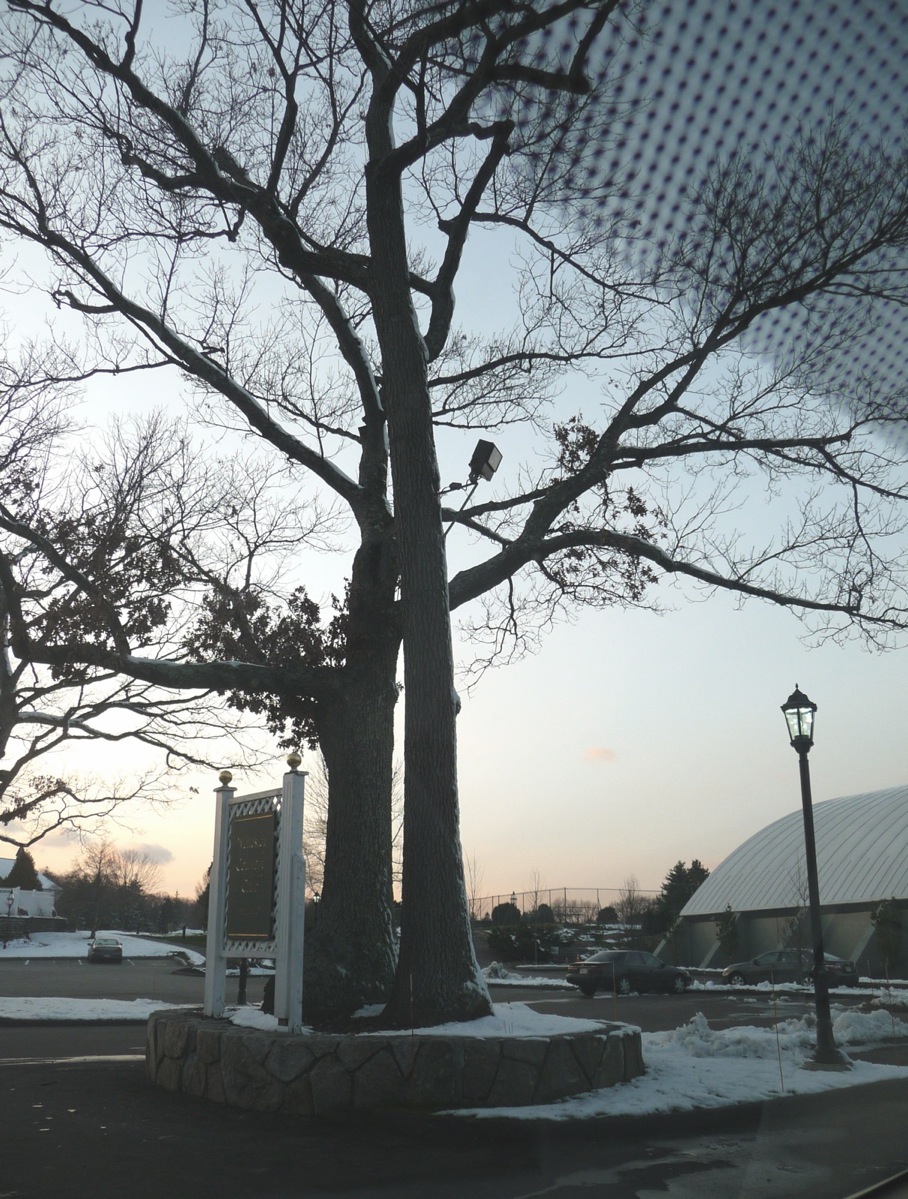
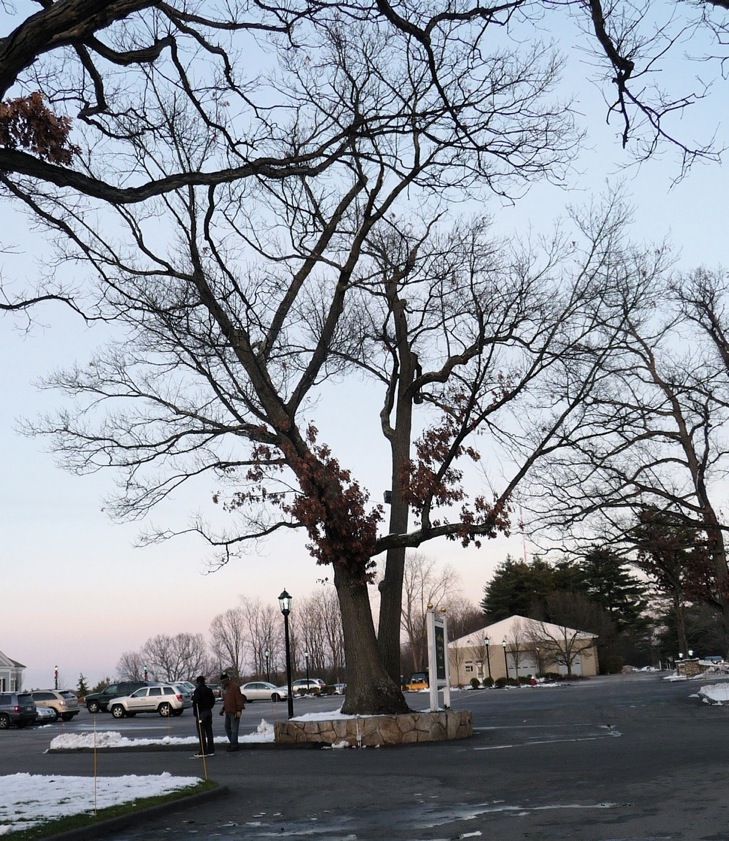
Say you’re a growing country club in a nicely-treed community, and you need to enlarge your parking lot. And perhaps you want to lower its grade. The lot has some mature oak trees in it, and they add a certain je ne sais quoi to the scene, so you decide to save the trees by keeping the grade as is around the base of their trunks. You retain the roots and soil with a mortared stone wall. Voila!

Good idea – but woops! The minimum standard for root preservation is to keep 10 inches of root mass diameter per caliper inch of tree. For these trees, that would spell at least 360-inch diameter root masses. Because the trees are so close together, their roots overlap significantly — but still, 360 inches is thirty feet of diameter.

This 18-footish enclosure takes a tad too much root; the country club will almost certainly be watching these trees decline and die over the next few years (and they may well drop dead branches onto the parking lot, or cars in it, in the process).

The idea of saving a mature tree is a good one, as long as the tree’s actual requirements for continued healthy life are met.   Now that we have the tools to see how large a tree’s root mass really is, it’s much easier to see how big the unimpeded area around it has to be for the tree to survive happily and to thrive.

Last week I was lucky enough to see the loading, unloading, and half the planting of an 18″ caliper European beech tree.  The tree had been air-tool excavated, and was being moved over state highways to its new home at the residence of a former client of mine.  Here’s what the tree and its immense root mass looked like:

Giant root mass, 30 feet across, preserved by air excavation. Note the trunk's heavy padding, and pigtailing of the roots.

So that's what a beech's roots look like. This tree had been transplanted with a tree spade about 20 years ago, and it was possible to look under the root plate and see where severed roots had sprouted out.

The 30-foot high tree being lowered onto a specially rigged trailer for transport.

After the tree had been loaded onto the trailer, its roots were covered with burlap and sprayed down for the ride to its new home.

This post is just a teaser; next spring after the tree leafs out I’ll write a post on the  whole air-tool transplant operation, and give all the who’s, what’s, why’s, hows, wheres, and whens.  Stay tuned.

To continue yesterday’s post on the bare-root transplanting of a Norway spruce at the Perkins School for the Blind in Watertown, MA:

The crew uses a heavy canvas strap wrapped securely (more than once) around the trunk, and pads the Bobcat fork bracket. This tree's flat back meant it could be pulled securely up onto the forks without tying up branches; other trees would need to be tied up for easier spading and transport. Here, the forks are poised to push under the root ball, just below the wire basket.

Rolando prunes thin fibrous roots from under the basket, to release the root ball from the ground. Most of the root mass has already been blown out.

Spruce on the move. With almost all the soil blown off the root mass, it is light enough for the Bobcat to carry the tree easily across campus. Canvas straps secure the tree to the Bobcat; Rolando rides along just in case.

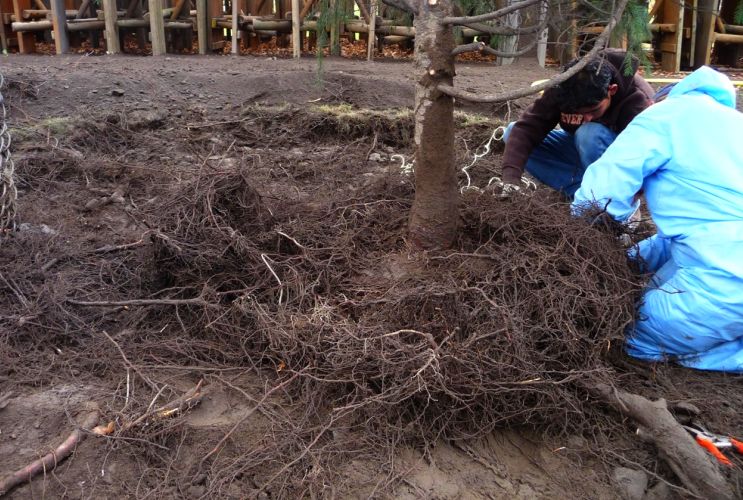
Closeup of the root mass. Virtually all of the roots on this tree were quite thin, and they made a dense mat that extended about nine feet out from the tree's trunk on several sides.

Mynor had dug out the hole with the Bobcat while Sonia and Rolando blew out the soil from around the tree. This site, next to a busy campus parking lot, challenged the crew to place the tree carefully. Cars were parked just to the right of the orange barrier in this photo, and other relocated trees ringed the dish on two other sides, so maneuvering to get the tree in place was a bit tricky. It's relatively easy to spin at least a small B&B tree to the right orientation; turning an air-spaded tree requires a bit more forethought. In this situation, a bit of three-dimensional visualization was necessary to be sure that the flat side faced away from the parking lot.

Sonia and Rolando used a rake handle and tape measure to determine the root mass's depth before adjusting soil depth in the new hole.

Additional native soil is added and compacted to make a pad under the trunk. When in doubt, it's better to place the tree slightly higher in its new location than to risk it settling deeper once it has been backfilled and watered in; tamping the soil firmly under and around the roots right at the tree's base helps insure both that the soil won't subside and that air pockets are eliminated.

Rolando guides Mynor in setting the tree in the right spot. Good communication is key through this entire project, and these guys were excellent in coordinating their work with each other.

Rolando and Santo shovel native soil under the rolled-up root mat, to secure and level the tree before its roots get spread out.

Sonia and Rolando spread soil under and over the roots as they unroll them from the bundle. Note that they are using soil excavated from the site, with no amendments. Bare-root transplanting eliminates the difficulties associated with moisture transfer between two types of soil (root ball soil and soil outside the root ball), which makes establishment in its new site less stressful for the tree.

With backfilling complete, the crew builds a berm.

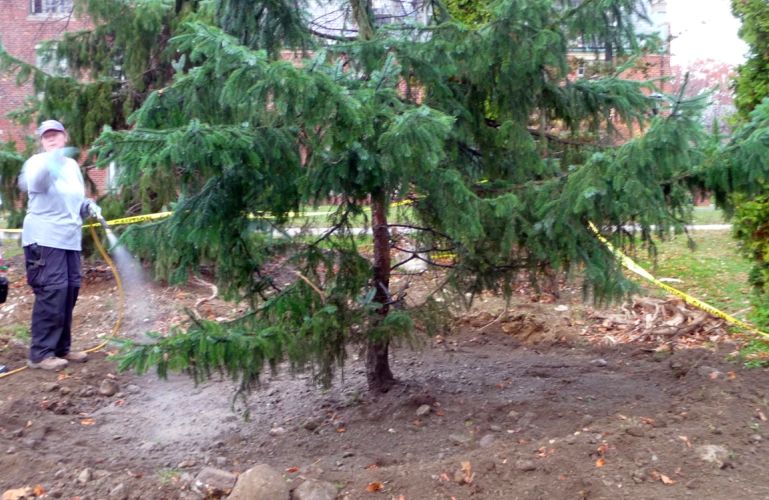
With the berm in place, Sonia waters the backfill thoroughly. Some crews shovel in the backfill and water simultaneously, "mudding in" the tree for extra stability and the complete elimination of air pockets. Mulch will go on this new planting next, and then more water. Note that you can see the root flare, now that the tree has been excavated from its original root ball and planted at the proper depth.

Project site:  The Perkins School for the Blind, Watertown, MA

Project manager:  Sonia Baerhuk

Project crew:  Rolando Ortega, Mynor Tobar, Santo Masciari

The Massachusetts Arborists Assocation bare-root workshops — one in August 2008, and one in August 2009 — have been spreading word through the Commonwealth about the benefits of air-tool tree transplanting, and word is travelling throughout Massachusetts horticulture circles now.

A couple of weeks ago I was chatting with Kristen DeSouza, one of the horticulturists at the New England Wild Flower Society‘s Garden In The Woods, and she mentioned that she had passed my name along to Sonia Baerhuk, who tends the grounds at Watertown’s Perkins School for the Blind.  Kristen told me that Sonia and her crew have been using air tools to  transplant trees on the school’s grounds for the last several months, and suggested that I get in touch with her.

And so last Thursday, a couple of emails and a phone call later, I pulled in to the visitor’s parking area at the Perkins School.  Sonia soon arrived in one of the grounds department’s Gators.  She very kindly showed me around the campus, explaining that a new and large building project had required the removal of dozens of large trees.

It’s a scenario typical of many institutional sites:  a program outgrows its home, the phasing of a master plan leads to a shifting of facilities or the construction of a new building, and the vegetation on site must either be removed or relocated.  Having worked at Perkins for several years, Sonia was no stranger to this course, of events, but still, she had been dismayed to see so many large specimen trees being cut and fed into the chipper.

Though the grounds crew does most of its own tree work, over the years they have called in arborists for their expertise, and Sonia knew and trusted Matt Foti’s expertise.  Matt had told her about the air-tool method, and on the strength of his recommendation, she signed up for the MAA’s Elm Bank bare-root workshop this past August.  At it, she absorbed as much information as possible.  She came away from the day’s event convinced that air-tool excavation and transplant was the best way for her crew to relocate any salvageable campus trees.

So Sonia and her boss Rich Falzone equipped the crew with an Air Spade and an Air Knife, coveralls, eye protection, ear protection, and respirators, and began to direct the relocation of trees.

To date, the Perkins crew — Sonia Baerhuk, Rolando Ortega, Mynor Tobar, and Santo Masciari — has moved several 15-20′ Norway spruce, a fastigiate white pine, a Forest Pansy redbud, several apples, and a beautifully structured 25-30′ tall Halesia.

On the day I visited, they were ready to move another Norway spruce from a location that is slated to become a pondside patio.  Its new home would be a lawn next to a parking lot to which they had already moved a number of evergreens.  The new planting is beginning to screen the lot from adjacent buildings; over time, this grove will shade the parking lot and the walkway near it.

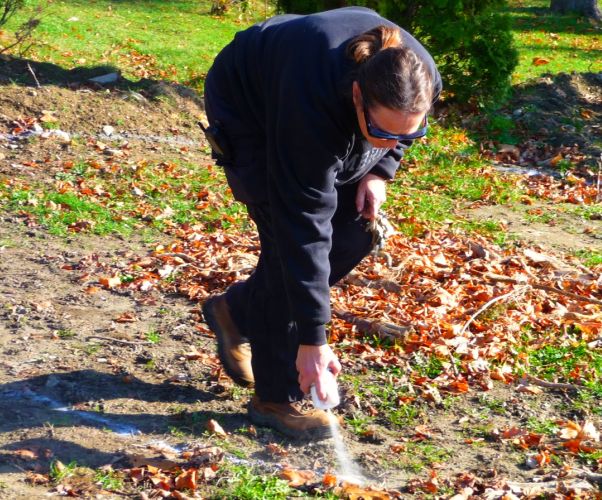
Sonia Baerhuk marking the new home of a 15' Norway spruce to be relocated.

Fifteen-foot Norway spruce in its original location next to the campus pond. The crew discovered that the Norway's roots were interwoven with roots from other nearby trees. This tree was flat on the side facing the fence.

Currently, the grounds crew rents compressors. These two generated air for an Air Knife and an Air Spade. Note the plywood barriers set up to prevent soil overspray onto the lawn. In this project, the crew did not dig a trench to hold blown-out soil; they simply started blowing soil out from the trunk and followed the roots out to and beyond the dripline.
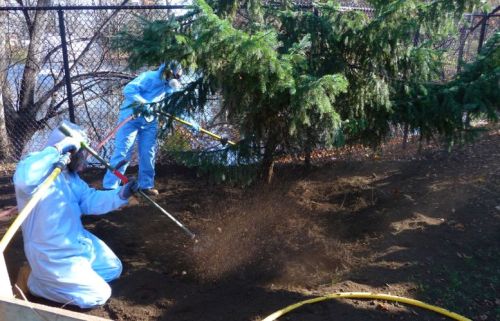
Sonia and Rolando, kitted out in their PSE: coveralls, gloves, hats and hoods, ear protection, eye protection, and respirators.

Blowing soil off the roots took about three hours. Sonia likes to divide the root mass diameter into quadrants and work systematically, while Rolando prefers to work all around the tree; when they work in tandem they use whichever method fits the site conditions best.

Edges of the original B&B root ball are barely visible here; it was roughly 24-30" across. Rolando and Sonia discovered the wire basket still around it. They also discovered that the root flare sat several inches down in the original root ball.

The spruce was anchored with a thick mat of fibrous roots; the crew found virtually no roots larger than 1/2" in diameter. Here, they are pruning root ends under the eighteen-inch deep mat.

Still pruning the mat, and rolling it up toward the trunk to blow soil out from under the tree.

The root mat rolled up and bound in burlap for further blowing-out and moving.

Project site:  The Perkins School for the Blind, Watertown, MA

Project manager:  Sonia Baerhuk

Project crew:  Rolando Ortega, Mynor Tobar, Santo Masciari