Feeds:
Posts
Comments

Archive for the ‘Arboriculture’ Category

Dave Leonard from Lexington, KY, manned the root forensics station at the September 10 MAA air-tool workshop at Elm Bank.  He used an Air Knife to excavate the root ball of a 4″ caliper red maple that was showing signs of decline.

Turf provided the only competition for this tree, but it was showing dieback and early fall color at the MAA workshop.

Turf provided the only competition for this tree, but it was showing dieback and early fall color at the MAA workshop. Dave Leonard excavated at its base to take a look at its rooting habit for possible problems.

With soil blown away from the original root ball, it was clear that the tree’s planting had initiated some problems — parts of the wire basket appeared at the edges of the root ball, and cut root ends had sent out an explosion of fibrous roots that turned back toward the trunk.

Root ends cut during the tree's digging in the nursery sent out masses of fibrous roots, quite a few of which turned back toward the trunk.  The interface between root ball soil and surrounding soil can inhibit root growth into the surrounding soil; removing burlap, removing the wire basket, and breaking up the root ball soil, particularly at the ball's perimeter, can help promote the spread of new roots.

Root ends cut during the tree's digging in the nursery sent out masses of fibrous roots, quite a few of which turned back toward the trunk. The interface between root ball soil and surrounding soil can inhibit root growth into the surrounding soil; removing burlap, removing the wire basket, and breaking up the root ball soil, particularly at the ball's perimeter, can help promote the spread of new roots. Note the soil line some inches up the trunk flare; removing soil above the trunk flare will also benefit the tree and lessen its stress.

Dave cut away the roots that he could not redirect outward, and trimmed off the roots that had begun to circle the trunk flare’s base, which would otherwise eventually girdle the trunk and major anchor roots.  Some of these roots were the beginnings of a secondary root system put out by the tree in response to its stress.

Removing the worst of the inward-growing and circling roots improves the tree's chances for survival.

Removing the worst of the inward-growing and circling roots improves the tree's chances for survival.

After excavating the root ball, Dave intended to continue to blow soil out away from the root ball, creating a shallow crater  out at least to the tree’s dripline.  Removing turf from that zone would eliminate plant competition for soil moisture; the addition of 2-4″ of mulch (kept away from the trunk) would help the soil retain moisture and an even temperature, add organics to it over time, and lessen the chance of soil compaction that inhibits soil/air gas exchange.

Dave said that he would also consider lifting the tree a few inches, to bring its trunk flare into a better relationship with surrounding grade.  This tree had been in the ground for a couple of years; Dave suggested that tree lifting might be worth doing within two to four years of planting, but could be detrimental to the tree after that.  (The window of opportunity for lifting a tree would be a lot wider if an air tool were used, rather than a Bobcat or excavator, as the tree could be bare-rooted and set back in place with relatively little stress from the process.)

Demonstrating arborist at this station:

Dave Leonard, Dave Leonard Consulting Arborist, Inc., Lexington, KY

Read Full Post »

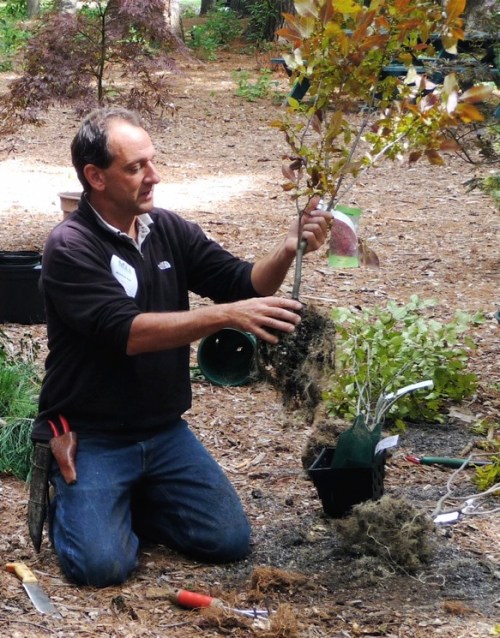
At the MAA Elm Bank workshop on September 10, 2009, Matt Foti demonstrated how to address root problems at the time of planting.  He had a fairly large collection of trunk-and-root masses to illustrate his points, and used them to show how girdling roots, secondary root systems, and J-rooted systems can develop as a result of poor planting or growing practices.

Matt first showed a couple of forest saplings he had pulled early in the day to illustrate how a naturally-seeded tree’s roots grow.  The sapling’s roots were evenly spaced around its stem, and extended out a distance relatively equivalent to the distance its topgrowth extended from the stem.

This little forest-grown white pine has a clean, evenly spaced root system.

This little forest-grown white pine has a clean, evenly spaced root system.

He then pointed to a couple of nursery-grown trees whose rooting problems had become evident after several years.

These root systems have been cut in the digging process.  In an attempt to regrow roots, the foreground tree has sent out a secondary root system, several of which are beginning to girdle other roots.  Kept too long in a burlapped ball or in a container, roots will often turn back in to the ball, making effective planting and long-term growth problematic.

These root systems have been cut in the digging process. In an attempt to regrow roots, the foreground tree has sent out a secondary root system, several of which are beginning to girdle other roots. Kept too long in a burlapped ball or in a container, roots will often turn back in to the ball, making effective planting and long-term growth problematic.

Shrubs as well as trees are susceptible to root problems; Matt dismantled an Ilex verticillata root mass to illustrate how he treats roots bound in a container or in burlap before planting.

Fibrous roots hold together in a near solid mass right out of the container.

Fibrous roots hold together in a near solid mass right out of the container.

Using a three-pronged fork to untangle the root mass.  For a bigger shrub or small tree, a machete or pitchfork may work well to loosen soil and reorient roots.

Using a three-pronged fork to untangle the root mass. For a bigger shrub or small tree, a machete or pitchfork may work well to loosen soil and reorient roots.

Ilex verticillata root mass, now ready for planting.

Ilex verticillata root mass, now ready for planting.

Soil can present another problem for nursery-dug B&B trees.  Clay soils make sturdy root balls, which can be useful for shipping, but not so great for root growth.

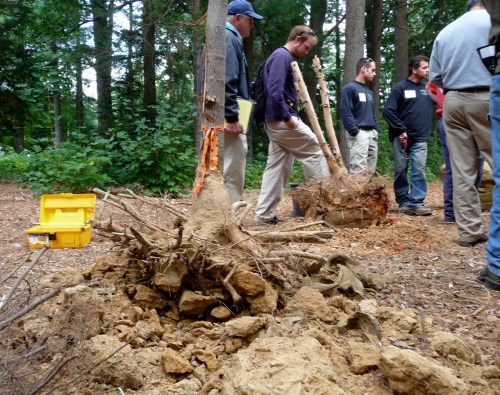
This pair of trees have root masses encased in rock-hard clay soils.  Note the solid clumps of clay in the foreground, and root growth only on top of the root ball -- these roots found it impossible to grow into and through this soil.  Breaking up the soil in a root ball like this before planting promotes the tree's future health; leaving this kind of root ball intact almost guarantees tree stress and decline.

This pair of trees have root masses encased in rock-hard clay soils. Note the solid clumps of clay in the foreground, and root growth only on top of the root ball -- these roots found it impossible to grow into and through this soil. Breaking up the soil in a root ball like this before planting promotes the tree's future health; leaving this kind of root ball intact almost guarantees tree stress and decline.

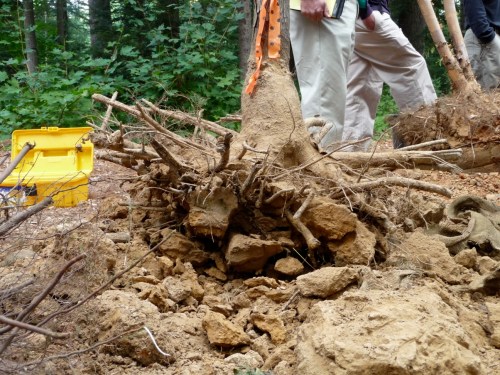
Closeup of rock-hard clay root ball, broken apart (fairly violently) for demonstration purposes.

Closeup of rock-hard clay root ball, broken apart (fairly violently) for demonstration purposes.

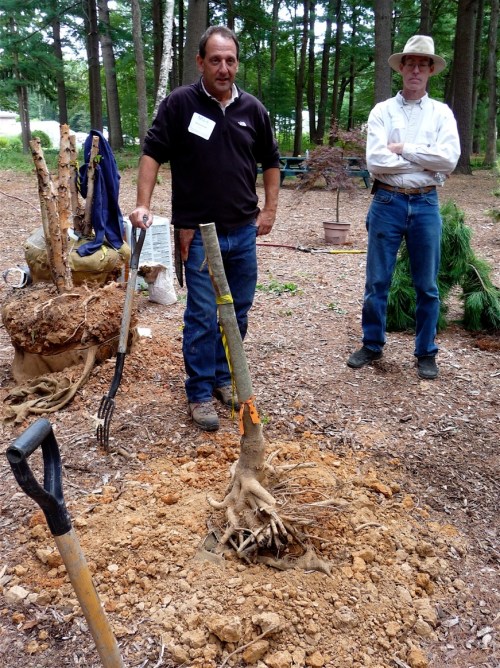
Another example of a dense clay root ball that constricted root growth to the tree's great detriment.  Soil had also been piled up around this tree's trunk flare, further challenging its ability to live.  Tough conditions for a tree to grow in.

Another example of a dense clay root ball that constricted root growth to the tree's great detriment. Soil had also been piled up around this tree's trunk flare, further challenging its ability to live. Tough conditions for a tree to grow in...

The point of these illustrations was to show how necessary it is, when planting a tree or shrub, to work with the root ball before covering it with soil.  Removing wire baskets, removing burlap, loosening or removing the soil, untangling roots as best as possible, pruning roots when necessary — all these tactics make up a strategy for promoting real tree growth.  Bare-root techniques have shown that a great deal of the work that arborists do these days is remedial — that is, is work intended to remedy poor growing, digging, or planting practices.  With the knowledge arborists now have of how root issues so obviously affect plant health, it only makes sense to attend to those issues early on, to avoid greater problems later.

Demonstrating arborist at this station:

Matt Foti, Matthew R. Foti Landscape and Tree Service, Inc., Lexington, MA

Read Full Post »

Tree Specialists manned the decompaction station at the MAA workshop on September 10, 2009.  Standing between two mature sugar maple trees, Rolf Briggs used a compaction meter (from Forestry Suppliers, Inc.) to show how thoroughly compacted the soil around these trees was (very).

Again, the arborists set up barriers to limit the area affected by blown-out soil and pebbles.  Rolf Briggs (right foreground) showed how to use a compaction meter, and explained that the green flags delineate the area to be decompacted.  Flagging the area for review by the client makes the limit of work clear to all parties.

Again, the arborists set up barriers to limit the area affected by blown-out soil and pebbles. Rolf Briggs (right foreground) showed how to use a compaction meter, and explained that the green flags delineate the area to be decompacted. Flagging the area for review by the client makes the limit of work clear to all parties.

Compaction limits the movement of moisture and of gases (oxygen included) in soils, and so can create significant problems for trees.  Trees rely on water being available to their roots, and on the ready intake of oxygen (from the air and from water molecules) for carbon dioxide discharged by those roots.  Compacted soils tend not to allow oxygen in in sufficient quantities, nor allow the steady release of carbon dioxide that a tree needs.  Breaking up the compaction, adding organic amendments to improve soil structure, and replacing lawn areas around trees with mulch beds are steps that benefit soil health, and as a result, tree health.

Decompacting soil around two sugar maple trees.  One man operates the air tool, blowing vertical trenches and mixing their backfill with a proprietary organic soil amendment that mimics forest duff.  The other operator mans the air hose, and tugs on it to signal to the operator.  Air tools are loud!.  Green flags indicate limits of the decompaction zone.

Decompacting soil around two sugar maple trees. One man operates the air tool, blowing vertical trenches and mixing their backfill with a proprietary organic soil amendment that mimics forest duff. The other operator mans the air hose, and tugs on it to signal to the operator. Air tools are loud!. Green flags indicate limits of the decompaction zone.

Tree Specialists prewaters the work area 24-48 hours before starting on a decompaction project, to hydrate the roots and help keep dust down.  As they proceed with the process, they begin to ‘fold in’ amendments.

For further information on decompaction, Briggs recommended an article in the current issue (September 2009) of Tree Care Industry Magazine on soil decompaction and amendment.

Demonstrating arborists at this station:

Tree Specialists, Inc.,  Holliston, MA

Read Full Post »

The Massachusetts Arborists Association workshop on September 10, 2009, took place on a sunny, cool day at the Mass. Hort. Society’s headquarters at Elm Bank in Wellesley, MA.

Quite a few arborists and other landscape professionals attended the workshop, which began with slide talks and then moved outside to field demonstrations.

Quite a few arborists and other landscape professionals attended the workshop, which began with slide talks and then moved outside to field demonstrations.

This workshop focused on root issues, with demonstrations of what some of those issues are — conflicts with utility lines, the effects of poor growing and planting practices, decline due to compacted and poor soils, and inappropriate tree locations — and how they may be remedied.

Rolf Briggs and Tree Specialists set up shop at a couple of different stations to show how they use air tools both to decompact soils and to excavate utility trenches near trees.  The demonstrating arborists first discussed protective equipment, and showed what  they use when they employ air tools:  We watched as they put on respirators, helmets with face masks, ear protection, gloves, and either foul weather gear or jumpsuits — all necessary to protect from the great quantities of dust, soil, and stones blowing into the air.

To protect the surrounding area from flying detritus, Mike Hickman of Tree Specialists set up plywood or screen barriers around his work zone.  I’ve seen plain plywood sheets used; the Tree Specialist guys have figured out that hinging several sheets together makes for a sturdier barrier, a good thing if you’re using air tools with any regularity in anything but a wide-open landscape.

Hinged plywood panels keep the dust contained to the area around a trench.

Hinged plywood panels keep the dust contained to the area around a trench.

When it's necessary to dig a trench near a tree, air tools can do the job while preserving the tree's roots.  You can see roots crossing this trench, but plenty of space beneath them for a new conduit or line.  This trench was blown out with an air spade, and rocks and excess loose material after the blowing-out removed by hand.

When it's necessary to dig a trench near a tree, air tools can do the job while preserving the tree's roots. You can see roots crossing this trench, but plenty of space beneath them for a new conduit or line. This trench was blown out with an air spade, and rocks and excess loose material after the blowing-out removed by hand.

The power of compressed air will break up soil move it out of the way; it can also damage roots to some extent, by blowing root bark or feeder roots entirely away.  When using an air tool, experienced operators keep the nozzle moving to limit this kind of damage, and whenever possible (definitely not always possible in trenching work), they direct the air flow parallel to the direction of major root growth, away from the base of the tree.

Note the plywood barrier inside the trench as well, to focus the air blast and prevent soil from blowing into a previously blown-out section.

Note the plywood barrier inside the trench as well, to focus the air blast and prevent soil from blowing into a previously blown-out section.

Blowing out the trench.  This air tool is a new product that uses an auxiliary stream of water to help keep the roots hydrated and the dust down.  Tree Specialists is assessing this new feature.

Blowing out the trench. This air tool is a new product that uses an auxiliary stream of water to help keep the roots hydrated and the dust down. Tree Specialists is assessing this new feature.

After blowing out a utility trench, Tree Specialists simply returns the native soil to the excavated area.  They may add some amendments such as lime or humates, if they have already had soil tests done that indicate the need for such amendments.  And to mulch the area once excavation and backfilling are complete, they have developed a proprietary mix of chipped and composted wood fibers (mainly from tree parts 3″ and less in diameter), twigs, and leaves.  They use this same mix in their soil decompaction process, and note benefits to the trees from its use.

Mike Hickman pointed out that air tools break down soil aggregates and so obliterate soil structure in the area blown out.  This breakdown can be considered a disadvantage of using compressed air for excavation; in Mike’s words, “Destruction of some of the soil aggregates I see as a “con,” but proper horticultural practices such as mulching and site specific amendments effectively mitigate these cons.”

Demonstrating arborist at this station:

Mike Hickman, Tree Specialists, Inc., Holliston, MA

Read Full Post »

Yesterday the Massachusetts Arborists Association held a day-long workshop at Elm Bank, headquarters for the Massachusetts Horticulture Society in Wellesley, MA.  Three arborists — Dave Leonard from Kentucky, Rolf Briggs of Holliston, MA, and Matt Foti of Lexington, MA — spoke about particular  root issues; Mike Furgal, from Northborough, MA, discussed the use of air tools in bare-root tree transplanting.  After hearing the talks, the hundred or so attendees split into groups and visited five stations on the Elm Bank grounds where the featured speakers were giving demonstrations on their topics.

It was a fine workshop, and I’ll be posting quite a few photos from it in the next few days.  Today, though, I’m only posting this photo:

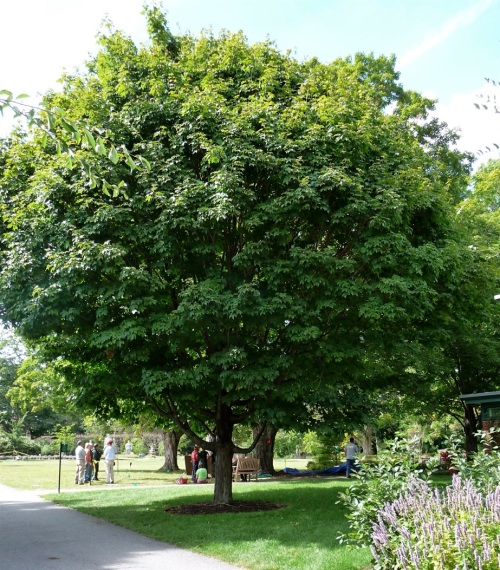
Sugar maple whose root flare was excavated several years ago at a Bartlett Tree workshop given to demonstrate the new and revolutionary use of air tools in tree work.

Sugar maple whose trunk flare was excavated several years ago at a Bartlett Tree workshop given to demonstrate the new and revolutionary use of air tools in tree work.

Several years ago, I went with a friend to this Bartlett Tree workshop at Elm Bank, and we were among a smallish group who watched as an arborist blew several inches of soil away from the trunk flare of this Sugar Maple.  As I recall, the tree had been planted a bit deep, it was set in a fairly compacted lawn, and it was not looking as well as it might; at the time (this was perhaps seven or eight, or perhaps even ten years ago) it had about a six-inch caliper trunk and was not thriving.

Now, however, the tree looks really good.  It may have a little too much mulch around its base — built up since its excavation — but its foliage is deep green, its bark is intact (trunk injuries sometimes show up as a result of some kind of root trauma or injury), and it certainly has grown.  A mulch bed surrounds it and keeps lawnmowers away as it minimizes compaction.  If this kind of growth results from attending to root issues early on and from maintaining a tree properly, the arborists from this workshop may prove, down the road, to be responsible for promoting what truly may be the best arboricultural practices around.

Workshop speakers:

Dave Leonard, Dave Leonard Consulting Arborist, Inc., Lexington, KY

Rolf Briggs, Tree Specialists, Inc., Holliston, MA

Mike Furgal, Furgal’s Tree and Landscape, Northborough, MA

Matt Foti, Matthew R. Foti Landscape and Tree Service, Inc., Lexington, MA

Read Full Post »

Here’s a quick post to alert readers to the Massachusetts Arborists Association‘s Special Seminar and Demonstration on air tool use. A team of four arborists — Mike Furgal, Matt Foti, Rolf Briggs, and Dave Leonard — will be showing how compressed-air tools can be used in arboricultural work (root forensics, bare-root planting, bare-root transplanting, shrub moving, etc.), and will discuss the advancements that this technology provide those working with or using woody plants in the landscape.

The seminar will be on September 10 at Elm Bank, the Massachusetts Horticultural Society’s property in Wellesley, MA — check the MAA link above for registration information.

Registration is not limited to arborists, so interested landscape architects and contractors can go and see this work. I highly recommend signing up; last year’s seminar at Matt Foti’s farm, where Mike Furgal debuted the air-tool transplanting method, was really outstanding, and this year there’s bound to be even more information available and a great deal of informed and informative discussion.

One point: Bare-root transplanting, either with an air-tool or by root-washing, may never replace other methods of transplanting. But for specimen tree transplanting, where the value of an existing tree merits the effort involved, it is currently the gold standard. The number of roots retained with bare-root transplanting prevents the tremendous stress caused by other methods, and should be considered a valuable tool in the kit available to landscape architects, arborists, and contractors.

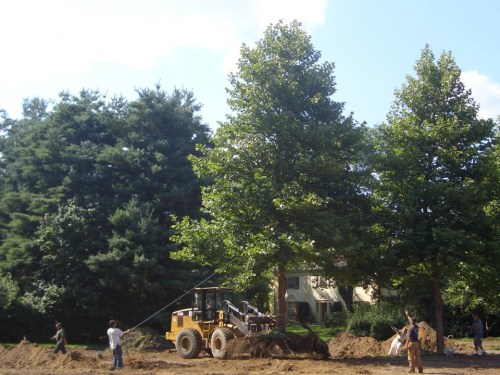
Bare-rooting allows for the moving of a tree this large in less than one day...

Bare-rooting allows for the moving of a tree this large in less than one day...

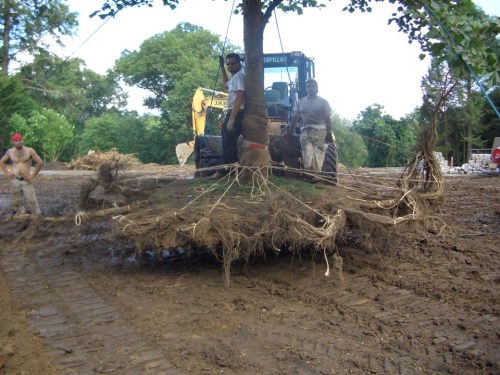
...while preserving this much root mass.

...while preserving this much root mass.

Read Full Post »

Matt Foti took these photos from last week’s big transplant project, and they illustrate some useful points.

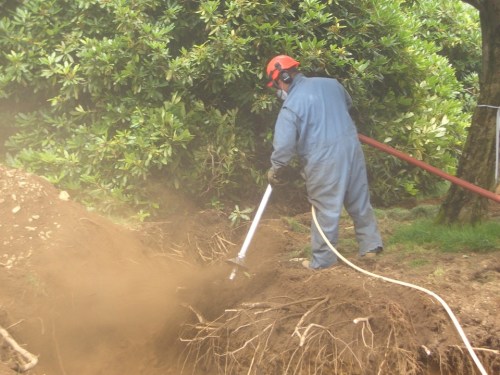
Air-tool excavation is a very messy process, and it bears mentioning again that eye, ear, head, and face protection are really necessary.  Mike Furgal is wearing a face mask here; a respirator would give him even greater lung protection.  Blowing a good sandy loam is one thing; when pebbles and small rocks show up in the soil they become missiles, so long sleeves and pants should also be worn.

Air-tool excavation is a very messy process, and it bears mentioning again that eye, ear, head, and face protection are really necessary. Mike Furgal is wearing a face mask here; a respirator would give him even greater lung protection. Blowing a good sandy loam is one thing; when pebbles and small rocks show up in the soil they become missiles, so long sleeves and pants should also be worn.

Here is what a well-tied tree looks like in transit.  Note how the roots have been carefully pigtailed, and tiebacks to the tree's trunk are done neatly and professionally, to preserve the roots during excavation and the move.

Here is what a well-tied tree looks like in transit. Note how the roots have been carefully pigtailed, and tiebacks to the tree's trunk are done neatly and professionally, to preserve the roots during excavation and the move.

This project took place in late July, during a week of 85-degree heat.  Leaf turgor pressure was maintained throughout by the trees themselves (aided with some in-process watering).

This project took place in late July, during a week of 85-degree heat. Leaf turgor pressure was maintained throughout by the trees themselves (aided with some in-process watering).

Keeping the pigtails neat from the start makes unbundling and spreading the roots fairly easy.  The tree is now resting in the crater dug for its new home; the crew will unbundle and spread the roots out radially, pack soil underneath them to help level the tree, and backfill, water, and mulch the transplant.  Using a forklift allows the arborists to look under the root plate and gauge its bottom profile, which helps in shaping the floor of the planting crater.

Keeping the pigtails neat from the start makes unbundling and spreading the roots fairly easy. The tree is now resting in the crater dug for its new home; the crew will unbundle and spread the roots out radially, pack soil underneath them to help level the tree, and backfill, water, and mulch the transplant. Using a forklift allows the arborists to look under the root plate and gauge its bottom profile, which helps in shaping the floor of the planting crater.

Project arborists:

Matthew R. Foti Landscape and Tree Service, Concord, MA

Furgal’s Tree and Landscape, Northborough, MA

Read Full Post »

One reader wrote in with this comment to my last post: “It would be no good to specify bare root unless you were thoroughly acquainted with the land – soil, ledge, utility lines, for example – and spreading roots of other trees.”

And my answer, because there’s a lot to it:

Actually, bare root is good just for the reasons you enumerate; it’s much easier to plant roots alone than it is to plant a big slug of soil encasing a plant’s roots. And landscape architects, contractors, and arborists have ways of dealing with the issues you mention.

Contractors are required to call Dig Safe (http://www.digsafe.com/) to locate underground utilities on site before any excavation begins. The mis-location of utilities has been known to happen, but excavators are (ideally) careful about how they dig and about stopping when they hit something. Accidents can and do happen, but safeguards have been worked out to minimize their occurrence. (We had a little excitement at last week’s transplanting site over a gas line — apparently DigSafe found one gas line and marked it, but didn’t realize there was another several feet away. The mini-excavator found it — without breaking it — and DigSafe was called out to mark its course immediately.)

Irrigation lines, visible in some of the photos from last week’s posts, are considered expendable/fixable during a construction project. They are relatively flimsy and they run everywhere under many projects, so it is understood that they may be broken (even a shovel can break one), and will be fixed after construction and planting have been completed.

Bare-rooting a tree or shrub for planting — regardless of the surrounding soil type — often is better for the plant than planting it in a soil root ball. When one type of soil is introduced to another, as when a clayey soil root ball is placed in a sand/loam soil, the interface between those two types of soil resists the movement of water from one to the other. That means that if a clay root ball gets watered in thoroughly, water may not move so readily into the sandy loam. What incentive does the root mass have to move beyond that interface and thus into the sandy loam? Not much.

Opening up a root ball and mixing some of its clay with the surrounding soil in the wall of the hole will help, but still — with a bare-root plant that issue is a non-issue. Even with a poor soil, it’s easy to mix some planting loam in with the surrounding soil (again, you want to mix, not simply dump a pile that will give you that same resistant interface) and plant the bare-root tree or shrub in the mix; doing so will make it possible for the plant’s roots to reach as far as they have to for the moisture they need.

it is a tendency, unfortunately, of many planting crews (especially on very large jobs where speed is of the essence and there may be little job training for laborers) simply to push the burlap on a root ball down just below the surface, or in some instances to leave it tied in place before backfilling. Natural burlap eventually will rot, but it can take years, especially given the subsurface soil environment, where the burlap is protected from the atmospheric oxygen and UV light that breaks it down so readily in the nursery. In the meantime, that burlap constrains root extension into the surrounding soil, and can contribute to the roots turning back in to the root ball, which affects the growth of the whole tree. So — another reason bare-root is a good approach: no burlap to fool around with and to constrain root growth.

As for ledge: You’re unlikely to know the location and profile of subsurface ledge until you start digging. That’s just the way it is. Again, though, the presence of high ledge (that is, ledge just below the soil surface) argues for using a bare-root planting method. Since tree roots typically live in the top 12″ of soil (sometimes 18″, and sometimes deeper, given the plant genus and the depth of good soil), and tree root balls can be as deep as 36″, planting a tree with soil around its roots means that you have to accommodate that root ball. Sometimes you can slice off its bottom with little ill effect on the roots. Sometimes you can’t. With a bare-root plant, you don’t have to jimmy around so much with adjusting the height of the root ball.

Certainly, you’ll have to be sure you have adequate soil depth to plant the roots themselves (spreading them out radially, as they typically need to grow), but bare-root planting gives you much more flexibility in this regard.

OK. That’s it for this post, because I have to hit today’s design deadline, and this was a digression from working on it. Sorry about the lack of photos on this post; next one will have a set of really good ones, courtesy of Matt Foti.

Read Full Post »

Tom Ryan*, my first landscape architecture mentor, and I have discussed the desirability of specifying that the trees and shrubs we design into a site be planted bare root whenever possible.   As long as the roots can be kept moist — something now entirely possible with the use of hydrogels — most nursery-grown plants fare better, are more apt to be planted in a way that promotes their future health, and are less expensive than B&B plants. And we all know that healthier plants mean more long-lived designs….

Nina Bassuk and the Urban Horticulture Institute at Cornell have put up on the web an outstanding illustrated tutorial on how to plant shrubs and trees bare root.

One of the challenges for landscape architects is to get more nurseries to offer bare-root plants for sale. Currently, balled-and-burlapped and container-grown are the most available kinds of woody plants in the nursery-to-contractor trade. Like any business, nurseries respond to demand.

Years ago, I was having a casual chat with the president of a local nursery and garden center, and asking why plant selections were limited to a number of fairly standard species and cultivars (I had recently assembled a plant list that specified some more unusual species than his large nursery carried). He told me that his nursery responded to demand; without greater demand for more variety, his business stuck with the standard choices. If more contractors were to bring him more complex lists, his nursery would be happy to accommodate them. It’s a bit of a chicken and egg argument — but essentially it means that continued and persistent demand will get results.

If landscape architects, through our planting choices and plant specifications, possess the ability to influence nursery offerings, then why shouldn’t we also be able to influence the method with which those offerings are packaged? With a greater understanding of the benefits of bare-root plants, perhaps more of us will start to specify bare-root plants, and so create the demand for nurseries to meet. It’s an idea worth exploring.

If you have had experience specifying bare-root plants for a project, we’d love it if you would write in and tell us about it.

Chionanthus retusus, Swan Point Cemetery

Chionanthus retusus, Swan Point Cemetery

*This September Tom will be named a Fellow of the American Society of Landscape Architects — a great honor for any landscape architect, and one that he fully deserves.

Read Full Post »

For those of you checking out this blog for the air-tool transplanting posts, you may find it helpful to read the comments on those posts for more information…And if you’re a landscape architect or arborist and have observations, questions, comments, please feel free to submit them in the comment box as well. This technology and its applications are so new that the more good information gets exchanged, the better.

Lots of root mass.  Irrigation lines run through it; they are cut during the trenching process, and then pulled out in feet-long lengths once enough soil has been blown away from the roots.

Lots of root mass. Irrigation lines run through it; they are cut during the trenching process, and then pulled out in feet-long lengths once enough soil has been blown away from the roots.

Read Full Post »

« Newer Posts - Older Posts »