Feeds:
Posts
Comments

Burning Bush

Last week I was driving through a shady and pleasant part of Wellesley, MA, enjoying the really stunning show of fall colors.  One bucolic road was flanked on one side by a steep wooded hill, at the bottom of which a small stream flowed next to the road.  I noticed that the brightest colors came in that stretch from an almost continuous line of Euonymus alatus, commonly known as Burning Bush or Winged Wahoo (Yes! I couldn’t resist giving this one of its names.).  A few were still green, some had turned brilliant red, and in some that robust red had drained out, leaving the foliage looking delicately pale and anemic.

Ealata wild

I don’t believe any of those Euonymus had been intentionally planted there; more likely birds had eaten fruit from some nearby cultivated Euonymus alatus shrubs, the seeds survived digestion, and found a hospitable niche next to the stream.
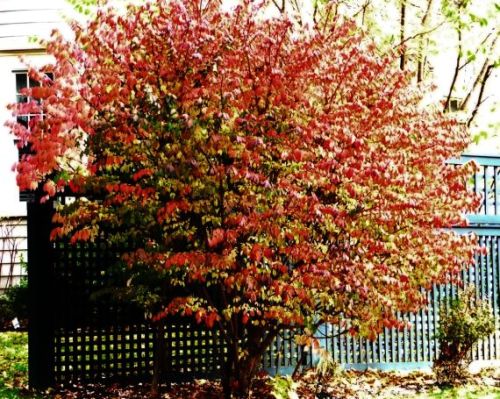
Ealata tame

Right around the bend from the stream was this beefy looking Burning Bush, an obviously well-tended accent in someone's yard.

The scene was lovely, but it was repeated all over the woodlands in that area of town — great color, and large quantities of this non-native and now-invasive shrub.  It’s at this time of year that the ubiquity of some invasives become really evident (Oriental Bittersweet — also a member of the Celastraceae family — is another).  Visually, it’s a wonderful treat; ecologically, perhaps a little more challenging.  Euonymus alatus is now on the Massachusetts Prohibited Plant List, which means that nurseries are prohibited from growing or selling it in the state.
Big-leafed mystery

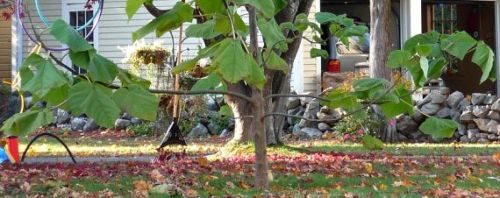
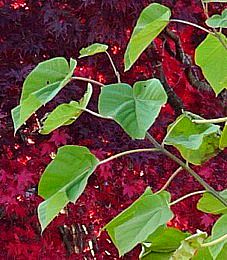
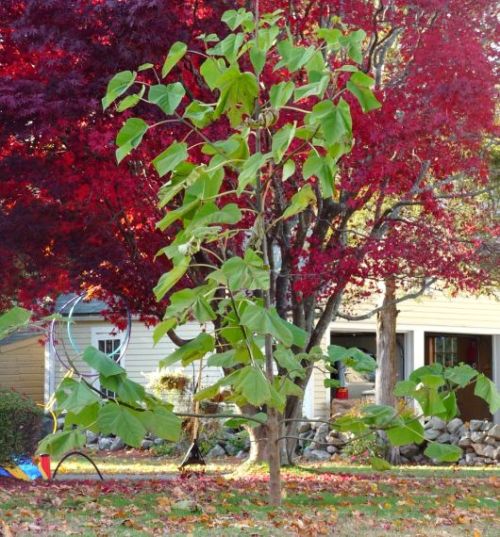
Last June, I notice three small woody plants in the front yard of an unassuming house in my town.  They had each been carefully planted and mulched, and each had enormous leaves — about 12″ across, which for a three-foot high plant really is enormous.  I was fascinated, and through the summer watched them take off and grow to about twelve feet in height.

Paulownia detail

Couldn't figure out what it was: Catalpa? Castor bean plant? Some kind of Rodgersia? Big leaves, even when small -- but then it grew to about 12' in height in one season, and those speculations dissolved.

Paulownia vert

This mystery tree, paired with two others nearby, baffled me for months.

Paulownia horiz

One day in October I walked past with my camera, trying yet again to figure out what these 14-inch leaves on fast-growing stems could be. I was ready to steal a leaf and start keying it out.

And then that night, just before I fell sleep, the words ‘Paulownia tomentosa*’ floated across my mind’s eye.  Next morning I pulled out Dirr and — voila! — the mystery was solved.  I’d been watching three juveniles of the Paulownia genus (also known as Empress Tree, Dragon Tree, or Princess Tree) take hold and begin their march toward world domination in the suburbs south of Boston.  From what I’ve seen of these plants, they are like those guests at a party who arrive at full volume, make a big scene, and leave early (though these have kept their leaves into November now).

I’d first met Paulownias in Somerville, MA, where a picket-fenced yard on my bike route home from work was home to several large trees.  One day I was riding past, and noticed lots of large mauve flowers strewn on the road and sidewalk.  I looked up, and saw still more flowers hanging from the overarching branches.  The trees in flower were spectacular, though the yard itself looked a bit down at the heels, with dry bare dirt where lawn should have been.  Later, I saw some in bloom next to Route 1 in Westwood; they had clearly volunteered in some roadside fill, and were putting on their spring show.

This summer’s mystery planting was the first of these three sightings that I could tell had been intentionally planted.  I aim to keep an eye on them through the winter to see how their buds fare in this zone, and then watch out come spring as the show begins again.

*Not sure of the species, of which there are many.

Root flare

Root flare — where the trunk of a tree and its roots meet — is a critical  juncture in a tree’s anatomy.  Nowadays, trees coming onto the Massachusetts market often have root flares buried in the B&B root ball when they reach a job site for planting.  The contractor then has to remove the covering soil (removing burlap and wire basket in the process, which is a good thing) so that the tree and its root soil sit at the proper relationship to finish grade.  Once the tree is dug and watered in, the contractor adds 3-4″ of mulch, keeping it well away from that newly revealed root flare.  In this post from Taking Place, and this one, I show the crown effects of buried root flares on pear trees and on sugar maples.

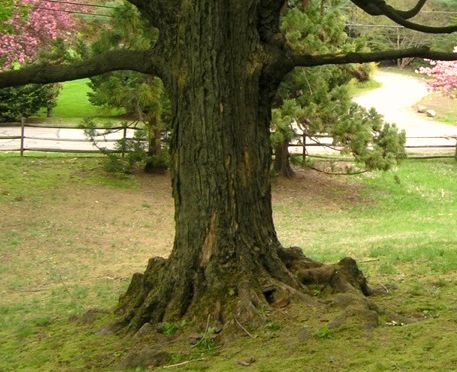
So that’s what juvenile trees with buried root flares look like.  In contrast, here’s a photo of the thriving root flare on a large and quite mature sugar maple:

Parry maple flare

Ever seen a sugar maple with knees?

Gleditsia pods


p1030994

What autumn in Boston brings.


Mike Furgal sent me photos of an 8″ caliper Weeping White Pine  that he moved a couple of weeks ago, remarking that this tree, though relatively small, was the most challenging tree he’s moved bare-root.

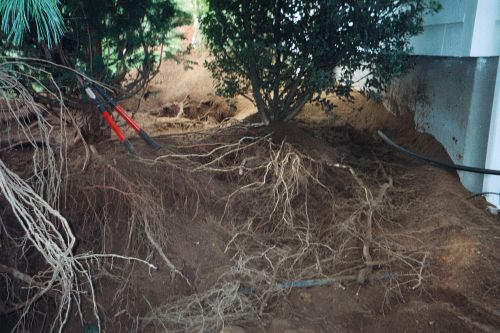
The tree was situated in a small berm next to a house and a driveway, and shared the bed with a 7′ Hinoki Cypress and an 8′ Blue Holly.  Mike blew soil out of the entire bed to move all three plants, whose roots were interwoven.

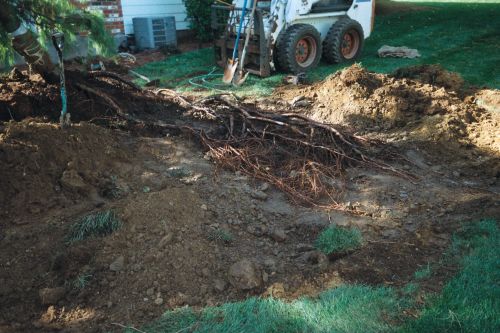
Pine roots running toward the house and drive extended no more than three feet. Roots running under the lawn told a different story; the two main roots that Mike found were 16-18 feet in length; they had plenty of moisture available and plenty of rooting room to grow.

Mike began work on the bed by blowing soil at the tree’s dripline and at its root collar, to assess where the roots were.  He found that they ran along the edge of the bed until they hit the house; from that point they grew out into the lawn.

Here are his photos:

beginning location 2

Rooting space is constrained by the berm's proximity to the house and the driveway.

begining location 3

Ample lawn space gives plenty of rooting opportunity in other directions.

beginning location 1

Lots of roots here -- note how they run along what had been the bed edge, and extend back toward the house. Once they hit the house, they then ran out into the lawn.

beforemove

Here's what the excavated bed looked like, with Hinoki Cypress, Blue Holly, and Weeping White Pine roots woven together.

veron pine diggiing

Tremendous root extension can be kept with air-tool excavating, and while not all fine roots remain, a significant number of them do.

veron white pine digging 2

The Pine ready for its move. These lawn-side roots are sixteen to eighteen feet long. Compare that root length to the accepted standard size of a B&B root ball, which allows ten inches of root-mass diameter for one inch of trunk caliper. For an apples to apples comparison, if we include the three feet of root on the tree's other side, this tree has 19 to 21 feet of root extension, as opposed to the 6-foot, 8-inch root mass diameter you would see on a B&B specimen.

veron white pine digging 3

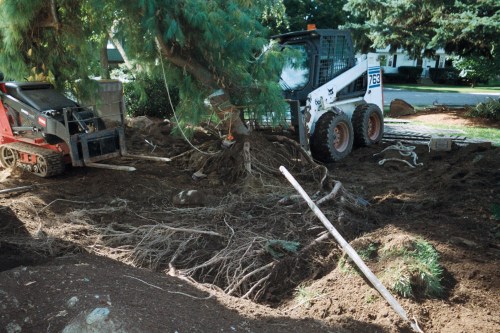
Moving the excavated pine was the trickiest part. Mike and his helper used a Bobcat and a Dingo -- tricky to coordinate both machines at once.

veron moving 3

Closeup of the two monster roots extending away from the house and drive.

veron moving 1

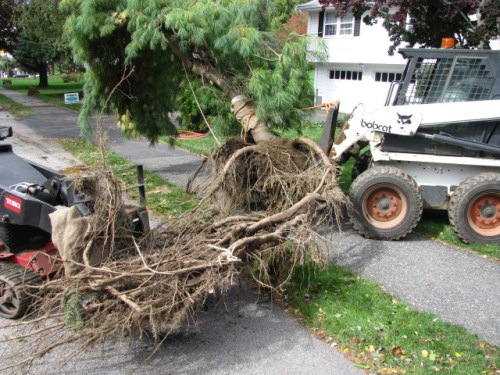
Anyone else reminded of a bride with a really long train? One major difference: a bride doesn't require this kind of machinery to move around.

veron moving 2

The pine moving to its new home on the other side of the house.

I’ll post photos of the tree in its new location shortly.

Arborist:  Mike Furgal, Furgal Tree and Landscape, Northborough, MA

Posted on Taking Place on July 1, 2009:

A few posts back I mentioned my February 2009 article in Lawn and Landscape Magazine on bare-root tree transplanting using an air spade. That article was preceded by my December 1, 2008 article in American Nurseryman, in which news of the technique debuted. Both articles describe the workshop at which several trees — a Juniperus virginiana, a couple of Acer palmatum, a couple of Betula pendula ‘Gracilis’, among others — were spaded and moved. Both articles outline how to carry out the process, though the Lawn and Landscape article is a bit more explicit. And they compare the merits of different methods of transplanting (tree spaded, ball & burlap, and air spade), including how cost, speed of operation, and effect on tree health may vary.

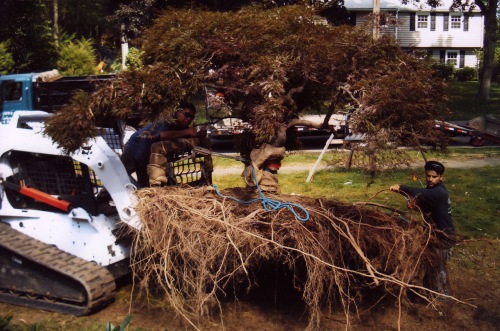
The beauty of using an air spade to transplant specimen trees is that so much root mass can be preserved and moved with the tree. The following photos of a dwarf Japanese maple (Acer palmatum dissectum), lent by Matt Foti, illustrate just how effective at saving roots this technique is.

Matt and his crews are using an air spade routinely now in transplanting work, because it preserves the tree’s resources so well, minimizing transplant shock and easing re-establishment. They moved this tree in early September of 2008. Take a look:

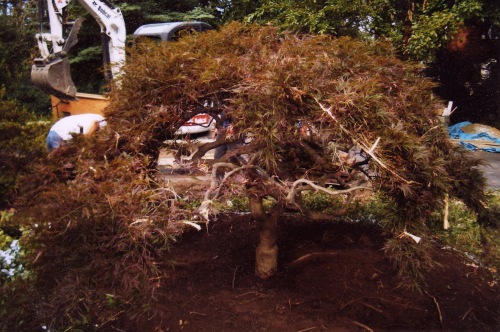
Acer palmatum dissectum awaiting its move.  Soil under the tree has been lightly spaded to check surface roots.

Acer palmatum dissectum awaiting its move. Soil under the tree has been lightly spaded to check surface roots.

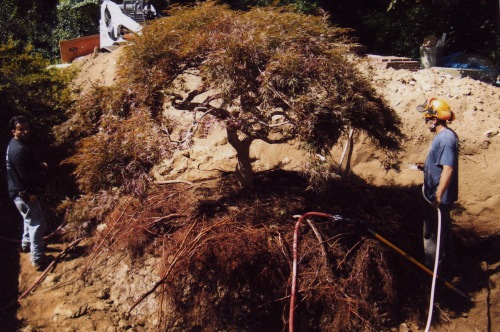
Same tree, roots now exposed by the air spade.  Note how far beyond the tree's dripline these roots extend.

Same tree, roots now exposed by the air spade. Note how far beyond the tree's dripline these roots extend.

Tree being lifted up for the move.  The crew has wrapped its trunk and main limbs, to avoid injury; guy lines insure that it won't tip in transit.

Tree being lifted up for the move. The crew has wrapped its trunk and main limbs, to avoid injury; guy lines insure that it won't tip in transit.

Wrapping thoroughly during this kind of move lessens the chance of bark injury.

Wrapping thoroughly during this kind of move lessens the chance of bark injury.

Tree in its new location, backfilled and awaiting thorough watering.  No staking is necessary, as most of the root plate has been preserved and will continue to support the tree in its new home.

Tree in its new location, backfilled and awaiting thorough watering. No staking is necessary, as most of the root plate has been preserved and will continue to support the tree in its new home.

In the fall of 2008 Carl Cathcart persuaded Cavicchio’s Greenhouses to wash the roots on a stressed B&B Quercus rubra (Red Oak), and to plant it in a spot where it might be able to settle in.  Carl sent me photos of the root-washing process, which I posted on Taking Place last summer.  He and I then drove to Sudbury to see the tree, and to check out the three Red Oaks in similar condition that Cavicchio’s had planted conventionally, to see how they would progress in relation to the root-washed oak.

Photos of all the planted-out trees are on Taking Place, and because there are so many of them I’m simply posting the links to those posts here.  To see the photos and read about the root-washing experiment, click here first, and then click here.

The summary:  in mid-July, the bare-rooted tree looked best of all four trees.  It had some dead wood, but nothing that hadn’t been on the tree the previous autumn, and it had good foliage color and density, if the foliage itself was a bit small.  By comparison, the other three trees looked as if they were struggling: each tree had sprouted out new shoots along its trunk, often a sign of a tree in decline; foliage was small, and there was lots of deadwood in each tree.  It’s not a scientifically rigorous experiment, but one worth following over the next few years, to see how the trees progress.

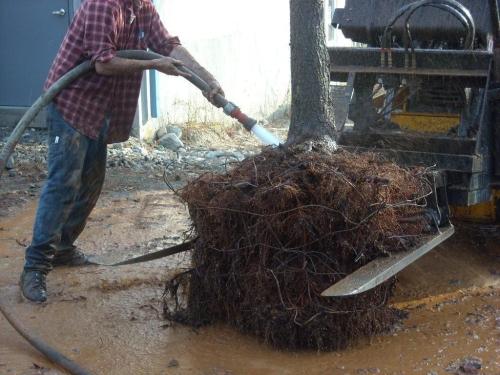
Leaning into the root ball.  Lower water pressure may be a bit easier for those tiny feeder roots, but high pressure makes getting the hard clay soil off a faster process.  It's not clear yet how feeder root regrowth is affected by this kind of treatment, whether the pressure comes from air or water.  Early reactions seem promising, but it may be several years before a re-examination of the roots shows how risks and benefits balance..

Leaning into the root ball. Lower water pressure may be a bit easier for those tiny feeder roots, but high pressure makes getting the hard clay soil off a faster process. It's not clear yet how feeder root regrowth is affected by this kind of treatment, whether the pressure comes from air or water. Early reactions seem promising, but it may be several years before a re-examination of the roots shows how risks and benefits balance..

The Garden Professors

If you’ve been interested in the issues on this blog, you might well want to look into another blog, this one written by four horticulture professors.  They’re each based somewhere different — Washington State, Virginia, Michigan, and Minnesota — and they write with humor and expertise about plants and plant issues.  The Garden Professors started posting in July 2009.  They talk about root-washing, propagation, nursery practices, soil contaminants, slugs, rubber mulch — you name it, they’re addressing it.  A recent post highlighted the air-tool transplant of a beautiful 10″ caliper weeping white pine by a Michigan State University Nursery Management class and the MSU arborist. — take a look for some good pix and clear, personable, often funny writing about a great range of up-to-the-minute plant issues.

Girdling roots

I was shuffling through some photos today, hunting for an illustration of girdling roots, thinking that I’d use one of a myriad of pix I have of subgrade snarlups.  But this picture popped up, and it seemed useful to show how a root that seems insignificant in infancy can grow to have an adverse effect on the health of the tree from which it springs.

These two girdling roots started out as thin, wirelike strands growing past the trunk of a sapling.

These two girdling roots started out as thin, wirelike strands growing past the trunk of a sapling.

This tree is a Norway maple in our backyard  (yes, we still have a couple of them).  From its position in the lawn I’m betting that someone planted it.  At the time of planting, it would have been a small tree — perhaps a 5-foot sapling dug from the yard’s border and moved to the lawn, or maybe one of the 1.5″ caliper whips given away by our town one year.

If you envision the young transplant then, you’ll imagine those two girdling roots as a couple of very thin, quite insignificant-looking roots, running parallel to and about two feet away from the trunk of that skinny tree.  They might have been considered circling roots, they might simply have just gotten twisted the wrong way in planting and continued to grow straight past the trunk.

As the tree grew in height it also grew in girth; the crown branched out, the trunk got thicker.  As the trunk got thicker, the roots and branches thickened.  A harmless condition in the tree’s juvenile days has turned into a bit of a problem in its middle age.  Now the skinny roots have fattened up, and have begun to squeeze the vascular tissue in the roots runny radially out from the trunk.  Bark above the girdling roots is traumatized (and not just by the squirrels that run up and down every morning) by constriction.  There’s a bit of dieback in the crown this year — though that may have been caused by something else (winter breakage invaded by fungus? Norway maple cussedness?)

The solution?  Chiseling the girdling roots away from the constricted roots to free up that vascular system could help, though at this stage it would be interesting to see if that section of root and trunk flare could really recover.  I have been using the Norway maples in the yard — the two mature ones, and a small thicket of saplings — as a small laboratory, so will keep watching to see what happens here.  Feel free to comment below….

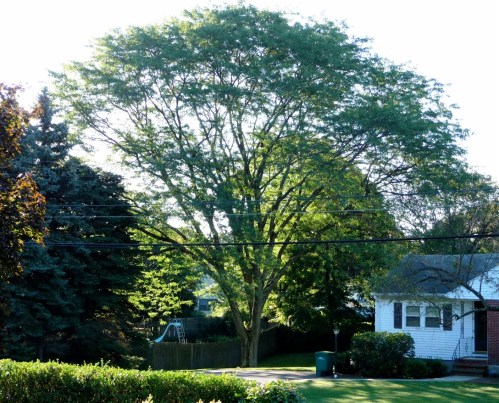
Well, this town outside of Boston can’t be considered ‘the country’ these days, but still, there’s plenty of room for a tree to grow. This Gleditsia, unlike the two in the previous post, can stretch its arms and legs, and shows what form and size a Honey Locust really wants to take:

Plenty of rooting room translates into plenty of canopy.

Plenty of rooting room translates into plenty of canopy.