Feeds:
Posts
Comments

Archive for the ‘Plant management’ Category

Here’s a quick post to alert readers to the Massachusetts Arborists Association‘s Special Seminar and Demonstration on air tool use. A team of four arborists — Mike Furgal, Matt Foti, Rolf Briggs, and Dave Leonard — will be showing how compressed-air tools can be used in arboricultural work (root forensics, bare-root planting, bare-root transplanting, shrub moving, etc.), and will discuss the advancements that this technology provide those working with or using woody plants in the landscape.

The seminar will be on September 10 at Elm Bank, the Massachusetts Horticultural Society’s property in Wellesley, MA — check the MAA link above for registration information.

Registration is not limited to arborists, so interested landscape architects and contractors can go and see this work. I highly recommend signing up; last year’s seminar at Matt Foti’s farm, where Mike Furgal debuted the air-tool transplanting method, was really outstanding, and this year there’s bound to be even more information available and a great deal of informed and informative discussion.

One point: Bare-root transplanting, either with an air-tool or by root-washing, may never replace other methods of transplanting. But for specimen tree transplanting, where the value of an existing tree merits the effort involved, it is currently the gold standard. The number of roots retained with bare-root transplanting prevents the tremendous stress caused by other methods, and should be considered a valuable tool in the kit available to landscape architects, arborists, and contractors.

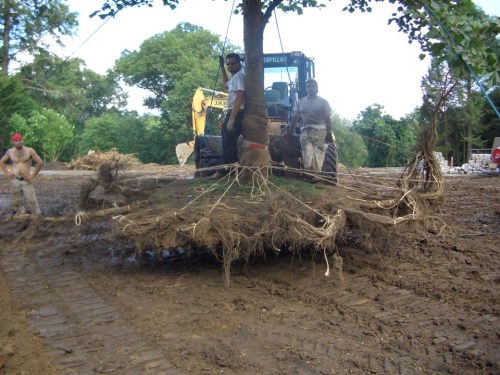
Bare-rooting allows for the moving of a tree this large in less than one day...

Bare-rooting allows for the moving of a tree this large in less than one day...

...while preserving this much root mass.

...while preserving this much root mass.

Read Full Post »

One reader wrote in with this comment to my last post: “It would be no good to specify bare root unless you were thoroughly acquainted with the land – soil, ledge, utility lines, for example – and spreading roots of other trees.”

And my answer, because there’s a lot to it:

Actually, bare root is good just for the reasons you enumerate; it’s much easier to plant roots alone than it is to plant a big slug of soil encasing a plant’s roots. And landscape architects, contractors, and arborists have ways of dealing with the issues you mention.

Contractors are required to call Dig Safe (http://www.digsafe.com/) to locate underground utilities on site before any excavation begins. The mis-location of utilities has been known to happen, but excavators are (ideally) careful about how they dig and about stopping when they hit something. Accidents can and do happen, but safeguards have been worked out to minimize their occurrence. (We had a little excitement at last week’s transplanting site over a gas line — apparently DigSafe found one gas line and marked it, but didn’t realize there was another several feet away. The mini-excavator found it — without breaking it — and DigSafe was called out to mark its course immediately.)

Irrigation lines, visible in some of the photos from last week’s posts, are considered expendable/fixable during a construction project. They are relatively flimsy and they run everywhere under many projects, so it is understood that they may be broken (even a shovel can break one), and will be fixed after construction and planting have been completed.

Bare-rooting a tree or shrub for planting — regardless of the surrounding soil type — often is better for the plant than planting it in a soil root ball. When one type of soil is introduced to another, as when a clayey soil root ball is placed in a sand/loam soil, the interface between those two types of soil resists the movement of water from one to the other. That means that if a clay root ball gets watered in thoroughly, water may not move so readily into the sandy loam. What incentive does the root mass have to move beyond that interface and thus into the sandy loam? Not much.

Opening up a root ball and mixing some of its clay with the surrounding soil in the wall of the hole will help, but still — with a bare-root plant that issue is a non-issue. Even with a poor soil, it’s easy to mix some planting loam in with the surrounding soil (again, you want to mix, not simply dump a pile that will give you that same resistant interface) and plant the bare-root tree or shrub in the mix; doing so will make it possible for the plant’s roots to reach as far as they have to for the moisture they need.

it is a tendency, unfortunately, of many planting crews (especially on very large jobs where speed is of the essence and there may be little job training for laborers) simply to push the burlap on a root ball down just below the surface, or in some instances to leave it tied in place before backfilling. Natural burlap eventually will rot, but it can take years, especially given the subsurface soil environment, where the burlap is protected from the atmospheric oxygen and UV light that breaks it down so readily in the nursery. In the meantime, that burlap constrains root extension into the surrounding soil, and can contribute to the roots turning back in to the root ball, which affects the growth of the whole tree. So — another reason bare-root is a good approach: no burlap to fool around with and to constrain root growth.

As for ledge: You’re unlikely to know the location and profile of subsurface ledge until you start digging. That’s just the way it is. Again, though, the presence of high ledge (that is, ledge just below the soil surface) argues for using a bare-root planting method. Since tree roots typically live in the top 12″ of soil (sometimes 18″, and sometimes deeper, given the plant genus and the depth of good soil), and tree root balls can be as deep as 36″, planting a tree with soil around its roots means that you have to accommodate that root ball. Sometimes you can slice off its bottom with little ill effect on the roots. Sometimes you can’t. With a bare-root plant, you don’t have to jimmy around so much with adjusting the height of the root ball.

Certainly, you’ll have to be sure you have adequate soil depth to plant the roots themselves (spreading them out radially, as they typically need to grow), but bare-root planting gives you much more flexibility in this regard.

OK. That’s it for this post, because I have to hit today’s design deadline, and this was a digression from working on it. Sorry about the lack of photos on this post; next one will have a set of really good ones, courtesy of Matt Foti.

Read Full Post »

Tom Ryan*, my first landscape architecture mentor, and I have discussed the desirability of specifying that the trees and shrubs we design into a site be planted bare root whenever possible.   As long as the roots can be kept moist — something now entirely possible with the use of hydrogels — most nursery-grown plants fare better, are more apt to be planted in a way that promotes their future health, and are less expensive than B&B plants. And we all know that healthier plants mean more long-lived designs….

Nina Bassuk and the Urban Horticulture Institute at Cornell have put up on the web an outstanding illustrated tutorial on how to plant shrubs and trees bare root.

One of the challenges for landscape architects is to get more nurseries to offer bare-root plants for sale. Currently, balled-and-burlapped and container-grown are the most available kinds of woody plants in the nursery-to-contractor trade. Like any business, nurseries respond to demand.

Years ago, I was having a casual chat with the president of a local nursery and garden center, and asking why plant selections were limited to a number of fairly standard species and cultivars (I had recently assembled a plant list that specified some more unusual species than his large nursery carried). He told me that his nursery responded to demand; without greater demand for more variety, his business stuck with the standard choices. If more contractors were to bring him more complex lists, his nursery would be happy to accommodate them. It’s a bit of a chicken and egg argument — but essentially it means that continued and persistent demand will get results.

If landscape architects, through our planting choices and plant specifications, possess the ability to influence nursery offerings, then why shouldn’t we also be able to influence the method with which those offerings are packaged? With a greater understanding of the benefits of bare-root plants, perhaps more of us will start to specify bare-root plants, and so create the demand for nurseries to meet. It’s an idea worth exploring.

If you have had experience specifying bare-root plants for a project, we’d love it if you would write in and tell us about it.

Chionanthus retusus, Swan Point Cemetery

Chionanthus retusus, Swan Point Cemetery

*This September Tom will be named a Fellow of the American Society of Landscape Architects — a great honor for any landscape architect, and one that he fully deserves.

Read Full Post »

Here’s a series of photos from an air-tool transplant project executed last week by a crew from Matthew R. Foti Landscape and Tree Service of Lexington, MA. These guys have been using air tools to bare-root trees for some time now, and they have refined the process pretty skillfully.

Shown here are a very large treeform Taxus and a smallish Cornus kousa. The Kousa Dogwood had been planted only about 8′ away from the Yew, and probably had been sheltered by it in its early days. At this stage, though, their crowns had been competing, and a revised landscape design gave further reason to spade out and move both plants.

Taxus and Cornus kousa planted closely together, as part of a larger planting that has already been dismantled.

Taxus and Cornus kousa planted closely together, as part of a larger planting that has already been dismantled.

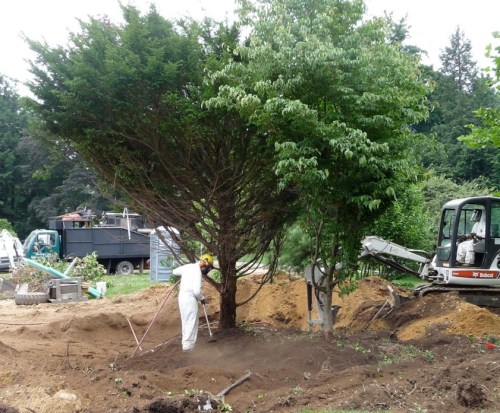
The Bobcat has dug a trench, and the crew is blowing soil into it. Note that the Yew's branches have been tied up to keep them out of the way.

The Bobcat has dug a trench, and the crew is blowing soil into it. Note that the Yew's branches have been tied up to keep them out of the way.

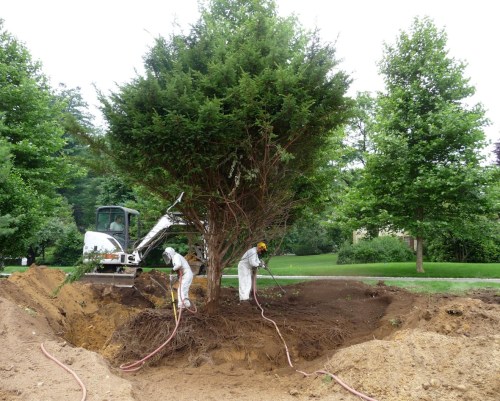
Taxus is a deeply rooted plant -- notice the trench depth, and presence of roots in the lower part of the mound.

Taxus is a deeply rooted plant -- notice the trench depth, and presence of roots in the lower part of the mound.

Soil and rocks fly during the process, so eye and ear protection are essential. The white jumpsuits keep these guys from getting covered with soil (color is optional).

Soil and rocks fly during the process, so eye and ear protection are essential. The white jumpsuits keep these guys from getting covered with soil (color is optional).

Bobcat continually takes blown soil out of the trench and stockpiles it.

Bobcat continually takes blown soil out of the trench and stockpiles it.

Double-teaming a soil clod. Pushing the nozzle down into the root mass helps loosen soil inside it.

Double-teaming a soil clod. Pushing the nozzle down into the root mass helps loosen soil inside it.

Pigtailing the roots -- tying them in long bundles -- helps keep them protected and out of the way.

Pigtailing the roots -- tying them in long bundles -- helps keep them protected and out of the way.

Twine holds the pigtails together; when the plant is ready to move, twine can also be used to tie the pigtails back to the trunk, to keep them from dragging during transport.

Twine holds the pigtails together; when the plant is ready to move, twine can also be used to tie the pigtails back to the trunk, to keep them from dragging during transport.

Progress shot. Look at how deep the trench is. The Taxus is nearly ready, and shortly the crew will move on to the Cornus kousa; when both trees have been blown out, they will be separated and moved to new locations.

Progress shot. Look at how deep the trench is. The Taxus is nearly ready, and shortly the crew will move on to the Cornus kousa; when both trees have been blown out, they will be separated and moved to new locations.

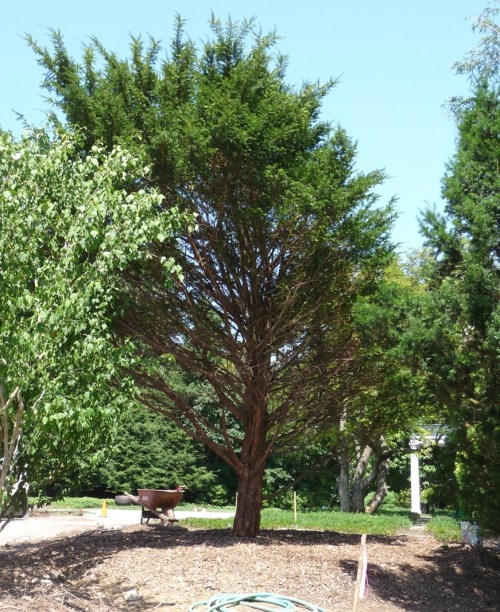
The following week: Taxus in a new spot, looking relaxed and healthy

The following week: Taxus in a new spot, looking relaxed and healthy

Final shot. Asymmetry in the Taxus crown reflects its previous location in a larger planting.

Final shot. Asymmetry in the Taxus crown reflects its previous location in a larger planting.

.”]<img title=”p1020427″ src=”http://takingplace.files.wordpress.com/2009/07/p10204273.jpg&#8221; alt=”Final shot. Asymmetry in the Taxus crown reflects its previous location in a larger planting.” width=”499″ height=”639″ />[/caption]

Read Full Post »

What is a landscape architect doing writing about these methods of tree planting and moving? Well, for one thing, I don’t like to waste woody plants. Planting an ingrown-root tree (or even a healthy one) in a new landscape without attending to the tree’s requirements — for rooting space, for decent soil porosity, for adequate moisture, for sufficient gas/air exchange at the root flare, for sufficient light, among other things — can lead to the tree’s being stressed, declining, and dying in relatively short order (a typical urban street tree lasts 7-10 years, and is in decline for most of that time). That seems a waste to me. A tree represents a lot of energy. A tree is a system, as well as a component in a larger system.

And my design work takes place in a larger system, too — that commercial system, where clients hire me to make comfortable, beautiful, gracious outdoor spaces for them. The more knowledgeable I am about these big, organic, living design elements, these systems, the better my built projects will be, and the more sustaining and sustained they will be, as well. If the best advertisement for a landscape architect is the landscape we design, then it makes sense for us to know a lot, and to use what we know, about the biggest elements we use in that landscape. Wait till I start writing about water….

Read Full Post »

p1010402

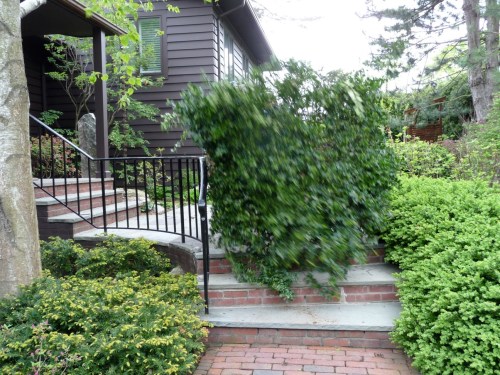
No, that’s not a shot of a revolutionary way of planting in pavement — that’s a photo of one of the enormous China Girl hollies being taken to its new home at the property belonging to L. and A., my longtime clients. This holly is a mature plant; in my Air Spade In Action post (May 16), you can see it set on the ground, opened to its full, voluptuous 9′ width.

You’ll also notice that shrubs flanking the steps and walk here are mostly mature plants. L. and A. have spent years developing their landscape, and it has the flavor of a place owned by art appreciators. The plants have been tended with care, diligence, and skill, and their character reinforces the design intentions evident throughout the gardens.

Landscape architects often heed Frederick Law Olmsted’s dictum, “Plant thick, thin quick” (a motto we learned in Lenny Mirin’s Landscape History class at Cornell — Lenny?), and plant shrubs more densely than the mature size of the plant might dictate. Clients often want to see immediately gratifying plantings, which means a minimal view of the mulch and a maximal view of plants.

Which is fine — as long as someone goes back in a few years later and actually does the thinning. The making of a landscape is not a one-off deal.

At the North Shore garden this past week, as we were in the midst of reworking two areas on the property, I had a revelation. My clients have been devoted to their gardens for years, and they enjoy and promote the evolution of their place. Their enthusiasm for their landscape has allowed me to make the refinements that continue to animate it.

Thinning out the plantings is one aspect of this work: dismantling the holly hedge gave us ten wonderful plants to use around the property, while allowing us to develop a planting in place of the hedge that uses a combination of new, younger plants and older transplants that have grown into their habits. Toby and I have discussed in earlier posts the idea of planting densely and allowing the plants themselves to elbow each other both into a coherent ensemble and into a set of individual character actors.

This week, I was able to take mature, idiosyncratic plants — in this case, rhododendrons, azaleas, and mountain laurel — and transplant them in an area where each plant’s form would be visible. This sort of refinement is possible when a landscape has been designed, planted, and growing for years; it is the stage at which the character of plants can truly be showcased.

Not every landscape reaches this stage, which requires something of the eye of an editor and a knowledge of horticulture in addition to the skills of a designer. A property may be sold, a client may find other priorities, or may simply feel overwhelmed by the “planted thick” place. Rather than thin it out or make new spaces in the landscape, that client or new owner may ask for an entirely new planting.

Refining a landscape by reimagining its plantings, though, and in some cases developing new spaces to fit a changed use of the property, can breathe new and vigorous life into a place. Mature plants, well-situated, give a well-structured place the look of inevitability that is difficult to achieve with the callow youth of new nursery-grown stock.

Some of my favorite work has involved shaping spaces with mature plants reused from the same site. I tend to see character in plants, and really like gussying them up to highlight that character. Putting together a collection of plants in this way is like developing the singing skills of a choir; individually, each singer’s voice is distinctive, and together, all the voices blend to create shifting and satisfying harmonies.

This kind of design starts with a plan, but requires an agile mind onsite, as the plants move from one situation to another, and relationships among their forms change. It’s challenging to see a plant from all sides, envision how it will work in harmony with the others to join it, be sure it works horticulturally, and assemble the collection to best effect.

There is no way to plan precisely that kind of work in advance; the joy of it comes when shifts, tweaks, and adjustments bring about a result that fits just right, and that pleases. This week, I got to spend three days of orchestrating this kind of work, and every minute was a pleasure. Here are before and after photos of one planting area we changed:

p1010537Same area, newly revised. The existing trees remain, and we’ve added another little Bloodgood. The great wall of China Girls is gone, we moved two of them back in front of the Norway maple to grow more loosely together as a backdrop to two mature azaleas. Older rhododendrons and mountain laurel show their forms to the left of the new Bloodgood. New Green Wave yews will grow together and in a few years will make a continuous loose line with the existing Green Waves.

Read Full Post »

This past winter I developed plans for a couple of areas on the property belonging to my longest-standing and wonderfully enthusiastic clients, L. and A. on the North Shore. They have a lovely place on a rocky cliff overlooking Nahant Bay, and they enjoy making it even more beautiful and comfortable each year. They are both artists, and both appreciate art in two and three dimensions: L. gardens and sculpts; A. is a talented photographer.

L. and A. had asked me to figure out how to screen out views of two neighbors from their house, and to develop plans in the two areas that would work with the extensive mature plantings already in place. I drew up plans that would bring a few new plants in, as well as reuse a number of plants already onsite. L. and A. liked the ideas, and we scheduled a date to move ahead.

Leahy Landscaping of Lynn carried out the work of digging and moving the plants; the crew, led by Anibal Marita, was excellent. At my request, and under the supervision of Mark Bolcome, Leahy’s arborist, they used an air spade on the project; we were working in a heavily planted area and I wanted to disturb or lose as few roots as possible.

The plan:  Remove a 32′ long, 7′ high holly (<em>Ilex ‘China Girl'</em>) hedge from the edge of a residential drive court, reusing some of the plants for screening at the front property line, and install a collection of transplanted shrubs, a new Japanese maple, and some low Green Wave yews where the holly had been. Transplant most of the hollies to provide a 22’ long screen at the front property line, and use the rest at another location onsite.

Proposed methods:  Hand-dig the holly. To avoid further stressing the three aging red pines under which some of the hollies were to be transplanted, excavate the transplant site with an air spade. Hand-dig the rest of the plants.

Actual methods:  Hand-dug the holly, then air spaded the root balls to loosen the nursery soil at their cores. Discovered that the wire baskets had not been removed at the original planting, removed those, and loosened the remaining soil, leaving roots intact. Removing the soil allowed the plants to fit in shallower-depth holes, which was helpful on a site with a lot of existing tree roots and drainage pipes. Removing the wire baskets will allow the hollies’ roots (and crowns) to grow unimpeded in their new locations. Excavated under the pines with the air spade, and removed existing shrubs there also with the air spade, leaving all roots, including masses of feeder roots, intact. Unwrapped the Japanese maple root ball, removed the wire basket and burlap, and removed/loosened the soil with the air spade.

Removing a girdling root from the Japanese maple.  Note the root-ball soil line, four inches up the tree's trunk from the base of the trunk flare.

Removing a girdling root from the Japanese maple. Note the root-ball soil line, four inches up the tree's trunk from the base of the trunk flare.

With a mini-claw mattock, pulled soil away from the trunk flare; soil had been piled 4″ up the trunk, concealing a girdling root and the flare itself. Mark Bolcome chiseled away the girdling root and made sure the flare was correctly exposed before laborers backfilled and watered in the root ball.

Removed the red clay soil encasing the nursery root ball of a rhododendron that had been planted onsite several years ago, but that had struggled for those years.
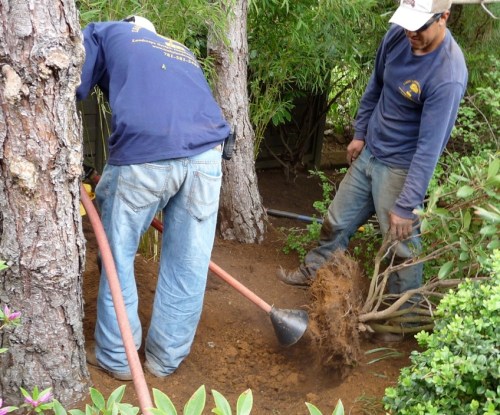
Breaking up the clay soil in the root ball of a 4' rhododendron.

Breaking up the clay soil in the root ball of a 4' rhododendron.

With the concrete-like soil mostly gone, the plant should finally have a chance to spend its energy growing, rather than trying to break through that clay cast.

Cleared ground cover by hand in front of a row of mature Taxus trees,

Holes for holly transplants were dug by air spade, to minimize disturbance to the roots of the treeform yew hedge behind the plywood.

Holes for holly transplants were dug by air spade, to minimize disturbance to the roots of the treeform yew hedge behind the plywood.

then excavated transplant holes with the air spade — again, to keep from disturbing roots of the existing yews — and transplanted more of the holly here.

The original plan, which also included the planting of six large clump bamboos and the moving of several broadleaf evergreen and herbaceous plant, was scheduled to take perhaps two days. The hollies changed everything, though. They were enormous: planted eight or nine years ago at 3′ on center, they opened out to seven to eight feet in width.

One holly, trussed for moving.  Ten of these plants had been placed on 3' centers to make a hedge; when freed from the hedge, each one opened out to cover at least seven feet in breadth.

One holly, trussed for moving. Ten of these plants had been placed on 3' centers to make a hedge; when freed from the hedge, each one opened out to cover at least seven feet in breadth.

There was no way we could fit them all where we had intended; they would have taken up more than seventy linear feet if we had placed them side by side!
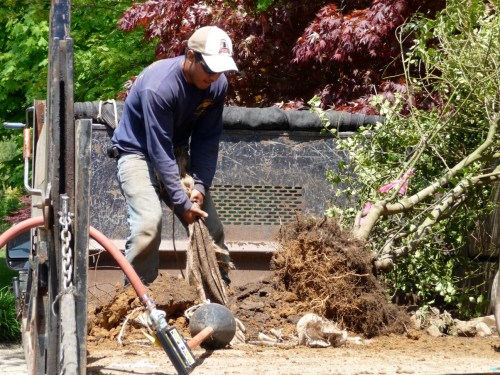
Hand-dug holly that has been bare-rooted being prepared for transplant. Notice the clumps of hard, heavy soil from its original root ball lying around it; the wire basket is lying off to the left.

Hand-dug holly that has been bare-rooted being prepared for transplant. Notice the clumps of hard, heavy soil from its original root ball lying around it; the wire basket is lying off to the left.

The trussed holly, now untied and moved to the planting bed, is at the back right of the photo. Liberated from the crush of a too-tight hedge planting, it has opened out to cover almost nine feet of fence.

The trussed holly, now untied and moved to the planting bed, is at the back right of the photo. Liberated from the crush of a too-tight hedge planting, it has opened out to cover almost nine feet of fence.

So it took a while to figure out where to put them, and then more time preparing those new locations to receive them. We ended up placing them — ten from the hedge, plus a shorter male plant — at various points around the property’s edge, where they do a magnificent job of screening out the neighbors.

Accomplishing the work took a full three days. Lessons learned:

1. An air spade is a great tool for any kind of planting work. We tested its capabilities, and found it invaluable for working under trees, for bare-rooting new plants, for excavating existing shrubs, and for removing that dreadful red clay soil from the 4′ rhododendron. We used it to investigate suspicious root issues — that concrete-like slug encasing the rhody’s root mass, the hollies’ wire baskets, the Japanese maple’s buried root flare and girdling root — and when it wasn’t being used on the transplanting operation, we used it to give a little breathing room to the root flare of a river birch planted on site a few years ago.

On this particular site, which has been intensively gardened for decades, the soil is beautifully dark and rock-free. The air spade had no difficulty blowing it out of planting holes. Even with a rockier soil, an air spade has enough pressure (90 psig) that bare-rooting shrubs takes a relatively short time. A laborer team can generally dig a 4-5′ broadleaf evergreen shrub in minutes. An air spade can do it as quickly or in a few more minutes, depending on soil type — but the amount of root mass saved makes the air spade by far the preferred method, horticulturally.

2. Plywood screens work beautifully to confine the overspray of soil from the spading site. For bare-rooting the already-dug hollies, the landscapers figured out that they could lift each plant into the back of their high-sided truck and spade off the root soil there, which kept the soil contained and the site clean.

3. At a minimum, workers using the air spade or helping with the bare-rooting should wear goggles and a face mask; very fine particles of soil spray everywhere at high pressure, and eyes and lungs should be protected. In rocky or sandy soil, the hazard is greater, and long sleeves and protective visored helmets are a good idea.

4. Never plant China Girl hollies that close together. They have a lush and luxuriant round form, and are determined to grow to that form (shrubs will push to grow into their particular habits — with some, you can push back by hedging them, but it makes sense to pick a variety whose natural habit lends itself to hedge form). Ten hollies had been planted at 3\’ o.c. to make a hedge; when removed from hedge configuration, the plants spread to between seven and nine feet in breadth. These plants now make a contribution to the landscape that they couldn’t in hedge form.

L. couldn’t remember if the original plan, done by another LA, had called for China Girls or for some other holly, and wondered if the contractor might have substituted China Girls for something else. We’ll never know — but we’ll know what to avoid in future.

Conclusion: The planting techniques were first-rate, the plants looked happy, the place looked great. L. and A. are delighted with the results (I know I’ve succeeded when I’ve pleased their artists’ eyes), and Leahy is moving on to do other air spade projects, knowing how well the technique works in a number of different situations. Now we’ll all be watching to see how everything grows; I’m betting they will all thrive.

Company:  Leahy Landscaping of Lynn, MA

Leahy Project Manager: Aisha Lord

Leahy Arborist: Mark Bolcome, MCA

Leahy Foreman: Anibal Marita

Read Full Post »
« Newer Posts