Feeds:
Posts
Comments

Thousands of people showed up at New England Grows this past week.  One of the conference’s principal speakers, Bonnie Lee Appleton, unfortunately fell ill and had to cancel her Wednesday talk; for a while the day before the conference it looked as if one of the two convention center ballrooms would be empty for a couple of hours.  At the last minute, NE Grows asked Matt Foti to take Ms. Appleton’s place with a talk on bare-root planting.

The talk was great — packed with information — and sent a steady stream of people to the Foti Tree and Landscaping booth to learn more about bare-root transplanting.  Matt teamed with Teddy and Mike, two of his arborists, to field questions at the booth, which had a good set of air-tool transplant photos, a continually running rough cut of my London Plane video, and two 3-inch caliper Zelkovas from Matt’s nursery. One of the Zelkovas had been dug, balled, and burlapped; the other sat with its bare roots splayed on a sheet of plastic, showing off their extension (they extended about 3-4′ on all sides from the tree trunk), uncut tapers, and web of water-collecting and nutrient-storing capacity.  Every now and again one of the arborists would spray the roots with water.

It was cool to watch visitors to the booth stop and take in what they were seeing.  Some of them shook their heads and moved on; most, though, would watch the video for a few moments, or peer at the photos and the trees and start asking questions.  Matt and Timmy and Mike rarely had a moment in the three days when they weren’t answering questions.

A couple of questions popped up over and over.   Arborists, landscape architects, designers, and contractors all wanted to know how much air-tool transplantation costs.  The answer, based on labor requirements, species, condition, and size of tree, as well as on site conditions, was that bare-rooting a tree for transplant may cost more than digging it with a tree spade, but less than digging it with the more traditional drumlaced B&B method.  Bare-rooting a tree for transplant typically preserves at least 90% of the tree’s roots, though, a claim that cannot be made for the other methods.  The more roots you save, the less transplant stress and the shorter the tree’s reestablishment period — and all other factors being equal, the healthier the tree tends to be after transplant.

The other question, also coming from arborists, landscape architects, designers, and contractors, was about taproots.  How did bare-root transplant affect a taprooted tree?  The answer is that taproots are rarely an issue, at least in this part of the world.  In New England, soils tend to be shallow.  As we know, trees tend to develop their roots in the top 18″ of soil; the larger the tree, the deeper that zone may go, but typically it extends no more than 3 or 4 feet below grade.  Some thick roots do extend vertically down in this zone, but many more run horizontally away from the tree’s trunk.

It’s helpful to keep in mind another factor when thinking about taproots and transplanting trees.  More often than not, a large tree being transplanted was planted out years earlier as a B&B plant, or possibly moved into place with a tree spade.  Both methods would have cut any taproot in the initial planting.  When the end of a root is cut, the tree tends to send shoots out from just above the cut end.  In a vertically oriented root, the new shoots are apt to extend horizontally from the cut end, and feeder roots would similarly extend out horizontally.  The situation may well be different for a tree that has grown from seed in one place, that someone now wants to transplant bare root, but for most landscape trees the taproot issue is moot — whatever taproot may have existed when the tree seed germinated has already been cut, and the tree has adjusted for its loss.

A carrot grows downward, with rootlets out to the side and foliage above ground. A tree is not a carrot. Photo by obenson in Flickr.

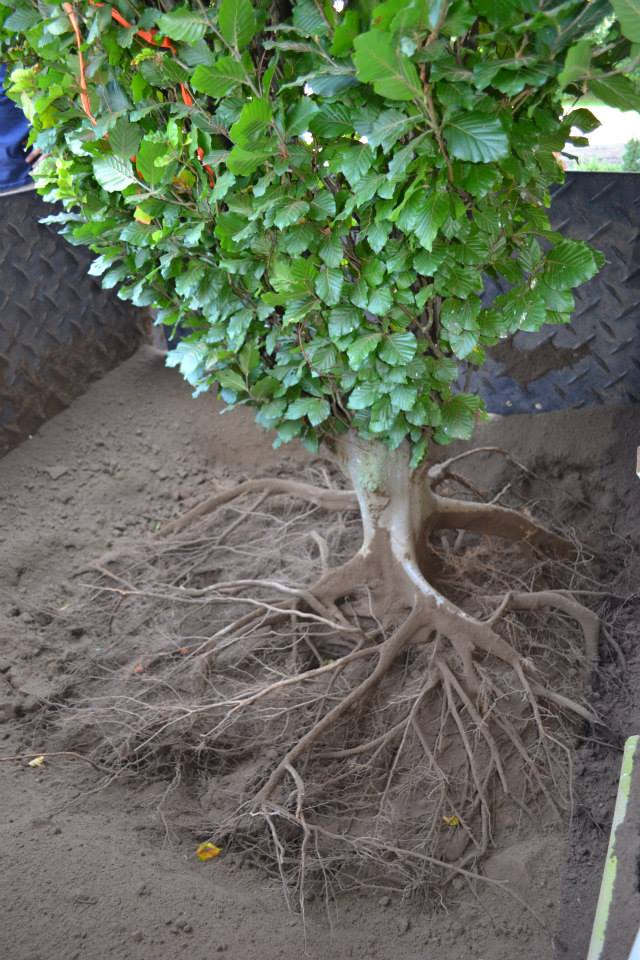
This beech tree was moved last fall, having been transplanted once about 20 years ago. See how the root mass extends far out horizontally, with a relatively shallow depth.

This is one of the thickest roots extending vertically from the beech's trunk. This root was cut in the earlier (20 years previous) transplant; note the resultant root growth just above the cut.

Word is in:  the rough cut of the London Plane transplant video I’ve been working on will be showing at the Foti Tree and Landscaping booth at New England Grows tomorrow, Thursday, and Friday.  If you want to take a look at how these guys moved five very large (12-14″ caliper, 30′ high) London Plane trees bare-root last summer, stop by the booth, which is #2850 on the expo floor.  The process astonishing.  The sight of a fully leafed-out mature tree, in all its bare-root glory, travelling across a construction site fully upright on the forks of a front-end loader is amazing.

Bring your own popcorn; the video runs about 29 minutes long.

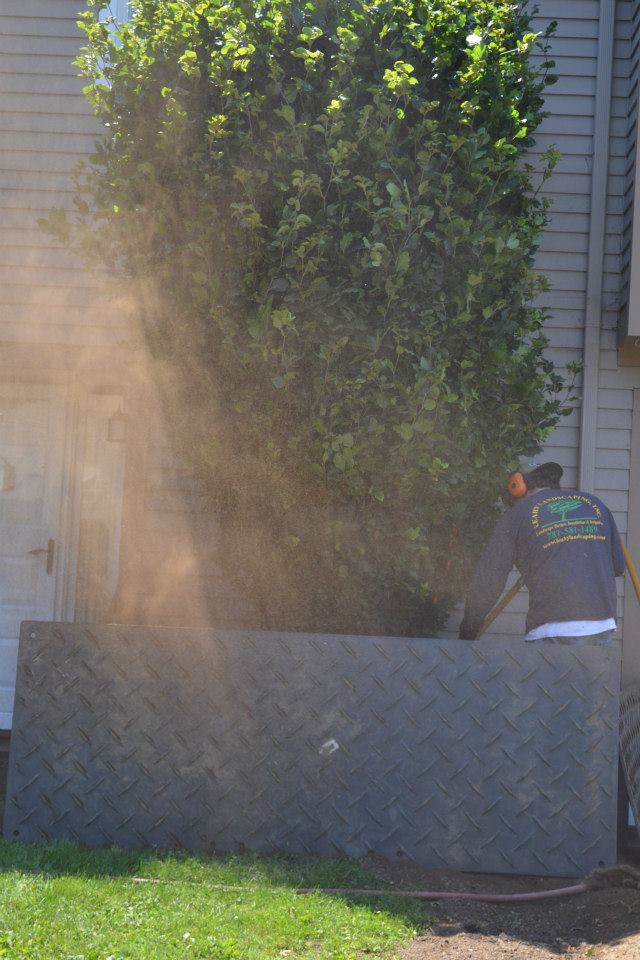
Blowing soil out from the first London Plane root mass, prior to moving.

This set of images popped up on my Google Reader today, and I just have to share them.  Click on the highlighted link to Vulgare, a blog on landscape issues, and take a look at the remarkable Chapel Oak in France.

Then take a look at Leaves from the Notebook of a Tamed Optimist,, to see images of other tree-chapels.

Finally, here’s a more rustic, but still graceful example:

Flickr image by dagochan*55

In memoriam

I was in Maine last week, and planned to stop in Yarmouth on Monday to watch the removal of Herbie, the champion elm that had finally become too compromised to stay standing.

For several months,  stories about Herbie and his long-time steward, Yarmouth tree warden Frank Knight (at 101 years old, he is now retired) had been appearing in the news — Knight had cared for Herbie for over 50 years, and had treated the elm in repeated battles with Dutch Elm Disease.  He had succeeded for decades, but in recent years the disease and old age had been catching up, infecting whole limbs and making it necessary to remove large chunks of the tree’s crown.  Last summer, the town’s current tree warden, Debra Hopkins, determined that Herbie should come down, and Knight concurred.   The date of removal was set for January 18.

There were reports that arborists and Herbie-fans from around New England would show up to watch the proceedings.  As I would be driving past Yarmouth that day, I decided to join them.  Work was slated to begin at 7:30 a.m.

Fortunately or not, a heavy snowstorm started on Sunday night, and when I awoke at 5 on Monday morning several inches had already fallen, with no end in sight.   A couple of tasks delayed my departure by several hours, and as it seemed unlikely that the work would proceed that day anyway, I didn’t arrive in Yarmouth until about 2:30 p.m.  Herbie still stood.  As I drove up, several people were snapping photos of the tree; more showed up when they left, and still more arrived as I was leaving.  Lots of people wanted to get a last look at this giant.

Herbie the American Elm, on the day scheduled for his removal.

Herbie was massive — in his prime, he stood 110′ tall, with a crown spread of 120′ and a girth of 20′.  Disease and age had diminished him, and it was clear that this was a tree under serious stress, but it was impossible to stand next to or near him without feeling awe.

To get a sense of the tree's scale, note the people standing to the left of Herbie.

Someone had tied a red, white, and blue ribbon around the tree, and people had attached cards and well wishes and information on this champion to it.

The placard in the middle is an 8.5" x 11" sheet of paper, with facts on Herbie's size and life.

The tree had quite a lot of evidently viable growth in the canopy, but the canopy itself had been hugely compromised, with several very large limbs removed.  I remember hearing Alex Shigo talk about how and when to make the decision to remove a tree; he spoke eloquently about the native dignity of trees, and about how at some point the act of removal shows more respect for the tree than leaving it in place.

There comes a point in a tree's life where removal of this much of its crown is a removal of dignity, as well. Though the tree's trunk appeared to be sound, and the limb removals had eliminated hazard wood, Herbie's time had come.

For about 15 minutes, I ran around in the cold photographing Herbie from different angles.  As I did, I saw carloads of people arrive, jump out, snap photos of themselves with the tree, put a hand out to feel its bark, and then gaze up at it reverently before they left.  And then I went over, put my hand on the craggy, lichen-speckled bark, and also said a silent goodbye.

Herbie in his heyday. This was a classic American elm.

Herbie was taken down the following day, with Frank Knight in attendance.  To see removal photos and videos, as well as how the wood from this elm will be used, click on this link.

I just got a rough cut today of the video, shot last summer, of the moving of a very large (about 14″ caliper, 30′ height) London Plane Tree.  It’s taken a while to edit several hours of footage down to a half an hour, but it’s about done, and in the next few weeks I hope to have added commentary.  This video is from the project run by Matt Foti’s crew, aided by Mike Furgal, and it showcases the techniques used in air-tool transplanting.  I hope to be able to preview the rough cut at New England Grows, and have the final version completed by the end of February; if there’s enough interest in the arborist community I’ll sell copies.  Stay tuned.

The first of five 12-14' caliper London Plane trees being excavated with air tools and transplanted bare root in August 2009.

The Massachusetts Arborists Association has a new volunteer initiative starting in 2010.  They aim to build on the traditional Arbor Day celebration by instituting a statewide volunteer service day on that day, which falls on April 30, 2010.

To get the ball rolling, the MAA is inviting anyone to identify potential tree care projects in their own communities, and then to post those project ideas on the Arbor Day link at www.MassArbor.org.  They hope to get ideas from all 351 Massachusetts cities and towns by January 15.  From that list, MAA members and member companies will choose projects for their own Arbor Day of Service volunteer effort.

This is a great way for professional arborists to make a contribution to the civic good, and for cities and towns to reap the benefits of a concerted professional effort.  Safety pruning, tree planting, hazard tree removal, ornamental pruning — a community you drive through daily may have the project that’s perfect for your company to tackle on Arbor Day.  To submit a project for Arbor Day of Service consideration by the MAA arborists, visit www.MassArbor.org by January 15, and click on Arbor Day.

Help younger generations grow up with the Arbor Day of Service.

Winter moth heads up

Hartney Greymont of Needham, MA has the most effective reminder this year to schedule winter moth treatments.  In November they sent out color postcards showing a single winter moth, about 6 times life-sized.  On the back the cards explain that the brown moths visible in November are parents of the caterpillars that will feed on trees in spring.

Hartney has hit upon a great way to connect a very visible autumn phenomenon with a very visible spring phenomenon, wrapping up a bit of client education with a pitch to schedule spring treatments early.  Nice.

Winter moth, taken from Flickr

Say you’re a growing country club in a nicely-treed community, and you need to enlarge your parking lot. And perhaps you want to lower its grade. The lot has some mature oak trees in it, and they add a certain je ne sais quoi to the scene, so you decide to save the trees by keeping the grade as is around the base of their trunks. You retain the roots and soil with a mortared stone wall. Voila!

Good idea – but woops! The minimum standard for root preservation is to keep 10 inches of root mass diameter per caliper inch of tree. For these trees, that would spell at least 360-inch diameter root masses. Because the trees are so close together, their roots overlap significantly — but still, 360 inches is thirty feet of diameter.

This 18-footish enclosure takes a tad too much root; the country club will almost certainly be watching these trees decline and die over the next few years (and they may well drop dead branches onto the parking lot, or cars in it, in the process).

The idea of saving a mature tree is a good one, as long as the tree’s actual requirements for continued healthy life are met.   Now that we have the tools to see how large a tree’s root mass really is, it’s much easier to see how big the unimpeded area around it has to be for the tree to survive happily and to thrive.

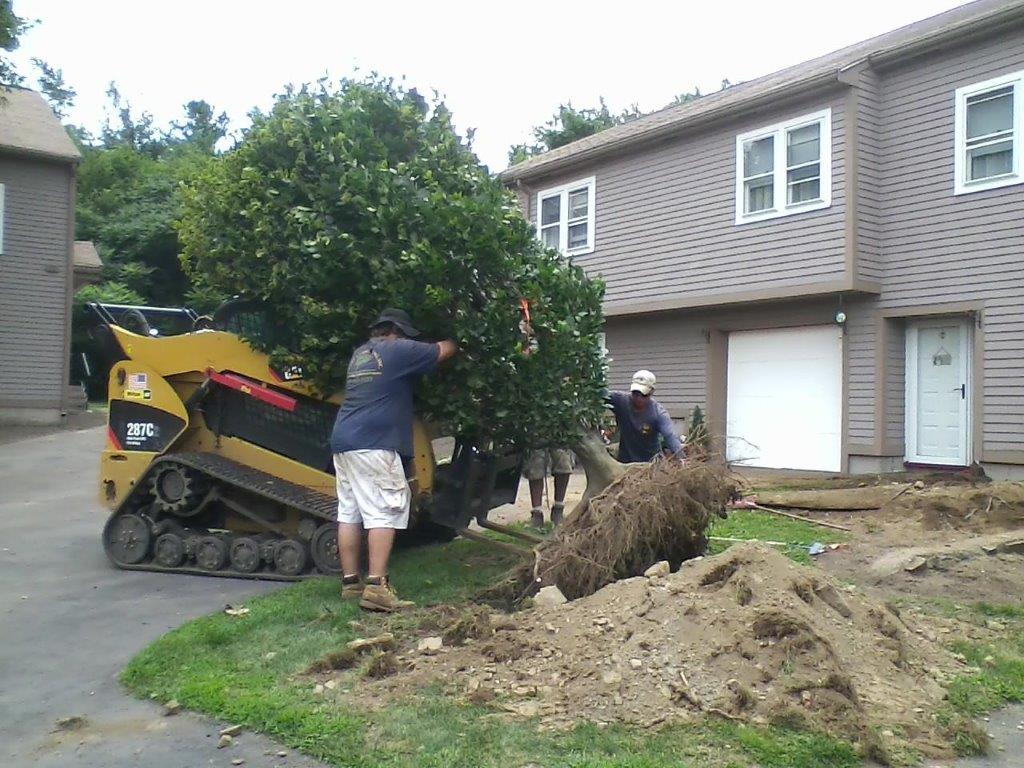
Last week I was lucky enough to see the loading, unloading, and half the planting of an 18″ caliper European beech tree.  The tree had been air-tool excavated, and was being moved over state highways to its new home at the residence of a former client of mine.  Here’s what the tree and its immense root mass looked like:

Giant root mass, 30 feet across, preserved by air excavation. Note the trunk's heavy padding, and pigtailing of the roots.

So that's what a beech's roots look like. This tree had been transplanted with a tree spade about 20 years ago, and it was possible to look under the root plate and see where severed roots had sprouted out.

The 30-foot high tree being lowered onto a specially rigged trailer for transport.

After the tree had been loaded onto the trailer, its roots were covered with burlap and sprayed down for the ride to its new home.

This post is just a teaser; next spring after the tree leafs out I’ll write a post on the  whole air-tool transplant operation, and give all the who’s, what’s, why’s, hows, wheres, and whens.  Stay tuned.

Root issues

Last year I worked on a large mall planting project.  A number of trees had to be pulled out to make way for a new parking layout; the islands they had been growing in were removed and paved over, with new islands located in a different configuration.  Most of the trees were hauled away by the landscape contractor, but one ended up in a discard pile next to the mountain of loam that had been excavated for reuse.

I was interested in the root configuration on this six-inch caliper red maple.  A mass of fibrous roots wrapped closely around the tree’s trunk, much like cotton-candy filaments spun around a paper cone.  Looking at it more closely, I found that the fibrous roots grew out of thicker woody roots, some of which had been cut during the tree’s original ball-and-burlapping, and some of which, growing since that operation, were circling the trunk.  Take a look:

Fibrous roots circling the six-inch red maple trunk.

Pulled away from the trunk, the roots clearly are circling it. Over time, as the tree grew in girth, these roots likely would have constricted the flow of nutrients between root mass and crown.

This sort of circling root is usually seen when the soil mass in a B&B root ball is of different porosity from the soil surrounding it; moisture will not move from one soil mass to the other until one mass is completely saturated.  Because roots tend to grow where moisture and oxygen are available, they will often stay within the root ball, and circle around the trunk as they grow.  The problem is made worse when burlap is not pulled away from the ball, as the burlap constitutes yet another interface for the moisture to move through.

Here's the tree's underside. Note the girdling root snaking on top of the big torn root facing the camera, and the curiously self-contained look of this root mass. The tree's problems likely began early in its life.

Not every B&B tree has these problems, and in those that do, not every rooting problem can be remedied at planting time.  Judicious treatment — looking for circling roots that can become girdling roots, cutting back girdling roots and cutting or redirecting circling roots, roughing up the sides of the root ball, removing or cutting down wire baskets, pulling down or removing burlap — can go a long way in helping B&B trees establish better in the landscape, and in remedying problems that threaten a tree’s long-term health and viability.  For more discussion on root issues affecting B&B trees, check out this post on Matt Foti’s station at the MAA’s Elm Bank bare-root workshop in September.

Older Posts »